Denver Art Museum with Kids
The Denver Art Museum gives families an opportunity to explore art without expecting children to quietly admire paintings for hours. Its sharply angled Hamilton Building, collections of Indigenous and Western American art, colorful contemporary works and hands-on creative studios offer several ways to keep young visitors engaged. The challenge is choosing the right galleries, arranging downtown parking and knowing when to stop before museum fatigue sets in.
Children 18 and under enter free. Adult general admission is $27-$30 for non-residents and $22-$25 for Colorado residents. Special exhibitions cost extra.
Full admission and parking costs →Two to three hours is a practical family estimate for selected galleries and a creative studio. Art enthusiasts can spend four hours or more exploring the campus.
Preschoolers enjoy artmaking and visual discoveries. School-age children and teens can engage more deeply with collections, architecture and design.
Accessible indoor galleries and family facilities help, but downtown parking, multiple buildings and the need to protect displayed artwork require planning.
See the full Family Friction score →Art that children can question, compare and sometimes create themselves
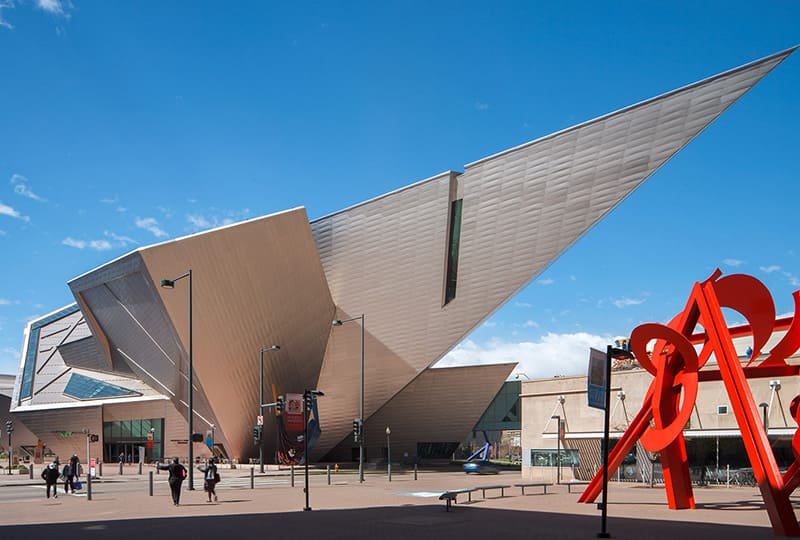
The Denver Art Museum is especially interesting because children encounter several very different ways of making art in one place. The Hamilton Building, designed by Daniel Libeskind, is an attraction before families even enter. Its unusual angles, dramatic walls and bold geometry can turn an ordinary arrival into an architecture game. Ask children to count triangular shapes, describe which direction the building seems to lean or imagine what it might look like as a spacecraft. The neighboring Martin Building, designed by Gio Ponti, offers another architectural personality, with multiple levels of galleries and views across Denver. Exploring these buildings gives families an accessible introduction to design without requiring prior knowledge of art history.
Inside, the museum's collections cover Indigenous Arts of North America, Western American art, contemporary art, Asian art, European art, photography and other cultural traditions. For children, the most engaging approach is not to read every label but to look for visual details. In Western American landscapes, ask what weather the artist might have experienced. When encountering portraits, encourage kids to guess what the person might be thinking before reading the description. In galleries featuring Indigenous art, help children notice materials, artistic techniques and the cultural context explained by the museum, rather than treating objects from different communities as interchangeable. This kind of guided observation can work surprisingly well with children who usually lose interest in traditional exhibitions.
Hands-on learning spaces provide an important change of pace. The Ellen Bruss Design Studio, on Level 2 of the Martin Building, introduces design thinking through materials, experimentation and creative problem-solving. The Thread Studio, on Level 6 of the Martin Building, explores textiles and related artistic processes. In the Hamilton Building, Cosmic Studio on Level 1 invites visitors into imaginative activities involving painting, weaving and creative exploration. These spaces help children connect the artwork they see with things they can actually make. Activities and studio themes can change, so it is worth checking which experiences are available before planning a visit around a particular project.
The museum also operates programs designed for younger children. Create & Play is intended for ages 0-5 and their caregivers, combining creative performances, gallery exploration and artmaking on scheduled dates. Families should check registration and the current calendar rather than assuming the program runs continuously. For older children, the museum's architecture, decorative arts and design galleries can be more rewarding than simply visiting every painting gallery. Teens interested in visual art, architecture or photography may enjoy spending longer comparing techniques and artistic choices. The museum's multiple buildings make it possible to adapt the route to each child's curiosity, although crossing the whole campus requires time and energy.
For parents choosing indoor things to do in Denver with kids, the museum works particularly well in cold, snowy or rainy weather. Most activities happen in climate-controlled indoor spaces, with restaurants and seating available for breaks. Unlike a children's play museum, however, the galleries contain original artworks that must not be touched. Explain this distinction before entering and alternate looking activities with approved hands-on studios. Families with children who enjoy making things, spotting unusual details and asking questions are likely to get more value from the visit than those expecting constant physical play.
Planning a family vacation in Colorado? Find more museums, parks, indoor attractions and creative experiences in our guide to Denver with kids, including ideas for combining a museum morning with an easier afternoon outdoors.
From first encounters with color to independent artistic interests
Infant
Babies may enjoy contrasting colors, faces and interesting shapes during a short stroller visit. Parents benefit from elevators and family restrooms, but there are few reasons to make a special museum trip solely for an infant.
Toddler
Toddlers may enjoy unusual sculptures, bright artworks and age-appropriate creative programming. Keep the visit short, focus on a small number of galleries and supervise closely because displayed objects cannot be touched.
Little Kids
A good age for color hunts, storytelling about pictures and hands-on studio activities. Scheduled Create & Play programs can provide structure for children who are not yet ready for long gallery visits.
Big Kids
Children can compare artwork from different cultures, investigate sculpture and architectural shapes, and participate in design-oriented activities. Asking them to choose their favorite three objects keeps the experience personal.
Tweens
Tweens often appreciate photography, contemporary art, fashion, architecture and more challenging studio projects. They can begin discussing how artists communicate ideas through materials, scale and composition.
Teen
Creative teenagers may find substantial inspiration in modern art, photography, design and architecture. Free general admission makes it easy to explore personal interests without needing to visit every gallery.
Family Friction: downtown parking and a multi-building art museum
KidWaypoint evaluates eight practical family challenges. Higher values reflect greater planning and physical effort rather than the quality of the art experience. Parking and campus size create most of the difficulties here.
Denver Art Museum is generally comfortable once families reach the galleries. Elevators, accessible entrances, indoor exhibits and restrooms help reduce effort. The main challenges are finding and paying for downtown parking, walking between buildings, choosing among many galleries and managing children around artwork that cannot be touched.
| Factor | Score | Why |
|---|---|---|
| Parking & Arrival | 3/5 | The museum is in downtown Denver, and nearby street spaces and garages generally require payment. The Cultural Center Complex Garage is reached from 12th Avenue near Broadway. Construction and downtown events can complicate arrival. |
| Queue & Wait Time | 2/5 | General admission is untimed, and tickets can be purchased in advance. Special exhibitions may use timed admission and can have limited availability, while popular free admission events may attract additional visitors. |
| Heat & Weather Exposure | 1/5 | The main galleries and creative studios are indoors and climate controlled. Families experience outdoor weather primarily when traveling between parking, building entrances and separate campus locations. |
| Walking Distance & Terrain | 3/5 | The campus includes several buildings and many gallery levels. Exploring the Hamilton Building, eight-story Martin Building and The Kirkland involves substantial walking, although elevators and selective routes help reduce fatigue. |
| Stroller & Mobility Access | 1/5 | Public museum areas are wheelchair accessible, entrances have power-assist doors and elevators connect levels. Strollers and manual wheelchairs are available to borrow on a first-come, first-served basis. |
| Restroom & Baby-Care Access | 1/5 | Accessible restrooms are available on every level of the Hamilton and Martin buildings. Both buildings provide single-user family restrooms on Level 1. |
| Sensory & Crowd Load | 2/5 | Many galleries allow relatively calm observation, but crowds, changing lighting and some exhibitions may be stimulating. Free sensory tools and scheduled sensory-friendly mornings offer additional support. |
| Schedule Flexibility | 2/5 | General admission permits flexible exploration throughout the selected date. Creative programs, guided tours and ticketed exhibitions can have specific times, while individual buildings may operate on special schedules. |
| Scored total | 15/40 | Medium Friction |
Elevators, stroller loans and family restrooms across the campus
Families with babies can navigate most public spaces using a stroller. The key logistical challenge is the distance between parking and buildings, rather than stairs inside the museum.
Both the Hamilton and Martin buildings have accessible entrances with power-assist doors. If you need a passenger drop-off, the museum identifies 13th Avenue between Broadway and Bannock as an accessible drop-off area.
Elevators connect public gallery levels. The Martin Building has eight stories, so planning a few priority floors is particularly useful with toddlers or children who tire easily.
The museum provides strollers and standard manual wheelchairs on a first-come, first-served basis. Availability cannot be guaranteed, so bring your own stroller if it is essential for your visit.
Single-user family restrooms are available on Level 1 of the Hamilton and Martin buildings. For snacks, drinks or feeding breaks, use permitted public areas rather than art galleries.
Denver Art Museum admission prices, free days and downtown parking
Admission depends on Colorado residency and the day of the week. Children and teenagers receive free general admission, but adults usually pay, and special exhibitions and downtown parking are separate expenses.
| Activity or service | Cost | What to know |
|---|---|---|
| Non-resident adult general admission | $27 off-peak / $30 peak | Peak pricing applies Friday through Sunday and on holidays. General admission includes the museum campus but not separately ticketed exhibitions. |
| Colorado resident adult admission | $22 off-peak / $25 peak | Discounted general admission is available to eligible Colorado residents. |
| Non-resident senior, student, teacher or military/veteran | $24 off-peak / $27 peak | Identification is required to qualify for the applicable discounted category. |
| Colorado resident discounted adult | $19 off-peak / $22 peak | Applies to eligible seniors, students, teachers and military/veterans with identification. |
| Children and teens ages 0-18 | Free | The Free for Kids program covers general admission every open day, regardless of Colorado residency. |
| Ticketed exhibitions | Additional charge | Exhibition charges vary; the current DIVA exhibition is listed at $7 in addition to general admission, with a special $5 youth rate available for ticketed exhibitions. |
| SCFD Free Days | Free general admission | Remaining published 2026 dates after October 15 include November 7 and December 8. Special exhibitions may still cost extra. |
| Cultural Center Complex Garage | From $2 per hour | Located at 12th Avenue and Broadway. The main parking page lists $4 for two hours and $8 for four hours, subject to posted rates and special event pricing. |
| Colorado resident SNAP discount | Discounted admission | Eligible Colorado SNAP cardholders can request reduced admission at visitor services by showing a valid card. |
Family cost example: Two non-resident adults with children ages 8 and 12 pay $54 for off-peak general admission or $60 on a peak-price day. The children enter free. If the family parks in the Cultural Center Complex Garage for approximately three to four hours, the listed four-hour rate is $8, bringing the estimated total to $62-$68 before food and optional exhibitions. Always check posted parking rates, which may differ during downtown events.
What time does the Denver Art Museum open, and when should families visit?
- Regular opening time is 10:00 a.m. Sunday, Monday, Tuesday, Thursday, Friday and Saturday.
- Regular closing time is 5:00 p.m., except Tuesdays when the museum usually remains open until 8:00 p.m.
- Wednesday is normally a closed day under the published standard schedule. However, the museum has announced special Wednesday access to the Hamilton Building for DIVA beginning in October 2026, while the Martin Building and The Kirkland remain closed on those dates. Verify the exact hours and entry conditions before planning a Wednesday visit.
- Thanksgiving Day and Christmas Day are listed as museum closures.
- General admission is valid for the date printed on the ticket. Separately ticketed exhibitions may require a specific entry time.
- For a first family visit, arriving near opening time generally gives children more energy for galleries and creative activities.
Families wondering what time does the Denver Art Museum open should check the live calendar for the exact date, particularly on Wednesdays, holidays and special exhibition days. Two to three hours is a practical starting point for families with younger children. The museum covers multiple buildings and extensive collections, so trying to experience everything in one visit is rarely necessary. Choose one or two collection areas and a studio, with a meal or snack break when needed.
Make art enjoyable without turning the museum into a long lesson
The best family strategy is to make a few meaningful discoveries, create something and leave while children still want to return.
- Choose three must-see experiences. Before entering, select one collection, one hands-on studio and one architectural feature. The museum is large enough to overwhelm families who attempt every floor.
- Begin with art that matches your child's interests. Animal lovers may respond to sculptures and nature imagery, while children interested in buildings or fashion may prefer design collections. Ask visitor services which relevant galleries are open.
- Visit an artmaking studio before attention fades. Check the current activities in Cosmic Studio, Design Studio or Thread Studio. A creative break can make the next gallery easier for children who prefer making things to observing them.
- Make the no-touch rule understandable. Explain that gallery artworks are original objects that must be protected, while designated studios provide opportunities to create. Do not assume every interactive-looking installation can be touched.
- Plan parking before driving downtown. Use the Cultural Center Complex Garage near 12th Avenue and Broadway as a starting option, but check current event rates. Downtown construction and events can increase travel time.
- Save snacks and water for designated areas. Food and drinks, including water, are not allowed in galleries. Use the permitted atrium or lower-level areas, or visit Café Gio for a casual meal break.
- Use family-friendly observation games. Ask children to find the smallest detail in a painting, invent a title for an unfamiliar sculpture or compare two artworks that use the same color. These activities often work better than reading every label aloud.
- Check free admission dates and special exhibitions separately. All children 18 and under receive free general admission. Adults can use SCFD Free Days, but ticketed exhibitions are not automatically included in free admission.
Denver Art Museum FAQ: parking, free tickets, hours and visiting with kids
Detailed answers to practical questions families ask when organizing a visit to Denver's major art museum.
Where to park for Denver Art Museum, and how much does parking cost?
The Cultural Center Complex Garage, located at 12th Avenue and Broadway, is one of the most convenient options for Denver Art Museum parking. It is within walking distance of the museum's Hamilton and Martin buildings and provides accessible parking on Level 2, with elevators serving the garage. The museum's main parking information lists rates starting at $2 for one hour, $4 for two hours and $8 for four hours, although event rates and updated posted prices can override those figures. The garage is owned and managed by Denver Public Works, not the museum, and its published operating hours are generally 5:00 a.m. to 11:00 p.m. Street meters and other nearby lots are alternatives, but parking availability can be affected by downtown construction and events. If you are arriving with a stroller, tired children or a wheelchair, choosing a nearby garage may be easier than looking for a lower-priced spot several blocks away. Check current garage payment instructions when you arrive because published payment guidance is not fully consistent across museum pages.
Is the Denver Art Museum free for children, and when can adults visit for free?
Yes, the Denver Art Museum provides free general admission for every visitor age 18 or younger through its Free for Kids program. This benefit applies to both Colorado residents and tourists, so families pay only for adults when visiting the permanent galleries and other general-admission areas. Adult tickets are normally paid, with different prices depending on residency and whether the day is classified as peak or off-peak. The museum also participates in SCFD Free Days, when general admission is free for all visitors. As of October 15, 2026, the remaining published free admission dates are November 7, associated with Night at the Museums, and December 8. These dates may be busier than regular paid weekdays. Free general admission does not automatically include separately ticketed special exhibitions, although the museum offers reduced youth exhibition pricing. Families should check the official calendar and exhibition details before making plans around a free day.
Denver Art Museum: how long does it take to visit with children?
For most families, allowing approximately two to three hours is a practical starting point, although this is a suggested family itinerary rather than an official required duration. The museum includes the Hamilton Building, the multi-level Martin Building and The Kirkland, and exploring the entire campus can take considerably longer. Preschoolers may be satisfied with 60-90 minutes of selected artwork and an artmaking activity, while school-age children can often enjoy two or three hours when galleries are mixed with creative studios and breaks. Teenagers who are especially interested in art, architecture or design may want three to four hours or more. Rather than walking through every floor, choose a few meaningful experiences. For example, begin with an interactive studio, explore one collection that relates to your child's interests and finish with an architecture or sculpture discovery activity. Food breaks, toilets, the distance between buildings and special exhibition entry times should all be included in your estimate.
What time does the Denver Art Museum open, and is it closed on Wednesdays?
The standard schedule lists a 10:00 a.m. opening time on Sunday, Monday, Tuesday, Thursday, Friday and Saturday. Most of those days end at 5:00 p.m., while Tuesday hours normally extend until 8:00 p.m. Wednesday is listed as the regular weekly closure, and the museum also closes for Thanksgiving and Christmas Day. However, special programming can change which buildings are accessible. In October 2026, the museum announced Wednesday access to the Hamilton Building related to the DIVA exhibition, while the Martin Building and The Kirkland remain closed on those Wednesdays. Families should therefore check the exact date rather than relying only on a general weekly timetable. If traveling with younger children, arriving near opening time is usually a convenient choice because they can experience the priority galleries before getting tired. Special exhibitions may have separate entry requirements and should be reviewed before departure.
What activities make Denver Art Museum enjoyable for children who do not usually like art museums?
The strongest approach is to combine visual discoveries with an opportunity to create something. Start outside with the Hamilton Building's dramatic angles and ask children what shapes they notice. Inside, let them choose artworks based on animals, colors, faces, unusual materials or interesting stories instead of following a strict chronological route through art history. The Ellen Bruss Design Studio explores design and creative processes, while the Thread Studio introduces textile-related activities. Cosmic Studio in the Hamilton Building provides additional hands-on opportunities, with activities changing according to current programming. Younger children may benefit from scheduled Create & Play events designed for ages 0-5 and caregivers. For school-age visitors, simple challenges such as finding three different ways artists represent movement or comparing two landscapes can create an engaging experience without a long lecture. Remember that hands-on activity is permitted only in designated spaces, while original gallery artwork must not be touched.
Is Denver Art Museum stroller-friendly, and are there facilities for babies or children with sensory needs?
The Denver Art Museum is generally manageable with a stroller because public areas are wheelchair accessible, main entrances have power-assist doors and elevators connect the different gallery levels. The museum also offers stroller loans and standard manual wheelchairs on a first-come, first-served basis through visitor services. Accessible restrooms are available on every level of the Hamilton and Martin buildings, and both buildings have single-user family restrooms on Level 1. Parents who need a particular nursing or changing arrangement should ask museum staff for the closest suitable facility. For children with sensory sensitivities, the museum provides free resources including noise-reducing headphones, visors, colored glasses, weighted sensory items and S.P.A.R.K. packs, subject to availability. Scheduled sensory-friendly mornings offer a more structured alternative for some families. Before arrival, explain the no-touch gallery rules, choose a shorter route and identify convenient places for snacks or quiet breaks. Food and beverages are not allowed inside the art galleries.