Orlando Science Center with Kids - Orlando, FL
Orlando Science Center gives families four floors of hands-on science, live programs, dinosaurs, animals and dedicated play spaces for younger children. KidsTown serves ages 0-7, and most family reviews describe a visit of 3 to 4 hours.
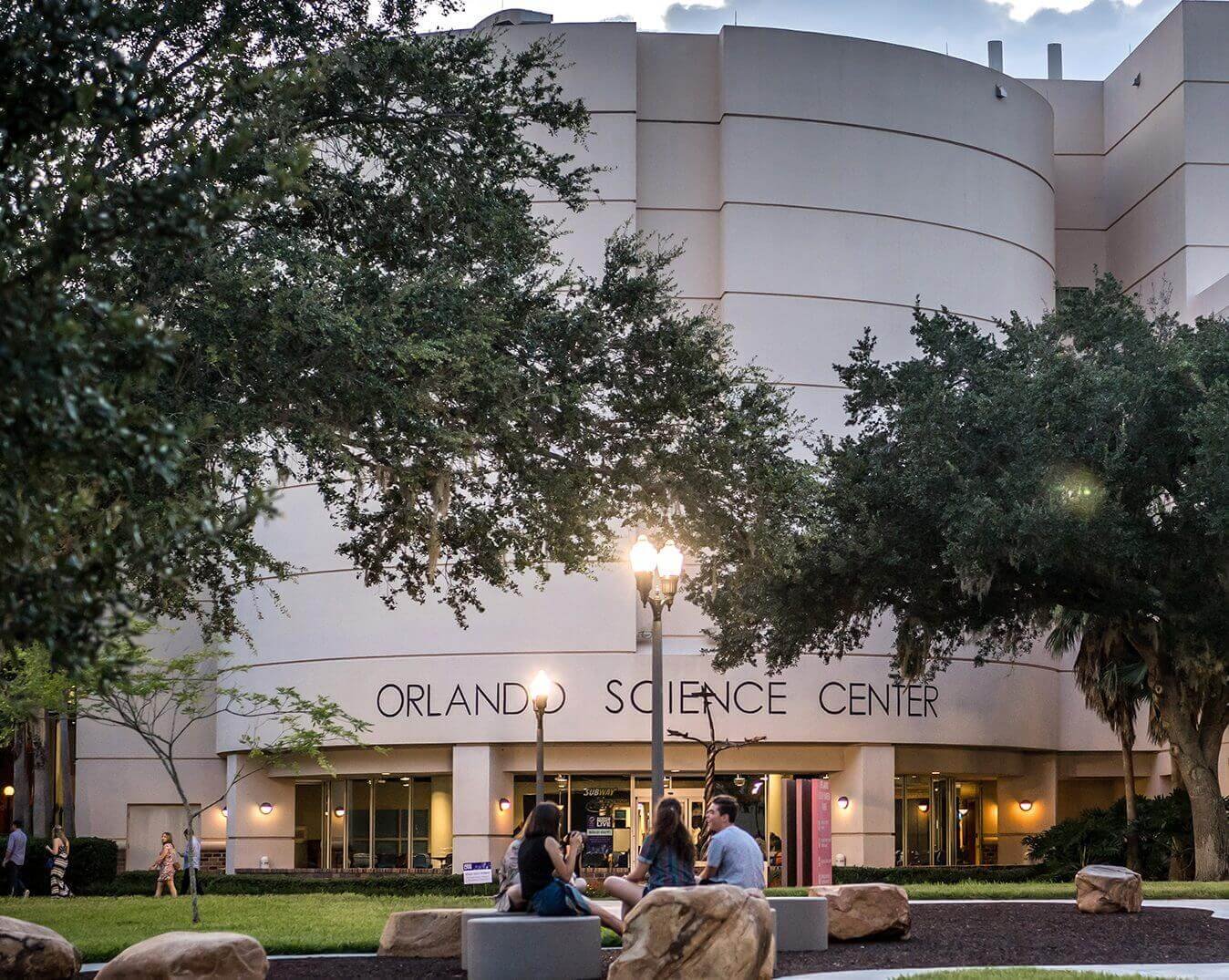
Youth ages 2-12 pay $22 online or $25 onsite. Adults 18+ pay $29 online or $32 onsite. Children under 2 and members enter free.
More about pricing →Plan about 3-5 hours for a first family visit. Families adding films, live programs and several exhibit halls can stay considerably longer.
KidsTown is built for ages 0-7, with Toddler Town for ages 0-2.
Almost everything happens indoors, the building is stroller-accessible, and family facilities are available on multiple floors.
See the full Family Friction score →Hands-on science gives different ages different reasons to explore
Orlando Science Center puts much of the science within reach of children's hands rather than behind display cases. In Kinetic Zone, kids can launch air rockets, experiment with electrical circuits, use pulley systems and test their own designs. DinoDigs takes a different approach: children can examine dinosaur and marine-reptile fossil replicas and use the dig pits to uncover fossils like a paleontologist.
The youngest visitors have a large area built specifically around their developmental stage. KidsTown covers 11,000 square feet and is intended for children through age 7. Its zones include water play at Drip Drop Splash, an Orange Grove where children move, sort and weigh imitation oranges, a creative studio and a climbing structure for ages 4-7. Toddler Town provides a separate space for children ages 0-2.
Older children have reasons to move beyond KidsTown. Our Planet, Our Solar System includes an earthquake simulator, a weather-forecast set, rocket-building activities and a lunar-landing challenge. Kinetic Zone adds more engineering, while The Hive makerspace is designed for ages 8 and up. DinoDigs, animal encounters and scheduled Science Live programs help break up the day so the visit is not simply a sequence of exhibit panels.
KidsTown is strongest for younger children, but older kids have more complex science to explore
Infant
Good fit for a sibling-inclusive visit. Toddler Town specifically serves ages 0-2, and the building provides nursing lounges and a private baby-changing room. An infant will naturally get less from the larger science exhibits, but families bringing older siblings do not have to exclude the youngest child from the day.
Toddler
Very good fit. KidsTown is the main reason. Water play, movement, cause-and-effect activities and imaginative play do not depend on reading ability or understanding formal science concepts.
Little Kids
Excellent fit. Children can use nearly all of KidsTown, including Climb Time for ages 4-7, while also beginning to engage with dinosaurs, animals and simple hands-on science elsewhere in the building.
Big Kids
Excellent fit. Children at this age can move from play-oriented exhibits into engineering and experimentation. Eight-year-olds and older also qualify for The Hive makerspace.
Tweens
Good fit. The strongest areas shift away from KidsTown toward Kinetic Zone, DinoDigs, space and Earth science, makerspace activities and scheduled live programs.
Teen
Selective but still worthwhile. Teens interested in engineering, space, animals, making or science demonstrations have substantial material beyond the early-childhood areas. A teenager expecting thrill rides or primarily entertainment-focused activities may find less reason to spend a full day here.
How easy is Orlando Science Center with kids?
A practical score for the parts of a visit that can create extra work for families - from parking and queues to stroller access, weather exposure and schedule flexibility.
This is an especially forgiving choice for families who want a full activity day without dealing with Orlando heat or weather. Timed admission helps make arrival predictable, while elevators, stroller rentals and accessible routes simplify visits with younger children. Busy hands-on galleries can still feel noisy when school groups or weekend families overlap, but a dedicated sensory room provides a genuine place to reset. Because there is plenty to explore across four floors, families should expect several hours inside rather than treating it as a quick one-hour stop.
| Factor | Score | Why |
|---|---|---|
| Parking & Arrival | 2/5 | The museum has its own garage directly across from the building, connected to the entrance by a Level 2 pedestrian bridge. Parking is convenient but costs $4 per hour, so a multi-hour family visit adds a noticeable extra expense. |
| Queue & Wait Time | 1/5 | Timed-entry tickets can be reserved online, and advance purchase speeds up admission. Some waiting can still occur at popular programs, interactive stations or elevators on busy weekends and school-group days. |
| Heat & Weather Exposure | 0/5 | Nearly the entire museum experience takes place inside a climate-controlled building, making this one of the easier Orlando attractions during hot, rainy or humid weather. |
| Walking Distance & Terrain | 2/5 | Exhibits are spread across four floors, so families cover a fair amount of indoor ground and move repeatedly between levels. Floors are generally smooth and accessible, with elevators available instead of difficult terrain. |
| Stroller & Mobility Access | 1/5 | Strollers and wheelchairs work throughout most of the building, and rentals are available at admissions. Very large strollers and wagons are discouraged because they can make circulation through busy exhibit areas harder. |
| Restroom & Baby-Care Access | 0/5 | Restrooms are available on every level, with a private baby-changing room, nursing lounges on two floors and private all-gender restrooms on several levels. Families with babies do not need to return to the entrance for basic care. |
| Sensory & Crowd Load | 1/5 | Hands-on exhibits can become energetic and noisy, particularly during busy family periods, but the center provides sensory bags, headphones, weighted lap pads and a dedicated sensory room for visitors who need a quieter break. |
| Schedule Flexibility | 1/5 | Families explore the main exhibits at their own pace and can build the day around optional films and scheduled demonstrations. There is enough to justify several hours, but there is no requirement to follow a fixed multi-hour itinerary. |
| Total | 8/40 | Low Friction |
The building is stroller-accessible across all four floors
Families can move from the garage to the museum and between exhibit levels by elevator, while rentals and baby-care facilities support longer visits with younger children.
The garage has an elevator, and visitors enter Orlando Science Center through the Level 2 Love Bridge.
Accessible routes make it possible to move through the four-floor building without relying on stairs.
A limited number are available from the Admissions Desk on Level 2 on a first-come, first-served basis; rentals are free for members and require a valid photo ID.
OSC says strollers or wagons wider than 31 inches or longer than 52 inches are not recommended because they can interfere with guest flow.
How much are tickets for Orlando Science Center?
Tickets include four floors of exhibit halls and an immersive film theater. Buying online lowers the price and speeds up entry, while onsite tickets are full price and subject to availability.
| Category | Online | Onsite |
|---|---|---|
| Youth (ages 2-12) | $22 | $25 |
| Teen (ages 13-17) | $27 | $30 |
| Adult (18+) | $29 | $32 |
| Senior (55+) | $27 | $30 |
| Under 2 | Free | Free |
| Members | Free | Free |
Family cost example: two adults and two children ages 2-12 pay $102 online or $114 onsite for general admission. Parking is additional for non-members.
What time does the Orlando Science Center open?
- Open 10:00 am-5:00 pm, including most holidays.
- Closed on Wednesdays, except during OCPS breaks.
- Closed on Thanksgiving Day, Christmas Eve, Christmas Day, and Easter Sunday.
- 4Roots Cafe serves 11:00 am-4:00 pm (grab and go until 4:30 pm), and The Coffee Spot serves 10:00 am-4:15 pm.
Veterans, active military, and first responders receive a discounted walk-in rate with valid ID. Families with an EBT or WIC card and a matching state photo ID pay $5 per person for up to six people through Science For All.
Give the museum enough time and plan around the busiest parts of the day.
A few practical choices can make a four-floor visit easier with children.
- Allow more than a quick two-hour stop.For a first visit, 3-5 hours is a more useful planning window, especially if you add films, live programs or extended time in KidsTown.
- Check the daily schedule before choosing your first floor.Science Live demonstrations, films, KidsTown activities and other programs run at scheduled times, so planning around one or two programs can reduce unnecessary trips between floors.
- Expect weekday school groups.Hands-on galleries can become louder and busier when school groups overlap with family visitors. Arriving near opening can make the first part of the visit easier, particularly for children who prefer a calmer environment.
- Bring a change of clothes for water play.Drip Drop Splash involves hands-on pouring, moving and splashing water, so a spare shirt or outfit can be useful for younger children.
- Plan food before everyone gets hungry.4Roots Cafe opens at 11:00 a.m. and has a kids menu. Loch Haven Cultural Park next door is another practical option if your family prefers to bring its own food.
- Use the sensory resources when needed.The Level 4 Sensory Room offers a quieter place to reset, while sensory bags with headphones, fidget tools and emotion cards are available from the Box Office on Level 2. Some Science Live programs may include loud sounds, low lighting or pyrotechnics.
Questions parents ask before they go
Use these answers to plan the length, cost and timing of a family visit.
How long does it take to see the Orlando Science Center?
A useful target for most first-time families is 3-5 hours. Younger children may spend a large portion of the visit repeating KidsTown activities, while older children may move through several galleries and scheduled programs. Families adding a film or multiple Science Live programs can easily stay longer.
How much are tickets for Orlando Science Center?
Online tickets are $22 for ages 2-12, $27 for ages 13-17, $29 for adults 18+ and $27 for seniors 55+. Onsite prices are $25, $30, $32 and $30 respectively. Children under 2 and OSC members receive free general admission. For a family of two adults and two children ages 2-12, that is $102 online or $114 onsite. Check current admission conditions →
How much is parking at Orlando Science Center?
Self-parking costs $4 per hour during regular museum hours and is free for OSC members. That means a typical 3-5 hour family visit adds about $12-$20 in parking. The garage is at 782 E. Princeton Street and parking is first come, first served.
What time does the Orlando Science Center open?
Orlando Science Center normally opens at 10:00 a.m. and closes at 5:00 p.m. It is generally closed on Wednesdays, although it may open on Wednesdays during Orange County Public Schools breaks, and it closes on several major holidays. Check current visitor information →
Is Orlando Science Center suitable for babies and toddlers?
Yes. KidsTown is specifically designed for children ages 0-7, and Toddler Town serves children ages 0-2 and their caregivers. A private baby-changing room is available on Level 1 and private nursing lounges are on Levels 2 and 3.
Is Orlando Science Center suitable for children with sensory sensitivities?
The museum has a dedicated Sensory Room on Level 4 and sensory bags with headphones, fidget tools and emotion cards available from the Level 2 Box Office. Families should still check the day's program because Science Live stage programs may include low lighting, loud noises or pyrotechnics, and weekday school groups can increase noise in interactive galleries.