The Franklin Institute with Kids in Philadelphia, PA
Walk through a giant beating heart, build a model space mission and watch the sky unfold across a planetarium dome. The Franklin Institute in Philadelphia is a three-floor science museum where kids can move, experiment and ask questions, with plenty of choices for a rainy day.
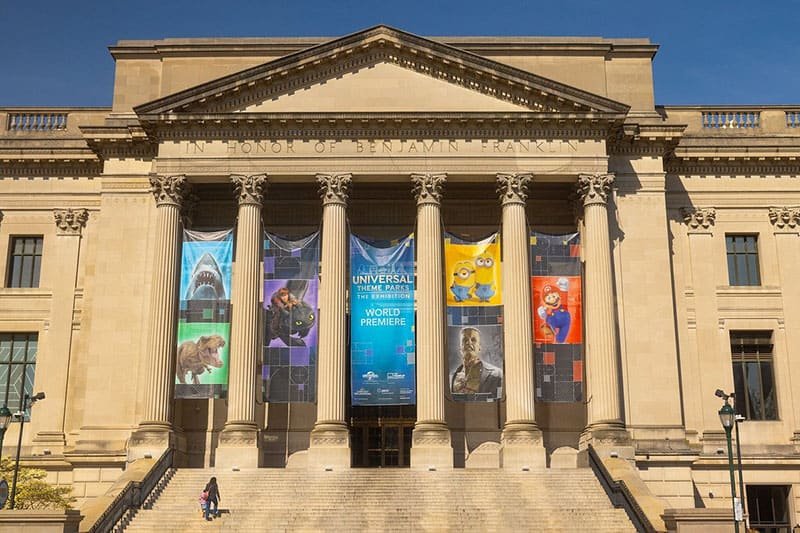
General admission includes permanent interactive exhibits, Fels Planetarium shows and live science programs. Special exhibitions cost extra.
Admission and parking details →Pick two or three priority galleries, allow time for a planetarium show and plan a break. A shorter two-hour visit works for younger children.
Preschoolers enjoy physical discovery with help; grade-school children and teens can explore the experiments and science concepts more independently.
Indoor comfort and a useful family-care setup reduce effort. Busy hands-on galleries, a large multi-floor layout and paid garage parking add planning.
See the full Family Friction score →A giant heart, space missions and experiments children can actually try
The Franklin Institute is not a museum where families spend the whole day reading labels behind glass. In Body Odyssey, the Giant Heart turns the journey of blood through the body into something children can physically explore. Its passageways, pulse sounds and changing light make an impression, but the enclosed route can be intense for younger visitors. Nearby activities shift the focus from looking at an organ to thinking about how the body works. A child who hesitates at the heart can still engage with other displays without needing to complete the walk-through.
Wondrous Space takes a different approach. Across two floors, children experiment with gravity, design a rover, test possible planetary conditions and explore the engineering behind space travel. Some activities work as quick trials; others reward a second attempt after a design fails. Your Brain offers a playful way to examine perception, attention and decisions. The museum also has Amazing Machine and hands-on building experiences, so families can balance screen-based activities with objects they can manipulate. Which stations are operating can change, and not every visitor needs to finish every exhibit.
Leave room for the Fels Planetarium rather than treating it as an afterthought. A show beneath the large dome changes the pace after busy galleries, although the darkened space, sound and fixed presentation may be difficult for some toddlers. Live science demonstrations add another type of discovery, with staff explaining experiments as they happen. On the way out, the dramatic Benjamin Franklin National Memorial offers a brief history stop. For a family with mixed ages, one major gallery, one shorter exhibit and a planetarium show usually make a more satisfying plan than racing through three full floors.
Make the science museum one stop in a Philadelphia family day. Explore nearby family-friendly activities, compare indoor and outdoor options, and plan the next stop with our guide to Philadelphia with kids.
Which ages get the most out of The Franklin Institute?
Infant
The museum welcomes babies, and caregivers can use the elevator, infant feeding room and changing facilities. The galleries are primarily designed for older children, so a short visit focused on a sibling works better than a full itinerary.
Toddler
A toddler may enjoy lights, movement and watching a demonstration, but interactive equipment can be too high or complex. Expect frequent breaks; the Giant Heart sounds and planetarium darkness may not be comfortable for every child.
Little Kids
A growing curiosity about bodies, rockets and cause-and-effect makes this a promising age. Choose simple Wondrous Space experiments and help children take turns at busy stations rather than explaining every display.
Big Kids
Excellent fit for experiments with a clear challenge: testing a rover, exploring gravity, examining perception and connecting the Giant Heart to their own heartbeat. Build a route with a few hands-on highlights.
Tweens
Tweens can follow more detailed science explanations, compare results and revisit stations to improve a design. Let them choose between space engineering, human biology and a planetarium presentation.
Teen
Teens who like engineering, astronomy, medicine or design can engage with advanced concepts and scientific problem-solving. They may appreciate time to read beyond the quick activity prompts rather than moving at younger siblings’ pace.
Family Friction: hands-on science brings energy and a few logistics
The experience works best when families account for four practical variables: school-group traffic, time spent moving between floors, sound levels at popular exhibits and the timing of seated programs. The score measures effort, not educational quality.
The Franklin Institute is comfortable in bad weather and provides elevators, baby-changing facilities and a dedicated infant feeding room. Its three floors are extensive, however, and interactive displays can become crowded, especially when school groups arrive. A museum garage removes some of the uncertainty of finding a nearby lot, but parking is paid and spaces are limited. Choosing fewer exhibits and checking the planetarium schedule helps turn a potentially tiring day into a manageable one.
| Factor | Score | Why |
|---|---|---|
| Parking & Arrival | 2/5 | The museum garage is directly behind the building and connects to the Atrium by elevator. Parking costs $25 and spaces are first come, first served; downtown traffic still affects arrival. |
| Queue & Wait Time | 2/5 | There is no single fixed queue for every exhibit, but busy interactive stations and weekday school groups can require waiting. Advance tickets help with entry, not with every activity inside. |
| Heat & Weather Exposure | 0/5 | The main three-floor museum experience is indoors and climate controlled. Outdoor Science Park or observatory experiences are optional and can be skipped in poor weather. |
| Walking Distance & Terrain | 2/5 | Spread-out galleries and multiple exhibit levels create substantial walking. Seating is available, and families can shorten the route by selecting just a few halls. |
| Stroller & Mobility Access | 1/5 | Strollers are welcome, and accessible entrances and elevators connect the main levels. Compact strollers are easier than bulky models in crowded galleries and some special exhibits. |
| Restroom & Baby-Care Access | 1/5 | Published facilities include changing stations in several locations, accessible restrooms and an infant feeding room near the gold elevators on the first floor. |
| Sensory & Crowd Load | 4/5 | Hands-on stations, group visits, sound effects inside the Giant Heart and dark planetarium presentations may be difficult for children sensitive to noise or sensory change. |
| Schedule Flexibility | 2/5 | The main exhibits are explored at your own pace, but planetarium and live-show schedules add time constraints. Arriving late to a show may mean missing it. |
| Scored total | 14/40 | Medium Friction |
Bringing a stroller? Keep it for the galleries, not every experiment
The Franklin Institute welcomes strollers and has accessible routes between floors. The main issue is not a blanket stroller restriction, but deciding where a stroller can be parked safely while a child enters a hands-on station or a narrower special-exhibition space.
The main visitor address is on North 20th Street. Accessible entry is available from the 20th Street business entrance, while the museum garage has elevators leading to the Atrium and ticketing level. This is useful if a family arrives with a stroller, diaper bag and a sleeping baby.
Elevators serve the main museum levels. Choosing one gallery on each floor reduces repeated backtracking, particularly when older siblings want to spend longer on experiments. Ask Guest Services for an accessible route if your family needs to avoid steps or congested passages.
The heart itself is a walk-through structure with steps, narrow segments and loud pulse sounds. Keep the stroller on the accessible general route and have one adult accompany a child through the interior only if the child can manage it comfortably. Do not assume the interior is a stroller route.
A stroller can help with the walk between exhibits, but a planetarium presentation has its own seating, darkened setting and start time. Ask staff about permitted stroller positioning and accessible seating rather than assuming a stroller can remain beside any chair. Consider a break before the show.
The Franklin Institute tickets, hours and parking in Philadelphia
Standard admission pays for three floors of interactive exhibits, live science demonstrations, available Fels Planetarium programs and regular observatory access. Special ticketed exhibitions, food and parking are additional, so a family should compare the base ticket with any add-on they actually want.
| Ticket or service | Price | What the admission covers |
|---|---|---|
| Adult admission, ages 18+ | $29 | General museum admission and included programs. |
| Teen admission, ages 13-17 | $25 | Same standard gallery and planetarium access. |
| Child admission, ages 3-12 | $23 | Hands-on exhibits and included programs with an adult. |
| Children ages 0-2 | Free | Youngest visitors enter without a general-admission fee. |
| Museum members | Free | General admission according to membership benefits. |
| Fels Planetarium | Included | Available daytime shows are part of general admission. |
| Special exhibitions | Extra | Separate ticket conditions and prices depend on the exhibition. |
| On-site garage | $25 per vehicle | Subject to available spaces; members save $10. |
Example: two adults and two children ages 3-12 pay $104 in standard admission before any online service fees or additions. Parking one vehicle in the museum garage brings this example to $129. Special exhibitions and meals are separate.
What time does The Franklin Institute open?
- Museum hours are generally 9:30 a.m.-5:00 p.m. daily, with exceptions for listed holidays and occasional special operations.
- Fels Planetarium and live science presentations follow individual schedules; check showtimes before choosing an exhibit route.
- Weekday school-group attendance is often heavier before 2:00 p.m., according to the museum’s visitor guidance.
- The indoor galleries work well on rainy days; any outdoor experience is weather-dependent.
A practical morning plan is to begin with one popular hands-on exhibit, check the planetarium schedule and then move to a second gallery. If your family prefers a quieter weekday experience, arriving after the main school-group period may be easier, though the shorter remaining day will require choosing priorities.
Choose a few experiments and leave time to follow the questions
The best visit is not the one that covers the most gallery labels. It is the one where each child gets enough time to test an idea, change something and try again.
- Check the show board first.Find the day’s Fels Planetarium and live-demonstration times before walking deep into a gallery. This prevents an interesting experiment from becoming an unnecessary rush.
- Give Wondrous Space a real attempt.The rover and gravity activities are more rewarding when children can adjust their first design. Allow a second try if the station is not crowded.
- Approach the Giant Heart on the child’s terms.Let children hear the sound from outside before entering. Those who dislike enclosed routes can experience other areas of Body Odyssey instead.
- Avoid turning the map into a checklist.With three floors, there are more stations than most families can explore carefully in a short visit. Choose topics your children already ask about.
- Carry a small bag for essentials.A lighter load makes moving among displays easier than managing loose coats, snacks and bulky bags. Use designated areas for eating rather than bringing food into exhibitions.
- Make the return trip manageable.If driving, note the garage level and use the elevators into the Atrium. A child who is tired after a long visit may struggle with extra walking to a distant lot.
What families ask before visiting The Franklin Institute
Practical answers about the museum’s purpose, admission, science experiences and the choices that shape a family visit.
What is The Franklin Institute in Philadelphia?
The Franklin Institute is a science museum and educational institution named for Benjamin Franklin, whose interests ranged from electricity to the practical design of everyday tools. Its exhibits are designed around experimentation rather than simply displaying historic objects. Families can investigate human biology, space travel, perception and mechanics through interactive stations and demonstrations. The museum also contains the Benjamin Franklin National Memorial, a monumental statue beneath a rotunda. That combination is what distinguishes it from a children’s play museum: younger visitors can explore through touch and movement, while older children can connect the activities to scientific ideas and engineering questions. It is in Philadelphia’s cultural district near the Benjamin Franklin Parkway, not in the historic Old City neighborhood.
Is The Franklin Institute free, and what does a regular ticket include?
The Franklin Institute is not generally free for tourists. Standard admission is priced by age, with free entry for the youngest children and members, and gives access to permanent museum galleries, live science programs and available Fels Planetarium shows. It does not automatically cover every separately ticketed traveling exhibition or premium event. Families comparing prices should look at the specific ticket product, not assume that a special-exhibition promotion is the same as ordinary general admission. Discounts, access programs and membership benefits have their own eligibility rules. If a child especially wants a limited-run exhibition, check its ticket requirements before buying general admission rather than expecting to add it at the door.
Is The Franklin Institute for kids who are not yet reading?
Yes, but the experience changes substantially with age. A preschooler may become absorbed in rolling an object through a gravity experiment, watching a demonstration or seeing a huge model of the human body without needing to understand every explanation. The challenge is that some stations require reading, coordinated steps or patient turns, and the popular gallery spaces can feel busy. A parent can make the visit more useful by asking simple observational questions: What moved? What happened when we changed it? What would you try next? Younger children also benefit from brief gallery sessions followed by a seated break. It is better to enjoy two or three exhibits carefully than to attempt a rushed, adult-paced tour.
What is the Giant Heart, and is it suitable for nervous children?
The Giant Heart is a walk-through model that helps visitors imagine how blood travels through the body. It uses a confined interior route, steps, lighting and a strong heartbeat soundtrack rather than presenting the heart as a quiet display case. For some children, those sensations are the highlight; for others, particularly those sensitive to loud sound or enclosed spaces, they may be too intense. There is no need to pressure a child to enter. Watch and listen from outside first, explain what the model represents and give the child permission to choose another activity. Families with multiple ages may split briefly, with one adult accompanying a willing older child while another stays with a younger sibling in the surrounding exhibit area.
How does the Fels Planetarium differ from an ordinary movie theater?
A planetarium uses a dome-shaped screen to surround the audience with a simulated sky or immersive astronomy imagery. Instead of watching a flat story from one direction, children look around and above them to understand positions, distances and motion in space. Presentations vary, and some focus on night-sky observing while others explore planets or deeper science subjects. The format can be exciting for children who love space, but the dark room and sometimes intense sound or motion effects may be uncomfortable for others. Shows have set start times and rules about late entry, so families should confirm the daily program before committing to a seat. A parent can help a younger child by describing the dome in advance and choosing the most suitable current presentation.
Can a family do The Franklin Institute and another Philadelphia attraction in one day?
It is possible, but the museum can easily occupy most of a family’s usable sightseeing day. A child who becomes involved in the space exhibits or experiments may need much longer than expected at individual stations. If you have tickets for a second attraction, choose a clear leaving time and prioritize one science gallery plus a scheduled show rather than trying to cover the whole building. A nearby outdoor walk along the Benjamin Franklin Parkway is an easier follow-up than another intensive indoor museum. Families with very young children may also prefer a short morning museum visit followed by lunch and rest. The right balance depends on age, energy and whether your children enjoy interactive challenges or become overwhelmed by crowded indoor spaces.