Boston Public Library with Kids
At Boston Public Library in Copley Square, a child can settle in with a picture book while adults admire one of the city’s best-known historic interiors. The Central Library combines a lively second-floor Children’s Library, a monumental reading hall and striking architecture. Entry and onsite reading are free, and visitors do not need a library card for an ordinary family stop.
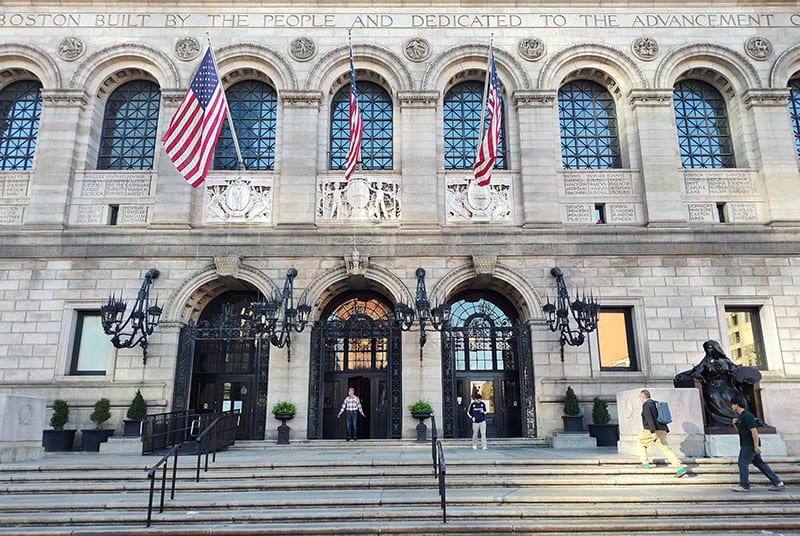
Browse the Children’s Library, read onsite and view public architectural spaces without an admission ticket or library card.
Free admission and visitor hours →A short book break and a look at Bates Hall can fit into an hour. Storytime or a slower architecture visit may extend the stop.
Babies, toddlers and early readers get the most from the children’s spaces. Older kids and teens can appreciate the collections and historic building.
Accessible entrances, elevators and free flexible admission help. Parking in Back Bay, movement between buildings and quiet-room etiquette add small challenges.
See the full Family Friction score →Where picture books meet marble staircases and painted ceilings
The Children’s Library gives younger visitors a place that feels very different from the solemn reading rooms adults may associate with Boston Public Library. Located on the second floor of the Boylston Street Building, it uses colorful, Boston-inspired design and shelves of picture books, nonfiction, stories and graphic novels to invite exploration. A family can browse without borrowing anything: choose a few books, find a suitable seat and read together. The space is intended for children through eighth grade accompanied by an adult, and its seating is reserved for children and their caregivers. That matters during a downtown sightseeing day when a baby needs a calmer setting or a preschooler simply wants to stop walking. Families can choose stories about whatever caught the child’s attention earlier in Boston rather than following a fixed museum-style program.
Four Early Literacy Stations provide another reason to linger. Their games and activities are designed for young children, with half-hour sessions available without a library card. The library also schedules storytimes and other activities for children, although the exact program depends on the calendar rather than a permanent daily promise. Parents can keep the outing simple by browsing and reading, or check the program schedule beforehand for a story session. This is not an indoor playground where loud running is encouraged; it is a working public library shared with local families and readers. A quieter, focused visit is more pleasant for everyone, especially when children are already tired from museums or busy streets.
The building itself rewards a second look once the children have had their book time. Across the Central Library’s connected buildings, families can see the historic McKim architecture, the vast barrel-vaulted Bates Hall reading room, murals, elaborate staircases and a peaceful courtyard. Ask a child to notice the green lamps, the scale of the ceiling or the difference between the bright modern children’s space and the formal older rooms. There is no need to linger in silent study areas if a toddler is restless. For school-age children, a short architecture scavenger hunt works better than attempting a complete tour. The Central Library is a useful family stop precisely because it can be modest: a book, a few wonderful rooms, and a calm place to regroup before heading back into Copley Square.
Want to plan more stops around Copley Square? Match this indoor reading break with parks, museums and family-friendly neighborhood walks in our Boston with kids guide.
Babies come for a pause; early readers stay for the books
Infant
For an infant, this is primarily a comfortable indoor pause with a caregiver. A stroller can reach the Children’s Library by elevator, and the adult can choose short books or leave when the baby needs a break.
Toddler
Toddlers can explore picture books with a parent and enjoy the colorful setting. Keep expectations modest: reading together and a brief literacy activity are more appropriate than running around.
Little Kids
A particularly good fit for early readers who like choosing their own stories, joining an age-appropriate storytime or trying an Early Literacy Station when available.
Big Kids
Independent readers can browse nonfiction, stories and graphic novels, then inspect architectural details in the older building on a short, respectful walk.
Tweens
Tweens may enjoy illustrated books, graphic novels, the scale of Bates Hall and a quick look at the historic murals. Children near eighth grade still fall within the Children’s Library age policy.
Teen
Older teens are better served by Teen Central and the architecture of the Central Library than the younger-children seating area. Quiet independent study or a historic-building visit may be more appealing.
Family Friction: easy to enter, with a few city-center catches
Our Family Friction rating weighs arrival, waiting, exposure, walking, mobility, basic facilities, noise and scheduling. A library visit is simple when families use the accessible entrance and choose the Children’s Library first, but parking and moving between quiet and lively spaces still take thought.
Admission is free and self-directed, with no sightseeing ticket queue or compulsory tour schedule. The Boylston Street entrance is level with the sidewalk, elevators connect public levels and the children’s reading area offers a practical indoor pause. Central Boston parking is the biggest avoidable hassle for drivers. Families should also respect the quiet atmosphere of historic study rooms and allow a little time to find the right elevator when moving between the modern and historic buildings.
| Factor | Score | Why |
|---|---|---|
| Parking & Arrival | 2/5 | The Central Library has no public visitor parking lot. Nearby Back Bay street spaces are limited and garages charge separately, while Copley and Back Bay transit stations make an arrival without a car easier. |
| Queue & Wait Time | 0/5 | Ordinary admission and onsite reading do not require tickets or reservations. Popular events and Early Literacy Stations have their own availability, but visitors can still browse books without joining a sightseeing queue. |
| Heat & Weather Exposure | 0/5 | Children’s reading areas and major public interiors are enclosed. The McKim courtyard is outdoors and optional, so poor weather need not interrupt the indoor visit. |
| Walking Distance & Terrain | 1/5 | The Children’s Library sits on the second floor of the Boylston Street Building, and the historic rooms extend into another connected building. Families can keep the route small and use lifts instead of exploring every floor. |
| Stroller & Mobility Access | 1/5 | Both public entrances offer accessible routes, and the library identifies elevators connecting all public floors and spaces. Families may need to select a different lift depending on the building and destination. |
| Restroom & Baby-Care Access | 1/5 | Public library restrooms are part of the building’s visitor facilities. Parents should ask staff to locate a suitable restroom or changing area rather than assume that a private feeding room or changing station exists on every floor. |
| Sensory & Crowd Load | 2/5 | The Children’s Library can be lively during family programs, while Bates Hall and other study rooms require a quieter approach. Moving between those settings may be difficult for children who are sensitive to crowds or sudden changes in expected behavior. |
| Schedule Flexibility | 1/5 | Browsing is self-paced and needs no library card. Families can leave after a short read, although programs have set times and public opening hours change by day. |
| Scored total | 8/40 | Low Friction |
Two entrances, several elevators and an easier route for strollers
The Central Library occupies two connected buildings with several public floors. Both street entrances are accessible, but the Boylston Street entrance is the simplest starting point for many stroller users because it sits directly at sidewalk level and leads into the building containing the Children’s Library.
The Boylston Street entrance is at sidewalk level. The alternative entrance at 230 Dartmouth Street is reached by an accessible ramp to the left of its flight of eight steps, so families do not need to carry a stroller up the grand entrance stairs.
The children’s collection is on the second floor of the Boylston Street Building. Public elevators serve that level; the West Elevator connects the building’s lower, first, mezzanine and second floors.
The McKim Building contains a separate set of public levels. The Dartmouth, Gold and Glass elevators serve different floors and connections. Read the floor plan or ask a staff member rather than trying to drag a stroller through ornamental staircases.
Move through reading areas without blocking aisles, doors or emergency routes. The historic Bates Hall is an active quiet-study space, not a place to park a stroller for an extended family rest.
Boston Public Library hours, free entry and parking near Copley Square
The Central Library welcomes visitors to browse and read free of charge. A library card is not required for ordinary entry, Children’s Library reading or the half-hour Early Literacy Stations. Paid food, nearby garages and special private activities are separate from this free stop.
| Activity or service | Cost | What to know |
|---|---|---|
| Central Library admission | Free | No admission ticket or library card needed for public spaces. |
| Children’s Library reading | Free | Browse books onsite with a parent or caregiver. |
| Early Literacy Stations | Free | Four stations offer half-hour sessions without a library card. |
| Children’s storytimes | Free when offered | Look up the event calendar; attendance and registration details can vary. |
| Bates Hall and public historic spaces | Free | Observe reading-room etiquette and any room-specific visitor rules. |
| Library borrowing | Library card required | Borrowing privileges follow Boston Public Library eligibility rules. |
| Café and tea lounge purchases | Prices vary | Food and drinks are sold separately, not included in free admission. |
| Nearby garages or street parking | Paid / varies | The library has no public visitor parking lot; observe posted street and garage rates. |
Family cost example: Two adults with a toddler and a six-year-old can browse the Children’s Library, read together and look at the public architectural features for $0 in admission. Snacks, transportation, parking and purchases in the cafés are optional separate expenses.
Boston Public Library hours at Copley Square
- Monday through Thursday: 9:00 a.m.-8:00 p.m.
- Friday and Saturday: 9:00 a.m.-5:00 p.m.
- Sunday: 11:00 a.m.-5:00 p.m.
- The Children’s Library generally follows the main Central Library schedule; holiday closures, tours and special collections may differ.
These are the Central Library’s regular published hours, not a guarantee for every holiday or individual program. The Children’s Library shares the standard daily schedule, but storytimes run according to the events calendar. Check the official location page before visiting on a holiday or when planning around a particular event.
Turn a library stop into a small Boston discovery
Keep the visit loose. A book and one remarkable room are often enough when young children have already spent the morning sightseeing.
- Head for the children’s second floor.Enter from Boylston Street and use an elevator to the Children’s Library before asking little kids to tour the historic building.
- Choose books before checking the clock.Let children browse for stories that interest them. Free onsite reading does not require the membership paperwork needed for borrowing.
- Try one literacy station.The four Early Literacy Stations offer half-hour sessions without a card; if they are in use, switch to books rather than making the day depend on a screen.
- Save Bates Hall for a quieter moment.Walk in for a brief look at its vaulted ceiling and green lamps, but remember that people are actually studying there.
- Check the program calendar, not assumptions.Storytimes vary by day and audience. Look for a suitable event in advance, then keep an independent reading plan as backup.
- Bring snacks to an allowed area.The library permits snacks in the Children’s Library and has cafés for purchases. Food rules differ elsewhere, so avoid eating in historic reading rooms.
Questions parents ask about the famous Boston Public Library
Useful answers about the historic Copley Square building, its younger visitors and what a family can do without committing to a formal tour.
Which Boston Public Library is famous, and where is it?
The best-known Boston Public Library building is the Central Library at Copley Square, 700 Boylston Street in Boston’s Back Bay neighborhood. It is not simply one small neighborhood branch: the large complex joins the historic McKim Building with the later Boylston Street Building, which houses the Children’s Library. When visitors talk about the grand hall, murals and courtyard of Boston Public Library, they generally mean this central location. The library has many other branches around Boston, each with its own collection and schedule. For a family wanting both children’s books and landmark architecture on the same visit, Copley Square is the appropriate destination.
How old is Boston Public Library?
Boston Public Library was founded in the mid-nineteenth century, making it one of the oldest major free municipal public libraries in the United States. The famous McKim Building in Copley Square opened several decades later, so the institution itself is older than its best-known home. Its founding mission emphasized public access to knowledge rather than a collection reserved for a small group of subscribers. Older children can look for the motto Free to All on the historic building and think about why that mattered when books and educational opportunities were less widely available. That history also explains why the Central Library mixes nineteenth-century architecture with much more modern spaces for reading, technology and community programs.
What should families see inside the historic Boston Public Library?
Begin with Bates Hall, the long reading room famous for its high barrel-vaulted ceiling and rows of tables with green lamps. Then notice the ornate corridors and murals in the McKim Building, where artwork makes an ordinary library corridor feel like part of a museum. The central courtyard offers a change of atmosphere with its fountain and surrounding arcades, although it is outdoors rather than a guaranteed rainy-day stop. Families need not follow every point of an architectural tour. A child might enjoy counting arches, finding different ceiling shapes or comparing the decorative old building with the bright new children’s wing. Remember that some rooms are active study areas and require visitors to move quietly.
Can children use the Early Literacy Stations without a BPL card?
Yes. The Central Children’s Library advertises four Early Literacy Stations with educational games and activities for younger children, available in half-hour sessions without a library card. That is separate from its regular public computers, which may require a child’s Boston Public Library card. Parents should not assume that a station will be available immediately at a busy time, since the number is limited. The best approach is to ask staff about access on arrival, then browse picture books if every station is occupied. A half-hour activity can work as a short break, but it does not replace the wider collection of stories, illustrated nonfiction and reading activities in the room.
Can families eat inside the Central Library?
Food rules depend on which part of the building the family is using. Boston Public Library allows children and teens to have snacks in the Children’s Library and Teen Central, while covered nonalcoholic drinks are permitted more broadly. Food can also be eaten in designated spaces such as the McKim courtyard and the Boylston Street Welcome Center at the orange tables. The building has a Newsfeed Café and Map Room Tea Lounge for separate purchases. Do not plan a picnic at a reading desk in Bates Hall or treat all public areas as dining space. With a toddler, it helps to choose a permitted snack spot before leaving the children’s area.
Is the Central Library worth visiting with older children who no longer want picture books?
Yes, provided the stop is tailored to their interests. Teenagers may prefer Teen Central, historic architecture, exhibitions or a look at the artwork instead of a session in the younger-children library. The original reading room and mural-filled spaces can appeal to children interested in art, architecture, Boston history or photography, especially when the visit is kept short and purposeful. The Children’s Library itself serves children through eighth grade with accompanying adults, so younger tweens can still find appropriate books, including graphic novels. For a family with several ages, one adult can focus on little readers while others explore a nearby public area, then regroup without trying to make every child enjoy the exact same activity.