Freedom Trail with Kids: A Short Boston History Walk
The red line in Boston sidewalks turns a history lesson into a navigation game. Follow it from Boston Common past old meetinghouses, burying grounds and sites tied to the American Revolution, or choose just a few blocks that suit the youngest walker. The route is free; entering certain historic buildings and joining a costumed guided tour are separate choices.
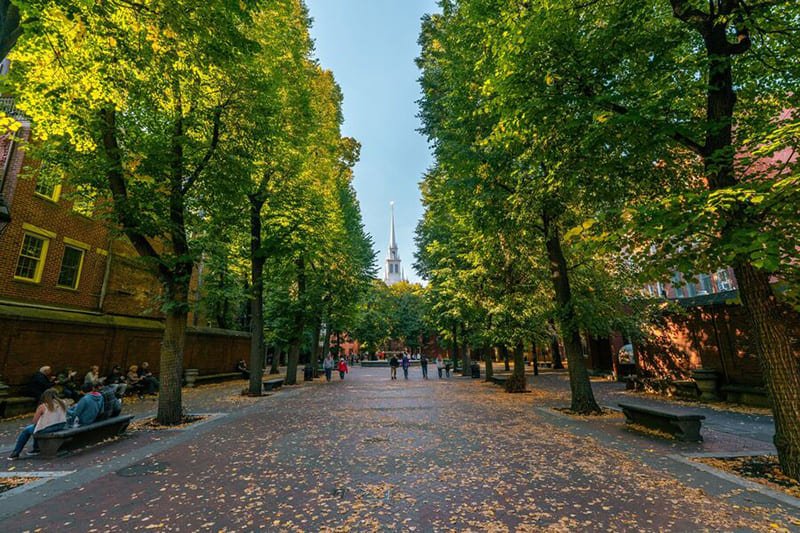
Following the public red-brick route requires no ticket. Paid historical interiors, private or group guides, and parking are separate.
Free walk and optional tour costs →A short downtown section with a few exterior stops is a practical family outing. The full trail extends 2.5 miles and can take much longer.
School-age children and teens can connect the landmarks to stories of protest, printing, civic debate and the Revolutionary era.
The route is flexible and free, but uneven sidewalks, crossings, changing weather and limited restroom access require attention.
See the full Family Friction score →Let the red bricks lead: a Boston history hunt for children
Begin at Boston Common and give children a simple job: find the next strip of red bricks or the metal Freedom Trail medallion. The route connects 16 historic sites, but it is not a single museum or a continuous exhibition. It is a walking line through working Boston neighborhoods, where older buildings share sidewalks with cafés, traffic and ordinary city life. At the Massachusetts State House, the gold dome creates a recognizable landmark. A little farther on, Granary Burying Ground connects the route with well-known figures from Boston's Revolutionary history. Even children who do not remember every name can notice how close the old burial ground sits to busy modern streets. Talk about what a cemetery, church or meetinghouse might have meant in a town long before smartphones and trains.
A manageable family section runs from Boston Common toward the Old State House and the Boston Massacre Site, with the option to continue to Faneuil Hall. The brick line becomes a treasure hunt, but adults should make the decisions at intersections; the route crosses active city streets and is not a pedestrian-only trail. Older kids can compare the roles of the Old South Meeting House, Old State House and Faneuil Hall in public debate and protest. These sites tell related stories, but their interiors are managed separately and may charge admission. Viewing their exteriors while following the route remains free. For a young child, two or three distinct landmarks with a snack break often work better than a long lecture or an attempt to check off all 16 stops.
The full Freedom Trail continues through the North End, past Paul Revere House and Old North Church, crosses toward Charlestown Navy Yard and ends at Bunker Hill Monument. That complete 2.5-mile route is a much bigger undertaking with children than the number alone suggests: stops, sidewalk conditions and the return journey add time. One way to keep stories lively is to use selected clips from the National Park Service's free audio tour, rather than play every recording while small children stand waiting. Parents can also let children sketch a favorite building, look for a brass marker, or decide which landmark they would like to understand better. A Freedom Trail walking tour can be as short as the family's attention span, and the historic Boston setting still comes through.
Make the trail one part of a Boston family day. Find nearby museums, parks and child-friendly stops in our Boston with kids guide, then choose a short route that connects the places your family actually wants to see.
Who gets the most from a red-brick history walk?
Infant
Best as a short carrier or stroller outing for adults who want to see downtown landmarks. Infants gain little from the history itself and need weather, feeding and rest stops planned carefully.
Toddler
Toddlers may enjoy searching for the next red brick but rarely follow the longer stories. Keep the distance small, use a stroller for tired legs and leave the busy road crossings to adults.
Little Kids
Children can count trail markers and spot unusual doors, domes and statues. One or two easy stories, plus an outdoor break, work better than a full-length walking lesson.
Big Kids
A strong age for turning the trail into a mission: trace the line, find several landmarks and connect a few places with people or events already familiar from books or school.
Tweens
Tweens can understand how meetinghouses, newspaper printers and public squares contributed to debate and resistance. Let them help select stops or use parts of the NPS audio tour.
Teen
Teens interested in American history can compare sites, ask whose stories are represented and handle a longer walk with more context. The full route is possible if they enjoy walking.
Family Friction: easy to start, harder to finish
The score reflects what parents must manage on an outdoor history route: busy crossings, uneven pavement, changing weather, breaks, facilities and the freedom to stop whenever children have had enough.
The Freedom Trail is simple to begin: there is no ticket counter, families can start at any landmark, and the route follows a visible line across Boston. Most difficulty comes from moving through a busy city rather than gaining admission. Cobblestones and uneven sidewalks may slow strollers, crossings require close supervision, and an extended walk exposes children to weather without guaranteed restrooms at every stop. Choosing a compact downtown section keeps these complications manageable and removes pressure to reach Charlestown.
| Factor | Score | Why |
|---|---|---|
| Parking & Arrival | 2/5 | Boston Common Garage at 0 Charles Street is a recommended starting option but charges for parking. Park Street station offers transit access, and starting at another landmark is possible. |
| Queue & Wait Time | 0/5 | There is no line to join the public trail. Queues may apply at independently operated interiors or paid tours, neither of which is required for this free walk. |
| Heat & Weather Exposure | 3/5 | The route is outdoors on city streets and through open spaces. Rain can make bricks slippery, while summer heat, wind and winter cold affect how long children can comfortably walk. |
| Walking Distance & Terrain | 3/5 | The complete route is 2.5 miles with uneven bricks, cobblestones, hills and several busy crossings. A short downtown section considerably reduces the walking demand. |
| Stroller & Mobility Access | 2/5 | Many sidewalks have curb cuts, but some official trail segments use steps and require alternate paths. Historic sites have separate, sometimes more restrictive access. |
| Restroom & Baby-Care Access | 2/5 | Restroom opportunities vary by stop and some are inside buildings with their own hours. There is no guaranteed changing facility or restroom at every landmark along the outdoor route. |
| Sensory & Crowd Load | 1/5 | Busy downtown intersections and popular landmarks can feel noisy, but families can step off the trail into a quieter side street or open space and continue when ready. |
| Schedule Flexibility | 1/5 | The public route requires no reservation or ticket and families can turn around at any time. Individual interior attractions and paid guides run to separate schedules. |
| Scored total | 14/40 | Medium Friction |
Strollers on the Freedom Trail: where to detour and slow down
A stroller can make a short Freedom Trail walk practical with younger children, but the marked line is not a promise of step-free travel at every turn. The National Park Service describes curb cuts at crossings as well as narrow or uneven sidewalks and several stair locations. Plan the sidewalk route and each building entrance separately.
The stairs near the Robert Gould Shaw Memorial can be avoided by walking toward Park Street station, following Park Street uphill to Beacon Street and rejoining the route. That keeps wheels on sidewalks instead of carrying a stroller up steps.
The National Park Service identifies an at-grade entrance off Beacon Street. From the main Tremont Street entrance, continue toward Beacon Street and use the alternate approach rather than the steps.
Bricks, cobblestones, uneven pavement and occasional narrow sidewalks can make a compact stroller easier to handle than a large one. Follow curb ramps at intersections and be alert to loose bricks or wet surfaces.
The Old State House has stairs at its entrance, and the later route toward Old North Church and Copp’s Hill includes special detours or steps. Historic ships near the trail endpoint have steep ladders and changing gangways. Check each site independently before committing to entry.
Freedom Trail cost, walking hours and Boston parking
A self-guided walk along the public 2.5-mile Freedom Trail costs nothing, and the National Park Service provides a free audio tour. The route itself is not a ticketed attraction. Cost appears only when families add an optional guide, visit a paid historic interior, park a car or make other purchases.
| Activity or service | Cost | What to know |
|---|---|---|
| Self-guided Freedom Trail walk | Free | Public sidewalks and outdoor landmark viewing; no reservation. |
| National Park Service audio tour | Free | Listen online or use the NPS App; phone and data access may be needed. |
| Outdoor landmark views | Free | The marked route passes 16 sites, but outdoor viewing is not admission to their interiors. |
| Selected historic building admission | Varies | Independently operated churches, museums and other sites may have their own tickets. |
| Freedom Trail Foundation guided walk - adult | $17 | Optional 90-minute Walk Into History tour; not required to follow the route. |
| Guided walk - senior or student | $15 | Optional Foundation Walk Into History rate. |
| Guided walk - ages 6-12 | $8 | Optional guided tour, not the cost of the self-guided route. |
| Guided walk - children under 6 | Free | On the specified Foundation tour; verify group and ticket conditions. |
Family cost example: Two adults and two children can follow the downtown Freedom Trail and play the free NPS audio clips for $0 in admission. A Foundation-guided tour or visits inside independently ticketed buildings cost extra; parking and food are separate.
When is the Freedom Trail open for a self-guided walk?
- The outdoor Freedom Trail follows public streets and can be walked year-round at any time.
- Historic churches, museums, visitor centers and burial grounds set their own access hours, which may differ from the outdoor route.
- The complete walk measures 2.5 miles and is not a loop; a short downtown section is easier to time with children.
- Paid guided walking tours have scheduled departures and their own check-in instructions. The free self-guided walk does not.
For daylight sightseeing with children, choose a start time that leaves room for rests and safe crossings, rather than planning around a single trail opening hour. Check the schedule of any historic interior you actually intend to enter. Public access to the sidewalk route does not guarantee that every building on the trail will be open.
Turn history into a hunt, not an endurance test
A few decisions make the difference between children following the story and children only watching the clock.
- Start with a landmark, not a mileage goal.Boston Common and the State House give children immediate visual targets. Choose the next two or three stops before deciding whether to continue.
- Let children follow the red line.Invite them to spot the next brick strip or pavement medallion, but hold hands at street crossings and keep adults in charge of directions.
- Download the free NPS audio tour.Select clips connected to your stops rather than playing every recording. Download beforehand if you do not want to rely on cellular service.
- Separate outdoor viewing from paid interiors.A building can be one of the 16 Freedom Trail sites without providing free admission inside. Pick any ticketed stop deliberately.
- Pick a stroller-friendly detour in advance.Use Park Street around the Boston Common stairs and Beacon Street for an at-grade route into Granary Burying Ground.
- Plan the way back.The full trail ends at Bunker Hill Monument in Charlestown, not at Boston Common. Decide whether to turn around early or return by transit.
The Freedom Trail questions parents actually need answered
How the route works, what children see, and why planning a short stretch often makes for a better family visit.
Where does the Freedom Trail start and end?
The traditional route starts in Boston Common near the Visitor Information Center at 139 Tremont Street and ends at Bunker Hill Monument in Charlestown. It is a linear route, not a circular walk back to the park. The brick trail passes from downtown through the North End and across to Charlestown, linking 16 official historic sites along the way. Families do not need to start at the official first marker or visit the sites in numbered order. If children are younger or the family has only a morning, a section beginning at Boston Common and ending near Faneuil Hall can provide several distinct landmarks without committing to the distant endpoint. Plan the return journey separately if you choose to keep walking toward Charlestown.
What is the Freedom Trail in Boston, and why is it marked in red?
The Freedom Trail is a route connecting sites associated with Boston's history, especially events and people linked to the American Revolution. The red brick or painted line on sidewalks helps walkers navigate between landmarks that would otherwise be scattered across several neighborhoods. The route includes churches, meetinghouses, burial grounds, a public square, a historic ship and a hilltop monument. It is not a single preserved street from the Revolutionary era, and the landmarks do not appear in chronological order of historical events. That gives families room to choose a theme, such as public protest, life in the colonies or how information traveled through Boston. Children often enjoy the trail more once they realize the red line is a clue connecting real places, not simply a decorative sidewalk feature.
How long is the Freedom Trail in Boston, and how much should families walk?
The official Freedom Trail is approximately 2.5 miles from Boston Common to Bunker Hill Monument. That is the distance of the route, not an estimate of how far every family must walk or the total distance after detours and getting back to the starting point. Adults walking past buildings without entering them may move relatively quickly, but family visits include traffic lights, snacks, explanations and breaks. A focused 1-2 hour downtown section is a more realistic first experience for many school-age children. Families with enthusiastic teens may choose a longer day and add indoor visits, although those require separate admission and opening-hour planning. A sensible goal is to stop while children are still curious, rather than treating all 16 landmarks as a compulsory checklist.
What will children recognize along a Freedom Trail walking tour?
The trail offers several different kinds of history that children can connect with. They may notice the Massachusetts State House dome, old gravestones at Granary Burying Ground, the Old State House and the site associated with the Boston Massacre. Other stops show where public speeches, debates, worship and commerce took place. For children who already know names such as Paul Revere or Samuel Adams, seeing the neighborhoods behind those stories can make the history easier to remember. For younger visitors without that background, a small game works better: look for the next red marker, compare old building façades, then pick a favorite landmark and ask one question about it. The street scenes between sites also show that historic Boston is still a working modern city.
Can a family use the National Park Service audio tour without joining a group?
Yes. The National Park Service provides a free self-guided Freedom Trail audio tour that can be played online or accessed through the NPS App. It is designed for visitors who prefer to move independently, and recordings are available in several languages. Families can pause whenever they stop for food, cross an intersection or decide to spend longer at a landmark. There is no requirement to play every track in order, and the audio guide does not grant admission to independently operated interiors. Older children may enjoy listening to a complete segment and discussing it, while younger children often do better with a brief clip followed by a chance to look around. Download content before leaving if mobile reception or battery life could be an issue.
Can families follow the Freedom Trail without finishing the entire route?
Absolutely. The Freedom Trail Foundation explains that visitors may enter the route at different points and explore the historic sites in any order. There is no finish-line requirement, completion ticket or fixed time limit for the public walk. Families can stop for lunch, leave the line for a nearby park or museum, then resume later if they wish. This flexibility is particularly useful when traveling with children who have very different interests: one might enjoy a historic cemetery while another wants only to follow the red bricks and see an imposing old building. A short outing is still a genuine Freedom Trail visit. If you stop halfway, remember that the official route does not loop back, so choose a convenient transit connection or plan a manageable walk to your starting point.