Historic Savannah Squares with Kids - Free Walking Route
Turn the Historic Savannah Squares into an easy architecture and monument scavenger hunt instead of a long history lecture. Begin at Chippewa Square, follow Bull Street to Madison Square and add Monterey Square if everyone still has energy. The walk is free, flexible and full of moss-draped trees, old houses and statues, but active intersections, uneven brick sidewalks and Georgia heat make a short route smarter with children.
No historic Savannah squares tickets are required for public pathways, monuments or a self-guided scavenger hunt. House museums and private tours are optional extras.
Free walking route and optional costs →Allow 45-90 minutes for Chippewa, Madison and optional Monterey Square with stops; shorten the walk to two squares for toddlers or very hot weather.
Kids who enjoy searching for statues, architectural details and filming locations get the most from the route. Babies and toddlers can join for a shorter stroller walk.
Admission is free and departure time is flexible; the main challenges are traffic crossings, patchy pavement, humidity and managing breaks along public streets.
See the full Family Friction score →What to see in Savannah historic squares: make Bull Street a family scavenger hunt
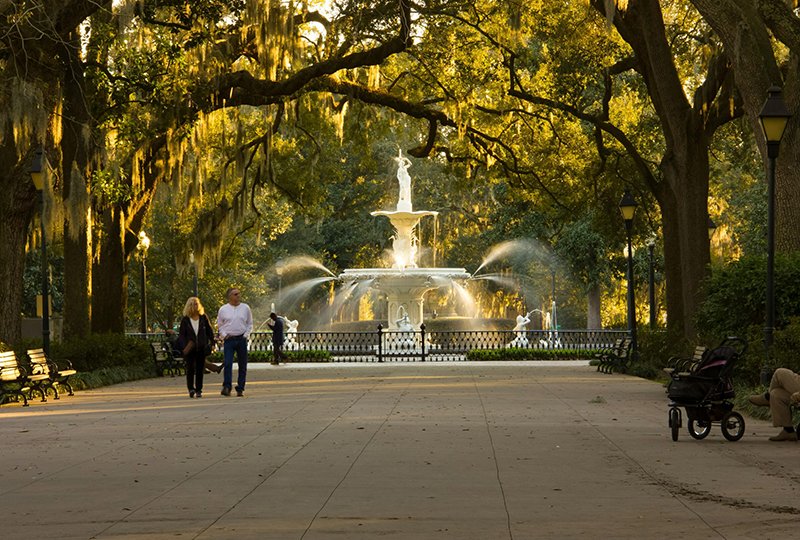
The historic Savannah squares are small public green spaces woven into the street grid, not a single attraction with gates or a ticket booth. That is what makes them particularly useful with children: you can explore a few, stop at a bench when someone gets tired and turn an ordinary walk into a game. Savannah's original town plan began with squares in 1733, and Visit Savannah now describes 23 squares in the city, including Yamacraw Square. The number may differ on older maps that count only the surviving original-plan squares. A family does not need to tackle every one. For a manageable first visit, follow Bull Street through Chippewa Square, Madison Square and, if energy allows, Monterey Square. Tell children to look for carved faces, dates, columns, iron fences, flowering plants and Spanish moss hanging from live oak branches. Ask them to choose one detail worth sketching or photographing in every square.
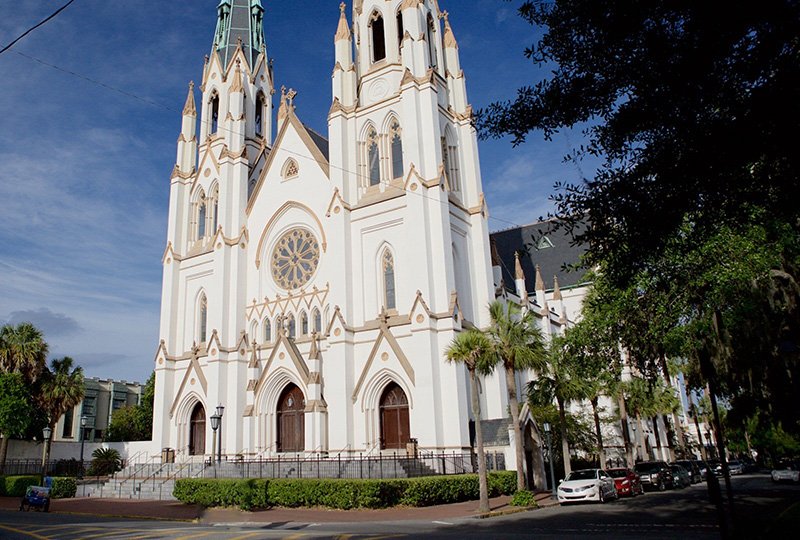
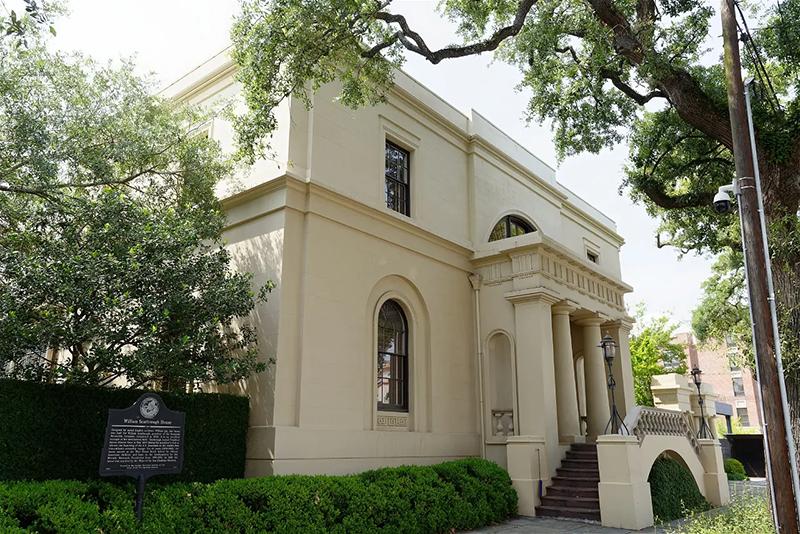
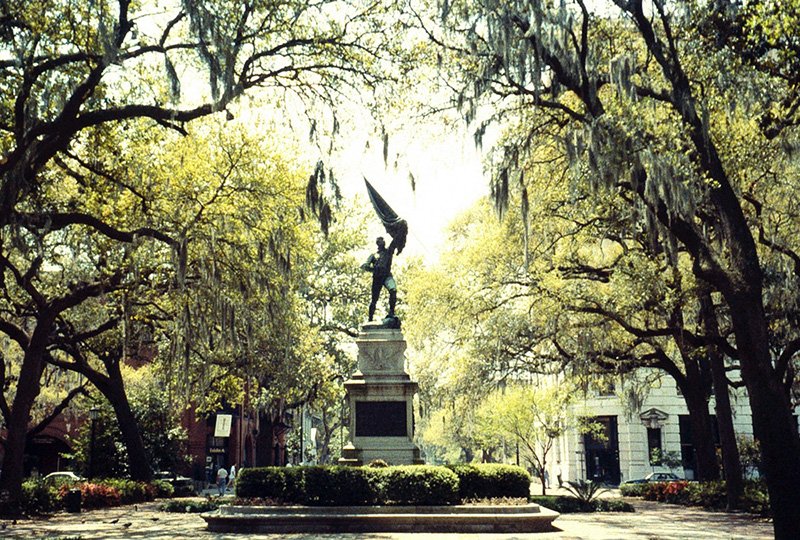
Chippewa Square at Bull and McDonough Streets makes a memorable starting point. In the center, the bronze monument depicts James Oglethorpe, the founder of Georgia's colonial settlement; the square dates to 1815. Children who know Forrest Gump may recognize the location of the movie's bus-bench scenes, but the actual bench was a film prop rather than a permanent seat to look for today. Walk south on Bull Street toward Madison Square at Macon Street, passing the area's churches and stately architecture. Madison Square's central statue honors Sergeant William Jasper, associated with the 1779 Siege of Savannah. Around it stand the Green-Meldrim House, the Sorrel-Weed House and St. John's Episcopal Church. Use the buildings to play a quick compare-and-contrast game: which has the tallest columns, the most decorative balcony or the strangest roofline? Looking from public sidewalks does not require entering any of these properties.
If children still have the patience for another stop, continue south along Bull Street to Monterey Square at Wayne Street. Here the tall monument commemorates Casimir Pulaski, and nearby architecture includes the Mercer-Williams House and Temple Mickve Israel. This third square adds another set of monuments and striking buildings without committing to an all-day Historic District tour. The route is compact by adult walking standards, but parents should count time spent crossing streets, reading plaques and sitting in the shade rather than simply distance between map pins. Historic brick pavement can be uneven and tree roots may lift sections of sidewalk. There are no universally guaranteed public changing facilities at every square, so plan a bathroom stop at an appropriate nearby venue. In the hottest months, a morning walk with drinking water and a clear finish point is usually more comfortable than trying to visit every square in one afternoon.
Build a Savannah day around a few squares, not a marathon. Find additional museums, gardens and family attractions in our Savannah with kids guide.
Which ages enjoy a Savannah square scavenger hunt?
Infant
A baby can join on a brief stroller or carrier stroll under the trees. Keep the outing focused on the adults' enjoyment and plan feeding or changing at a known nearby stop.
Toddler
Toddlers may like the trees, birds and short paths but need hand-holding at every street crossing. Choose one or two squares, a bench break and a simple game such as spotting three flowers.
Little Kids
Preschoolers can search for statues, fountains, dogs and large columns. Keep clues visual, allow frequent pauses and skip long historical explanations that exceed their attention span.
Big Kids
This age can enjoy counting monuments, identifying Roman-style columns and comparing different architectural facades. Give each child a short checklist and let them lead toward the next square.
Tweens
Tweens can investigate why different monuments honor different historical figures, use the walking map and photograph contrasting styles of homes, churches and public art.
Teen
Teens interested in history, photography, architecture or movies can enjoy the walk independently within family boundaries. Others may prefer pairing it with a cafe or a museum visit.
Family Friction: how demanding is a free Savannah squares walk?
The rating measures arrival, waits, weather, walking demands, stroller access, baby care, crowd sensitivity and flexibility for a short Chippewa-to-Madison family route.
This is one of the more flexible Savannah family outings: public squares require no booking, no admission queue and no fixed departure time. Families can end after Chippewa Square or continue to Madison and Monterey only if children remain comfortable. The effort comes from urban conditions rather than the activity itself. Cross streets carefully, watch for lifted bricks or tree roots, plan parking and consider summer heat. Restrooms and infant-care facilities are not reliably documented within the squares, so arrange those stops separately.
| Factor | Score | Why |
|---|---|---|
| Parking & Arrival | 2/5 | Several squares lie along Bull Street in a walkable downtown grid, but curbside parking is metered in many surrounding blocks and nearby garages charge separately. Park once and begin at Chippewa rather than moving the car between squares. |
| Queue & Wait Time | 1/5 | There are no tickets, gates or ordinary admission queues at the public squares. You may occasionally wait to take a photo near a popular monument or cross at an intersection. |
| Heat & Weather Exposure | 3/5 | Savannah heat and humidity are the main environmental limitations. Large live oaks provide welcome shade in some areas, but not on every connecting sidewalk; rain and lightning can interrupt the trip. |
| Walking Distance & Terrain | 1/5 | Chippewa and Madison squares sit a short walk apart along Bull Street, and the optional third stop at Monterey extends it modestly. Parents can choose a short out-and-back route with multiple benches. |
| Stroller & Mobility Access | 1/5 | Public sidewalks and paths permit many strollers, but brick surfaces, roots, curbs and historic irregularities may require slow pushing or an alternate crossing. Accessible conditions are not uniform at every corner. |
| Restroom & Baby-Care Access | N/A | Individual squares are open green spaces without a confirmed, consistently available public restroom, changing table or dedicated feeding room. Nearby businesses may have customer facilities. |
| Sensory & Crowd Load | 1/5 | Traffic noise, sightseeing groups and occasional street activity can be noticeable, yet the squares offer places to sit away from the busier sidewalks. Crowds vary by weekend and event. |
| Schedule Flexibility | 1/5 | Public square walks have no tickets or required time slots. Shorten, reverse or postpone the route to suit naps, weather and your children' attention spans. |
| Scored total | 10/35 | Low Friction |
Stroller-friendly Savannah squares: choosing sidewalks and crossings
Bull Street offers a practical route between Chippewa and Madison, but historic brickwork and raised tree roots can make a stroller ride bumpier than the map suggests.
Inspect intersections around Chippewa Square before choosing which side of Bull Street to follow; cross at designated points and do not assume every corner has the same curb treatment.
Historic sidewalks may include brick, cracks and tree-root changes in level. Larger stroller wheels tend to handle irregular surfaces more comfortably than tiny hard wheels.
Park benches are useful for snacks and a rest, but a square itself should not be treated as a confirmed source of restrooms, changing tables or drinking water.
Choose Madison as the planned finish and Monterey as a bonus. A carrier can help when a child is too tired for a walk or a difficult curb requires assistance.
Historic Savannah squares tickets, self-guided map and downtown parking
The self-guided walk through Chippewa, Madison and Monterey squares is free. Ticketed historic houses, specialty tours, restaurants and metered parking are separate choices.
| Activity or service | Cost | What to know |
|---|---|---|
| Chippewa Square and Oglethorpe monument | Free | Start at Bull and McDonough Streets; public outdoor paths and monument viewing. |
| Madison Square and Jasper monument | Free | Continue along Bull Street to Macon Street; architecture can be viewed from public sidewalks. |
| Monterey Square and Pulaski monument | Free | Optional extension south to Bull and Wayne Streets. |
| Self-guided historic squares walking map | Free | Use a map app or Visit Savannah square guide; no paid guide is required. |
| Private guided walking tours | Varies | Optional paid operators set their own rates, ages and meeting points. |
| Historic house museum admission | Varies | Some nearby properties offer separately ticketed interior tours. |
| Metered downtown street parking | $1.50-$2.50 per hour | Zone 1 maximum $2.50/hour; Zone 2 maximum $1.50/hour. Enforcement depends on location and day. |
| Snacks, meals and drinks | Varies | Bring refillable water and add a stop if the family needs a restroom or meal. |
Family cost example: Two adults and two children can explore Chippewa, Madison and Monterey squares for $0 in admission. If the family parks in a $2.50-per-hour zone for two hours, the metered parking example is $5 before any food, tours or other purchases.
How long does the Chippewa-to-Madison historic squares route take?
- Start at Chippewa Square on Bull Street at McDonough Street, with the Oglethorpe monument as the first scavenger-hunt clue.
- Walk south to Madison Square at Macon Street, stopping to spot columns, iron balconies, signs and tree-covered streets.
- If your group still has energy, continue south to Monterey Square at Wayne Street and look for the Pulaski monument.
- Allow roughly 45-90 minutes with photo stops, snacks and street crossings; your exact distance depends on detours and where you parked.
The three-square route is a suggested family itinerary, not a formal guided program. There are no set opening sessions for ordinary public walking access, although parks can have temporary closures or event restrictions. Take breaks only where they do not obstruct pedestrian paths and check weather before departure.
Turn Savannah monuments and buildings into a child-sized scavenger hunt
A small set of visual challenges works better than asking children to appreciate every historical plaque.
- Give kids a five-item checklist.Challenge children to find a statue, a date on a plaque, a tall column, an iron fence and Spanish moss. Let them draw or photograph their discoveries.
- Begin at Chippewa, not the farthest square.Chippewa has a recognizable central monument and is close to Madison on Bull Street. Starting with an easy success keeps the game moving.
- Add a Forrest Gump movie fact carefully.Forrest Gump filmed its bench scenes at Chippewa Square, but the familiar bench was a prop and is not sitting at the square as a permanent attraction.
- Look up as well as around.Look for church towers, balconies and windows on surrounding streets. Invite older children to compare buildings without entering private property.
- Plan for Savannah heat and crossings.Pack water, use crossings rather than cutting through traffic, and choose a morning outing in hot months. Trees shade some paths but do not make the entire route cool.
- Treat Monterey as a bonus, not a requirement.Children do not need to complete all 23 squares. If they remain interested after Madison, add Monterey or a snack; otherwise finish on a positive note.
Historic Savannah squares: maps, numbers and family walking questions
Detailed answers for parents choosing a free, short route among Savannah's historic public squares.
How many historic squares are in Savannah, Georgia?
Visit Savannah currently describes 23 historic and public squares in Savannah, including Yamacraw Square, a restored public space recognized as the city's 23rd square. The famous original town plan ultimately contained 24 squares. You may encounter sources that say 22 because some historic walking guides count the surviving traditional squares differently or use older totals. Not every square has survived unchanged: some were altered, and Ellis Square was restored after earlier redevelopment. For a family visit, the count is less important than choosing a few neighboring squares with distinct monuments and architecture. Three squares on Bull Street offer a manageable introduction without committing children to a citywide checklist.
Where can I find a map of historic Savannah squares for a family walk?
Visit Savannah's square guide identifies individual squares and their cross streets, and the city's Historic Squares and Monuments information provides context for public spaces. A simple family map can begin at Chippewa Square at Bull and McDonough Streets, continue south along Bull Street to Madison Square at Macon Street, and optionally reach Monterey Square at Wayne Street. These squares lie on the same north-to-south corridor, avoiding unnecessary zigzags across downtown. Save your preferred route before leaving, especially if you will be using a stroller or need to find a parking garage and restrooms. Do not confuse a map covering all Savannah squares with a route appropriate for a young child; a compact selection is easier to enjoy.
Are historic Savannah squares free, or do families need tickets?
Savannah's public squares are free to walk through, and there is no general admission charge to view the monuments, trees, lawns or surrounding exterior architecture from public paths. Parents can stop briefly, return later or end the activity early without losing money on admission. Nearby historic homes, church interiors with special visitor arrangements, guided walking tours and museum experiences may require separate reservations or paid tickets. Parking, food and drinks also add to the outing cost. A family of four can therefore make a completely free sightseeing stop if they arrive on foot and skip paid extras. Check for temporary restrictions during civic events, filming or maintenance, but do not purchase a tour simply to enter the public squares.
Which historic Savannah squares should we visit with children?
For a first family outing, Chippewa, Madison and Monterey squares form a useful sequence with enough variety to keep the walk interesting. Chippewa offers the prominent Oglethorpe statue and a well-known Forrest Gump filming connection, although the film bench itself was only a prop. Madison has the Sergeant William Jasper monument and visually distinctive surrounding properties such as the Green-Meldrim and Sorrel-Weed houses. Monterey adds the Pulaski monument and nearby Mercer-Williams House and Temple Mickve Israel. With preschoolers, start with Chippewa and Madison and stop there if attention fades. School-age children may enjoy all three when given a scavenger checklist. These squares are for calm walking and observation, not a substitute for a playground.
Can we use a stroller on a historic Savannah squares walking tour?
A stroller can be useful on a short walk between Chippewa and Madison squares, but do not expect the same smooth surface as a modern indoor attraction. Downtown Savannah has brick sidewalks, occasional uneven paving, curb changes and tree-root bumps. Families should use marked crosswalks and inspect curb access instead of assuming every corner is identical. A stroller with wheels suited to uneven urban paths may be more comfortable than one with very small hard wheels. Bring a carrier if your baby prefers being held and choose a route that you can easily reverse when children become tired. Public changing tables, private feeding facilities and continuously open toilets are not verified at each square, so arrange a restroom stop at a nearby venue before starting.
How long should we spend visiting Savannah historic squares, and when is the best time?
Plan approximately 45-90 minutes for an unrushed family scavenger walk through Chippewa and Madison squares with Monterey as an optional extension. A family with a toddler might spend only 20-40 minutes at one or two squares, while older children who like history or photography could spend longer reading markers and comparing historic buildings. Morning is often more comfortable during Savannah's hot and humid months because the sidewalks between the trees can still be exposed to direct sun. Bring water, sun protection and comfortable shoes, and monitor thunderstorm forecasts before committing to an outdoor route. Most public square sightseeing does not depend on a formal tour departure or museum opening hours, so you can fit the walk between meals or other attractions. Keep children close around street crossings and do not rely on every square to have a public restroom.