Rainy Day in Savannah, GA With Kids: Indoor Activities
A family trip to Savannah, GA often depends on walking. The Historic District's squares, old streets, and riverfront are easier to appreciate outdoors, which makes a wet forecast particularly inconvenient when a stroller, tired children, or prepaid activities are involved. Families searching for what to do in Savannah Georgia on a rainy day need more than a list of museums. They need to know which places are genuinely indoors, where a walk between buildings might defeat the purpose, and whether an experience is appropriate for children who would rather move than listen.
The best replacement for a canceled walking tour may be a guided gallery visit, a hands-on program, or simply a low-pressure afternoon close to the hotel. Those choices serve different families. A teenager interested in art can spend time discussing exhibitions, while a preschooler who has already been indoors all morning may find another quiet gallery difficult. This guide compares realistic Savannah rainy day activities, explains how to handle mixed-age groups and transportation, and identifies several details worth checking before anyone puts on a raincoat.
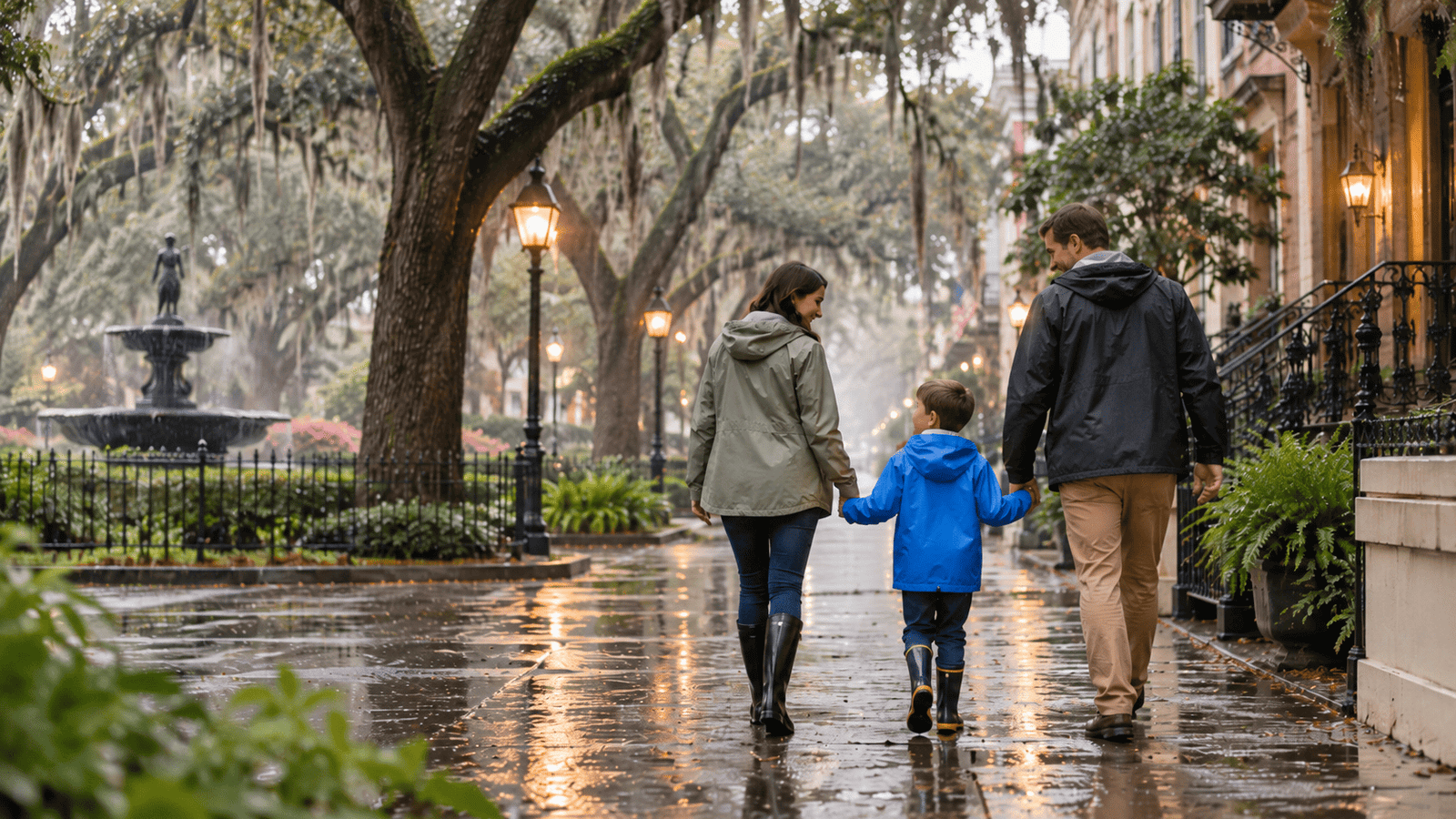
What to Do in Savannah Georgia on a Rainy Day
Rain does not mean every Savannah outing needs to be canceled, but it changes which details matter most. A fully indoor activity with nearby parking or a short drop-off is usually easier than a historic tour with multiple exposed stops, especially with young children. Before committing to a replacement, check whether admission is timed, the venue allows strollers, and the program requires children to stay with a guide. Keep a second, inexpensive option available in case the first choice is sold out or the weather worsens.
Cathedral Basilica of St John the Baptist
Mostly indoor sightseeing, subject to service schedules and temporary church closures.
Savannah History Museum
Most galleries are indoors; optional battlefield tours extend outdoors.
Ships of the Sea Maritime Museum
Indoor ship-model galleries remain an option in rain; gardens are outdoors.
Jepson Center and Telfair Children's Art Museum
Climate-controlled indoor galleries and family art activities make this a useful rainy-day stop.
Indoor Options That Need a Little Planning
Some of the most useful things to do in Savannah rainy day searches overlook the differences between an indoor gallery, a historic house and a children's activity. A museum may be sheltered yet expect visitors to stay together on a scheduled tour. Another may allow families to leave whenever a child needs a snack or quiet break. The locations below provide three distinct approaches, but none should be treated as an automatic fit for every age or family schedule.
Let Older Kids Make Sense of Contemporary Art
The SCAD Museum of Art presents changing exhibitions by contemporary artists in a museum operated by the Savannah College of Art and Design. This is a better match for families who enjoy looking closely, asking questions, and making their own interpretations than for children expecting a room full of touchable exhibits. An exhibition might connect to fashion, photography, sculpture or another visual medium, but the current selection needs to be checked before a parent promises a particular subject. For an interested tween or teenager, a gallery visit can be a welcome change from sightseeing built around historic streets and monuments.
SCAD's published visitor guidance says the museum's galleries and facilities are wheelchair accessible and that umbrellas, backpacks and bags must be checked before entering the galleries. That checkroom rule is especially relevant on a rainy day: put medication, diapers and other essentials somewhere they can be reached without retrieving a large bag. Families should also look at the current exhibition descriptions for material that might need explanation to younger visitors. Do not assume that an art museum is a supervised activity or that children can explore in a separate area while adults view an exhibition.
Ticket check: The official visitor page currently lists free admission for children under 14 and a family admission option for groups of three or more; other admission categories are also published. Verify current prices, closing days and exhibition changes before visiting, rather than budgeting from an older travel article.
A Free Museum With a Guided Format
The Savannah African Art Museum focuses on art and cultures from different regions of Africa. Its collection lends itself to conversations about materials, symbols, storytelling and how objects are used within communities. Parents of school-age children can prepare a simple question before arriving, such as what an object might have been made for or which details suggest that it was used for a ceremony. The goal is not to rush children past unfamiliar works but to help them look with curiosity and respect for the cultures represented.
The museum states that individual admission is free, but visits follow a guided-tour format and walk-in tours depend on docent availability. The official tour information gives an average duration of 45–60 minutes. That is a concrete consideration for a child who struggles to stay with a group or for a family trying to squeeze an activity between a nap and a meal. The museum's visitor information also describes limited free on-site parking and wheelchair access to the main museum. Review the tour timetable, group size conditions and holiday closures before driving over, particularly if the rain has caused other families to change their plans too.
Unlike an open-ended indoor play venue, this experience asks children to listen, observe and move with a guide. It may be more rewarding for an engaged older child than for a toddler who needs frequent changes of activity. A free ticket does not eliminate the cost of reaching the museum, and a tour that cannot be comfortably completed is not necessarily the best bargain for a family with younger children.
When a Historic House Is the Right Choice - and When It Isn't
For children who ask how people lived in the past, the Owens-Thomas House & Slave Quarters offers a more demanding but potentially meaningful experience. Its interpretation connects architecture and domestic spaces with the lives of enslaved people whose labor sustained the household. Parents should consider the subject matter beforehand and be ready to discuss slavery accurately in age-appropriate language, rather than presenting the house solely as an example of elegant old Savannah. Older children who have studied American history may benefit from hearing how the interpretation treats the experiences of people who lived and worked on the property.
This is not a completely rain-protected route: the site includes separate buildings and outdoor areas. Tours also operate on a schedule, and the original staircases mean that the main house has no elevator access. Those facts make it a less reliable backup for a family using a stroller, traveling with someone who cannot use stairs, or hoping to stay under one roof during a heavy downpour. Telfair says the tour normally takes approximately 45–60 minutes and requires on-site check-in even for some visitors who have already purchased admission. Check the museum's admission and tour guidance and choose it for the historical content, not simply because it is classified as a house museum.
Compare the Experience Before Booking
| Venue | What children are asked to do | Potential difficulty in rain |
|---|---|---|
| SCAD Museum of Art | Look, interpret and discuss changing exhibitions | Gallery behavior and bag-check rules |
| Savannah African Art Museum | Follow a docent and explore works from African cultures | Scheduled guided format; limited flexibility for breaks |
| Owens-Thomas House & Slave Quarters | Engage with historical interpretation and guided spaces | Outdoor transitions and original staircases |
| Indoor movie screening | Watch a selected film from a seat | Ratings, volume, screening times and ticket policies |
The comparisons above describe the visit format, not official age recommendations. A child's interest, accessibility needs and ability to participate matter more than assigning an attraction to a fixed age group. For any event-based choice, confirm the specific day's program directly with the provider.
Getting Around Savannah With Kids When Streets Are Wet
Savannah's compact historic center can encourage families to plan several stops on foot, but a short distance on a map is not the same as a comfortable wet-weather journey. A stroller may need to navigate curb transitions, puddles and older walking surfaces; a child with wet shoes may lose patience well before the next museum entrance. Strong wind also makes umbrellas less effective, especially when adults are carrying bags or holding children's hands. When the weather is unsettled, organizing a trip around one neighborhood and one main activity is usually easier than trying to preserve an ambitious walking itinerary.
Reduce Transitions Instead of Chasing More Attractions
Parents often focus on whether the destination is indoors but forget about the journey from the parking space or drop-off point to the entrance. Check the venue's exact entry location, then look for a nearby meal option and a place to take a break. The weather can change while a family is inside, so consider how the return trip will work if rain becomes heavier. It is reasonable to move a walking tour to another day and keep the day limited to one carefully selected indoor visit, especially when the children's regular sleep and meal routines are already disrupted by travel.
- Verify the door, not just the address: Historic buildings sometimes have an accessible entrance different from the most photographed doorway. Confirm it on the official website or with staff.
- Choose a realistic parking strategy: Compare the venue's parking instructions with public garages before departure. Look for the walking distance to the actual entrance, not simply the nearest parking symbol.
- Pack for the return trip: Keep dry socks, a small towel and a change of clothes for younger children in the car or day bag. Wet clothing can turn an otherwise pleasant museum visit into an uncomfortable afternoon.
- Do not mistake shelter from rain for lightning safety: If thunderstorms develop, move into a substantial enclosed building or hard-topped vehicle and follow official weather alerts.
- Keep snacks and restroom access in mind: Check whether the next stop permits outside food, and identify a practical meal break before children become overtired.
Choose a Different Pace for Mixed-Age Families
One reason Savannah rainy day activities can be difficult to compare is that children of different ages need very different kinds of attention. An infant may be comfortable during a quiet gallery walk as long as feeding and changing are manageable. A toddler who wants to touch everything can find a guided historic interior frustrating, whereas a tween might enjoy asking detailed questions about an exhibit. When siblings have widely separated interests, parents may prefer an activity with an easy exit instead of buying a nonrefundable timed experience for everyone.
| Family situation | Better planning approach | Confirm before leaving |
|---|---|---|
| Infant or stroller-dependent child | Favor accessible galleries with flexible departure | Entry route, changing facilities and stroller rules |
| Toddler or preschooler | Prefer shorter experiences with room for breaks | Whether quiet participation or guided touring is required |
| School-age children | Connect an exhibit to a question they can investigate | Program topic and hands-on restrictions |
| Tweens and teenagers | Choose deeper art or history content and involve them in planning | Current exhibitions and sensitive themes |
| Siblings with very different interests | Plan one main visit plus a flexible meal or rest stop | Re-entry, refunds and ability to leave early |
These are practical planning categories rather than admission requirements. A museum's official accessibility page and program details should take priority over generalized age recommendations, particularly when a child has sensory or mobility needs.
Choose the Better Value, Not Just the Cheapest Ticket
Rain may tempt parents to replace a free outdoor morning with a paid attraction they had not budgeted for. That can work when the replacement genuinely interests the children, but rushing into a purchase because a weather app shows a cloud can be expensive. First review what is already included in the trip: hotel common areas, reservations that can be moved, tickets with flexible admission and any scheduled family programs. Then compare the complete cost of a new outing, including transportation and parking, rather than looking only at the adult admission price.
Free admission at the Savannah African Art Museum is a useful example of why cost and suitability must be considered together. The guided structure is a benefit for visitors ready to engage with the collection, yet it can be awkward for a toddler who needs to move freely. SCAD Museum of Art, by contrast, publishes specific admission categories and a family option, which should be checked against the total number and ages of your group. A lower ticket total is only valuable if the experience works for the children who will actually attend.
A Short Checklist Before Spending Money
- Will the family stay dry from entry to exit? Verify whether the visit involves courtyards, uncovered queues or movement between separate buildings.
- Can everyone participate? Look at current age, behavior, accessibility and supervision rules, rather than judging from a promotional photograph.
- What happens if the weather interrupts travel? Read the cancellation and late-arrival policies before paying for a fixed time slot.
- Is the location worth the drive? A cheaper ticket across town may not save money after transportation and parking.
- Does the family need another activity at all? Rest, a relaxed lunch or time at the accommodation may be more useful than filling every hour.
When there is no confirmed official price or a venue's page does not identify a relevant discount, do not rely on an estimate copied from a third-party list. Contact the venue directly. For families traveling during busy weekends or holiday periods, published operating schedules and program availability deserve a final check on the day of the visit.
A wet day in Savannah calls for a smaller, more deliberate itinerary rather than an effort to see everything on the original list. Families with young children should begin with the practical questions: how far is the entrance, will there be a place to sit, and can they leave without losing a large payment? Older children may appreciate the chance to spend more time with an art collection or a thoughtful historic tour. Not all museum experiences are entirely indoors, and a beautiful old building may still involve uncovered paths and inaccessible staircases. Check the day's weather warnings, then select one activity that genuinely fits the family instead of stitching together several hurried stops. If the forecast improves, a short outdoor walk can always be added afterward. There is no need to treat a canceled sightseeing plan as a day that has to be rescued at any cost.
Frequently Asked Questions
What to do in Savannah Georgia on a rainy day with younger children?
Start by looking for an activity that allows breaks and does not require a child to remain on a guided route for an extended period. A younger child may enjoy a brief look at colorful artwork, but a traditional gallery is not the same as an indoor playground and generally cannot be treated as one. Check whether strollers are permitted, where diaper-changing facilities are located and whether there are sheltered places to wait. If none of the available venues fits the child's needs, staying near the accommodation for a meal and rest can be a better choice than paying for tickets the family may not use fully.
For children who are comfortable in museums, review the day's program rather than assuming all activities listed on a venue's website are offered every day. Seasonal workshops, scheduled tours and special exhibitions often have different participation conditions. That distinction matters when parents are looking for a dependable backup instead of an activity to plan several weeks in advance.
Are Savannah museums a good option during heavy rain?
Many museum galleries offer shelter, but the word "museum" does not guarantee a completely indoor visit. Historic house tours may cross open courtyards or connect separate buildings, and even indoor attractions can have exposed entrances or parking areas. When heavy rain or thunderstorms are expected, look at the actual route through the property, not just whether the main exhibit is inside. Contact the venue when the website does not make the outdoor portions clear.
Families should also distinguish ordinary rain from unsafe weather. When lightning is nearby, seek shelter in a substantial enclosed building or a hard-topped vehicle and follow weather warnings. Waiting under a tree, in an open-sided pavilion or beneath an umbrella is not sufficient lightning protection.
Are there free things to do in Savannah on a rainy day?
There are some no-admission options, but parents should check their format as carefully as their cost. The Savannah African Art Museum publishes free individual admission and offers guided tours subject to its timetable and docent availability. That can work very well for children ready to listen and ask questions, but it is less flexible than an open gallery. Parking availability also has limits, so a free ticket should not be mistaken for an outing with no potential travel expense.
Public community programs and library events may provide additional possibilities on certain dates, but availability and participation rules differ. Confirm the current calendar and visitor eligibility before promising a specific free activity to children. A scheduled event that isn't running during the family's stay is not a dependable rainy-day alternative.
Can families explore Savannah's Historic District in the rain?
Light rain does not automatically prevent walking around the Historic District, but cobbled or uneven surfaces, puddles and the distance between stops may make the outing less comfortable with children. A stroller should be evaluated for the actual pavement and curb conditions, and adults should keep younger children close near traffic and crossings. Short walks between nearby sheltered locations can be manageable; an ambitious walking tour is less appealing when clothes and shoes are already wet.
When thunderstorms or heavy downpours are forecast, shorten or postpone outdoor sightseeing. Avoid using a covered porch or open shelter as protection from lightning. Parents can move the walking portion to another day and focus on one nearby indoor stop without losing the broader experience of the city.
Which Savannah rainy day activities work best for teenagers?
Teenagers who enjoy visual culture or creative subjects may get more from contemporary art exhibitions than from an activity aimed primarily at young children. At the SCAD Museum of Art, the themes of the current exhibitions matter; ask teens to look at the museum's exhibition descriptions and choose what they want to investigate. A guided collection visit can also suit a teenager who is genuinely interested in cultural history and comfortable discussing unfamiliar objects and traditions.
Historical programs addressing slavery require a different sort of preparation. Parents should review the content first and allow children to ask questions about the lives and labor of enslaved people without simplifying the subject into decorative history. When a teenager is not interested in a museum visit, an appropriately rated film or another scheduled indoor event may be more suitable, provided current screening and admission information has been confirmed.
Should parents buy indoor attraction tickets before checking the forecast?
There is no single rule. Advance booking can be useful when a venue has limited tour places or fixed entry times, but it also introduces the risk that tired children or travel delays will make the booking inconvenient. A family whose itinerary depends on a historic house tour should read the check-in rules and decide whether the time commitment is realistic. For a flexible gallery visit, it may be reasonable to wait until the day's weather and children's energy levels are clearer, subject to the museum's ticket availability.
Before buying, review whether parking is included, whether the ticket can be changed and whether the family will have to walk through uncovered areas. Those practical details often matter more to a rainy-day outing than a small difference in admission price. If the official ticketing page does not explain an important policy, ask the venue rather than relying on assumptions.