Centennial Olympic Park with Kids in Atlanta, GA
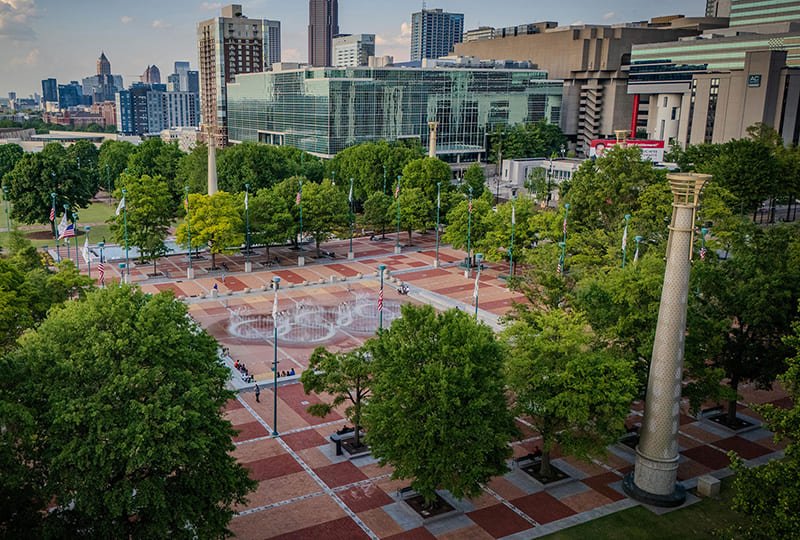
Between Atlanta’s biggest indoor attractions is a public park where children can follow Olympic ring patterns across the pavement, watch a fountain dance to music and stretch their legs. Centennial Olympic Park is free to enter, but the Fountain of Rings follows scheduled shows and may pause for events or maintenance. A short visit is often enough, especially with young children.
The lawns, Olympic landmarks, paths and public Fountain of Rings viewing are free. Food, parking and nearby attractions are separate.
What is free and what costs extra →A short loop, some monument spotting and time near the fountain fit a compact visit. Add time if children want to stay for a show.
Toddlers and younger school-age children enjoy moving between landmarks and watching the jets. Older kids may enjoy the Olympic stories.
A flexible free stop with paved paths, but intense weather, fountain noise, paid parking and changing event access add effort.
Read the complete family score →Follow Olympic rings, discover city landmarks and watch water move
A city park can be more interesting when children have something to search for. At Centennial Olympic Park, that can begin with five interlocking Olympic rings. The Fountain of Rings sets sprays of water into patterns shaped around that familiar symbol. During scheduled performances, jets rise high above the pavement while music and, in evening shows, colored lighting change the effect. It is a zero-depth interactive fountain, not a swimming pool. Children may be drawn to the water, but families should obey whatever access and safety signs are posted, since viewing a show and running through the jets are not always the same activity. A toddler may be happiest simply watching the water from a safe dry spot. For older children, guessing which ring will spray next turns the wait into a small game.
Walk beyond the fountain and the park becomes a miniature introduction to Atlanta’s Olympic legacy. The giant Olympic rings sculpture called The Spectacular is an easy photo stop. Other features require closer attention: the Quilt of Nations recognizes countries that took part in the Games, the Quilt of Olympic Spirit honors athletes, and the Paralympic Legacy monument introduces another part of the story. Look for the engraved bricks that helped support construction of the park. Children who are learning to read may enjoy spotting names and patterns; school-age visitors can ask why a city preserves memories of a sporting event long after the crowds have gone home. The Quilt of Remembrance marks a difficult chapter of the park’s history, so parents can decide how much to explain based on their child’s age.
There is room for a slow lap rather than a fixed route. The park’s open lawns, planted areas, sculptures and water gardens offer changing views of downtown, and the paved walkways make it straightforward to turn back when someone gets tired. It is not a playground filled with climbing equipment; the attraction is the fountain, the outdoor setting and the chance to pause between busier museum visits. Families often pair it with Georgia Aquarium or World of Coca-Cola because those destinations are nearby. The key to a smooth visit is not assuming the jets operate continuously. Check the current park calendar and fountain notice, then treat any water play as a welcome possibility rather than a promise.
There is more to do in Atlanta than the attractions around the park. Compare indoor museums, playgrounds and free family stops in our guide to Atlanta with kids.
Who enjoys a fountain stop, and who may want more?
Infant
Babies can accompany caregivers on the paved routes and watch movement and light at a comfortable distance. Sun, noise and feeding needs will set the pace.
Toddler
Toddlers may delight in the fountains, bright shapes and short walks. Keep them within reach near water and select a dry observation spot when jets are active.
Little Kids
Children ages 4-6 can look for the Olympic rings and follow the water patterns, with time to move through the park instead of sitting still.
Big Kids
Big Kids can connect the Olympic monuments with sports stories and enjoy a music-and-water show. A short landmark hunt makes this more than a photo stop.
Tweens
Tweens who like city history or architecture may enjoy the artwork and inscriptions, although the park alone is unlikely to fill a long afternoon.
Teen
Teens may appreciate the Olympic and Paralympic markers, skyline photographs and a pause between other downtown attractions rather than a dedicated day here.
Family Friction: the easy stop with a few moving parts
This score estimates how much planning a family needs for arrival, waits, weather, walking, stroller access, care facilities, noise and flexibility. It measures practical demands, not the historical significance of the park.
A free entrance and freedom to leave after just twenty minutes make Centennial Olympic Park easier to fit into a family day than a timed museum. Wide outdoor walking areas also help families manage a stroller and an energetic toddler. The friction comes from downtown traffic, event-related changes and a fountain whose show times do not necessarily match a child’s schedule. Hot sun or heavy rain can quickly shorten the stop. Parents who check the calendar and do not make water play the whole point of the visit can keep the day flexible.
| Factor | Score | Why |
|---|---|---|
| Parking & Arrival | 3/5 | There is no free dedicated park visitor lot. GWCCA recommends nearby paid Green Deck and Red Deck, and downtown traffic or event arrivals can complicate the approach. |
| Queue & Wait Time | 1/5 | Normal park entry does not require tickets or a line, although crowds can gather near the Fountain of Rings before scheduled performances. |
| Heat & Weather Exposure | 4/5 | The park, fountain plaza and most landmarks are outdoors. Sun, heavy rain or lightning can interrupt an otherwise short visit. |
| Walking Distance & Terrain | 1/5 | The roughly 22-acre park has paved promenades and can be explored in a small self-chosen loop without completing the entire site. |
| Stroller & Mobility Access | 1/5 | Main plazas and paths are paved; GWCCA states its campus facilities are ADA compliant. Fountain wet surfaces and event closures still require care. |
| Restroom & Baby-Care Access | 2/5 | Public restrooms are identified in destination information, but a specific changing station or dedicated nursing room at the park is not established. |
| Sensory & Crowd Load | 1/5 | Families can move away from a loud fountain show into other park areas, though music and event crowds may increase stimulation. |
| Schedule Flexibility | 0/5 | General entry is free and self-paced with no required tour time. Fountain show timing matters only if the family chooses to attend it. |
| Scored total | 13/40 | Low Friction |
Easy paths through the park, with extra care beside the fountain
A stroller is practical for a short loop across the park’s paved public paths. The more demanding moments are crossing downtown streets, navigating event crowds and keeping children away from wet pavement at the Fountain of Rings. Accessibility of the path is not the same as a safe place for a child to play in water.
The park has interconnected paved promenades and open plazas, so there is no reason to push through its entire footprint. Start near the fountain or a monument that interests your child, then circle back before heat or tired legs take over.
The fountain is a zero-depth surface with active jets, music and nearby spectators. Keep a stroller on dry, permitted routes and supervise children on foot; surfaces around an interactive water feature may be slick after spray.
The park borders active city streets and busy attractions. Use marked crossings and curb ramps, and give yourself room to turn the stroller in areas where foot traffic builds around a show or event.
Most of the experience is open to the elements. A canopy and drinking water may help on sunny days, but a stroller cover is not a safe alternative to leaving exposed plazas during lightning or strong storms.
Is Centennial Olympic Park free, and when does the fountain run?
The park and its usual outdoor landmarks are free. Fountain viewing and public interactive access are free when the water feature operates. Nearby rides, paid events, food and parking require their own budgets.
| Activity or service | Cost | What to know |
|---|---|---|
| Regular park entry | Free | Public lawns, paved paths and monuments during park hours. |
| Fountain of Rings viewing | Free | Scheduled performances; access may change because of maintenance, events or weather. |
| Interactive fountain access | Free when operating | Follow posted water-play and safety restrictions; jets are not continuous. |
| Visitor Information Center | Free | Public visitor information during its shorter daytime schedule. |
| Nearby SkyView Ferris wheel | Separate ticket | Operated separately; not part of the free park visit. |
| GWCCA parking decks | Paid, variable | Green Deck and Red Deck are recommended options; event rates can differ. |
| Food or drinks | Varies | Purchases at nearby businesses are not included. |
| Special festivals or ticketed events | Varies | Some events may restrict public access or require tickets. |
A family of two adults and two children can walk through the park and watch the Fountain of Rings for $0 in admission. Parking, transportation, snacks, separately ticketed festivals and nearby attractions can increase the cost.
When are the park and Fountain of Rings open?
- GWCCA lists daily park hours as 7:00 a.m.-11:00 p.m., although special events can change public access.
- The Visitor Information Center is generally open 9:00 a.m.-4:00 p.m.
- Published Fountain of Rings shows are at noon, 2:30 p.m., 6:30 p.m. and 9:00 p.m.
- Water feature operation may change for events, weather or maintenance. Confirm before planning splash play.
Those times refer to the scheduled choreographed water-and-music performances, not a promise that children can play in continuous jets at every hour. The public park may remain open even when the fountain is not running. If a fountain show is central to your plans, consult the latest GWCCA calendar and on-site notices before making a special trip.
Five ways to visit without turning it into a long downtown detour
A free park can still take effort in the middle of a busy sightseeing day. These small choices keep the fountain fun without making it the family’s entire schedule.
- Check the fountain schedule first.Shows are listed at noon, 2:30 p.m., 6:30 p.m. and 9:00 p.m. Operations can change with maintenance or events.
- Bring a change of clothes only if water play is possible.Do not promise the jets will be on or open for interaction. A dry outfit and towel are useful when signs allow children to play.
- Turn Olympic landmarks into a small treasure hunt.Look for the large rings sculpture, monuments and engraved bricks. Two or three discoveries are enough for younger children.
- Choose your parking deck before arriving.The Green Deck is a useful first option, with Red Deck as another GWCCA facility. Large events affect rates, road access and spaces.
- Keep the weather plan flexible.This is a fully outdoor stop. Shorten the walk in strong sun and leave the fountain area when storms approach.
Centennial Olympic Park: what families actually need to know
From the park’s Olympic story to its urban setting, these answers help families understand what the stop offers beyond a quick fountain photo.
What is Centennial Olympic Park, and why is it important to Atlanta?
Centennial Olympic Park was created as a central gathering place for the Olympic Games hosted by Atlanta. After the competitions, the grounds remained a public green space and became an anchor for the surrounding downtown attractions. Its monuments are not merely decorative: the Olympic rings, Quilt Plazas and Paralympic tribute explain how the city remembers the athletes, participating nations and people who helped bring the Games to Atlanta. Families can explore this history in small pieces without a museum ticket or guided tour. Younger children may simply recognize the rings and enjoy the fountain, while older students can think about why cities preserve places associated with major international events. The park also includes a memorial related to a tragic incident during the Games. Parents who want to discuss that history can introduce it calmly and at an age-appropriate level. A walk here combines public space with the layers of history that made downtown Atlanta what it is today.
How big is Centennial Olympic Park, and how much walking should families expect?
The park is generally described as approximately 22 acres, with open lawns, walkways, fountains, gardens and monuments occupying several downtown blocks. That figure does not mean children need to cross every corner of the grounds. Families arriving from the aquarium or World of Coca-Cola can choose a short loop around the Fountain of Rings and one or two Olympic markers, then leave when everyone is ready. For toddlers or children who tire easily, a compact visit is often more enjoyable than a complete landmark circuit. Paths are paved in the main public spaces, but there are still city crossings and variations in sun exposure to consider around the park. Parents with school-age children can extend the walk to examine engraved bricks and memorials. Build the outing around your child’s attention span, and save the remaining monuments for another downtown visit rather than trying to check them all off at once.
Is Centennial Olympic Park safe for a family visit?
Centennial Olympic Park is an actively managed public destination in central Atlanta. The Georgia World Congress Center Authority publishes visitor rules, public-safety contact information and restrictions intended to protect guests and the grounds. That does not guarantee that a busy urban park will be free of every risk. Families should use ordinary city precautions: keep young children in sight, use designated street crossings, secure personal belongings and be attentive when crowds gather for concerts or a fountain performance. Water is a separate concern. The Fountain of Rings is a zero-depth feature with moving jets, not a guarded swimming pool, so children need direct adult supervision and should follow posted play rules. An event can also change which parts of the park are open to visitors. Parents concerned about the atmosphere can choose a daytime visit, check the event calendar and contact GWCCA Public Safety if they need current guidance. No responsible visitor guide can promise that any location is completely safe at all times.
What is the Fountain of Rings, and can children run through it?
The Fountain of Rings is an interactive, zero-depth water feature built around the five interlocking Olympic rings. Its choreographed shows combine jets, music and, after dark, lighting to create changing patterns on the plaza. The operator describes it as an interactive fountain, which distinguishes it from a purely decorative pool; however, that does not mean water play is available whenever the park is open. The jets follow an operating schedule, maintenance or weather can interrupt the feature, and staff may limit access around specific performances or special events. Look at signs on arrival before encouraging a child to enter the spray zone. For families with toddlers, standing back to watch can be as enjoyable as getting wet, with less need for a wardrobe change. If children are permitted to play, bring a towel, dry clothes and shoes suitable for wet pavement. Keep an adult close even though there is no deep pool.
Why are there quilt-themed sculptures and engraved bricks around the park?
The park’s Quilt Plazas use a design idea borrowed from traditional patchwork: many pieces coming together to make a larger whole. Different plazas highlight the Olympic athletes, participating countries, the origins of the Games and the local effort to host them. Some monuments also preserve difficult memories, including the Quilt of Remembrance. The engraved commemorative bricks offer another way to read the landscape, with names and messages linked to supporters and the park’s creation. Children can search for repeating shapes, compare sculptures or find a name they recognize, while older visitors can consider what a city chooses to memorialize and why. This makes the grounds more meaningful than a generic green lawn. Parents do not need to give a history lecture at every monument. Pick one plaza, explain its central idea in a sentence or two, and let children look closely before moving on.
Are there other things to do immediately around Centennial Olympic Park?
Yes. The park occupies a convenient position among several major downtown attractions, including Georgia Aquarium, World of Coca-Cola, the National Center for Civil and Human Rights and the College Football Hall of Fame. SkyView Atlanta, a large Ferris wheel, is also nearby. These places operate independently, so the park’s free entry does not grant access to their galleries, rides, exhibits or programs. That separation can help a family plan an affordable day. For example, children may need fresh air after a long indoor museum visit, and the fountain and lawns provide a change of pace without purchasing another ticket. Conversely, an unexpected shower may be a reason to leave the outdoor park and choose a separately ticketed indoor attraction if time and budget allow. Check each destination’s schedule rather than assuming it matches the park’s long opening hours. A short walk in the park works especially well as the flexible part of a downtown itinerary.