Georgia Aquarium with Kids: Family Tips
The scale hits before the first exhibit: Georgia Aquarium fills a downtown Atlanta block with enormous underwater habitats, a walk-through tunnel and marine animals that rarely appear together elsewhere. Families can watch whale sharks glide past a vast window, pause for penguins and sea otters, and choose whether to fit a dolphin or sea lion presentation into the day. The best visit follows the children’s curiosity rather than every item on the map.
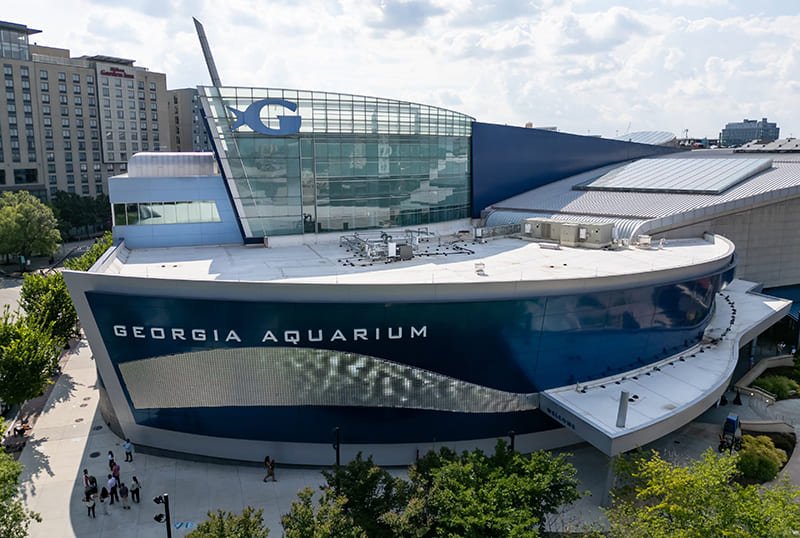
Fixed-date admission starts at $54.99 for ages 3+. Children ages 0-2 enter free; prices vary with the selected visit date.
Compare admission options →The aquarium itself suggests about 3-4 hours. Families stopping frequently for viewing windows, food or presentations can spend longer.
Toddlers love giant moving fish; elementary-age children can explore different habitats, while teens often enjoy conservation and marine biology.
The exhibits are indoors, but high admission costs, crowded galleries and same-day presentation reservations add planning pressure.
See the full Family Friction score →The Ocean Voyager window changes the pace of a family visit
At Ocean Voyager, children can stand in front of a window so wide that a whale shark seems to move across an entire wall. Manta rays turn overhead; schools of fish shift direction as a group. The underwater tunnel makes the scene feel different again, with animals swimming to the sides and above. It is a good place to let a child stay longer than planned. A toddler might simply point at the shapes passing by, while an older child can try to identify which animals are sharks, rays or large fish. The habitat holds more than six million gallons of water, and its transparent tunnel stretches 100 feet. Those dimensions explain the unusual sense of space without requiring children to memorize a single number.
The contrast between galleries is a large part of the appeal. Cold Water Quest brings penguins, sea otters and cold-water life into view. In Tropical Diver, bright reef habitats encourage a slower look at fish hiding among corals. Sharks! Predators of the Deep focuses attention on animals that children may have encountered only in pictures; River Scout shows freshwater environments with a completely different character. At Explorer’s Cove, families can check the day’s hands-on opportunities and animal talks. Not every child wants a structured program, and that is fine. Moving between big tanks and smaller discoveries works better than trying to turn each gallery into a lesson.
Dolphin and sea lion presentations provide a seated change of pace, but they require complimentary same-day reservations and can fill. Families with preschoolers might concentrate on three galleries and one presentation instead of racing around the whole building. Older children may enjoy asking why whale sharks filter-feed, how rays swim or what aquarium research can tell scientists about animals in the wild. This is a substantial indoor attraction with many reasons to linger, although its crowds and ticket price make it worth planning before arrival.
There is more to Atlanta than its largest aquarium. Find parks, hands-on museums and shorter outings for another part of your day in our Atlanta with kids guide.
Which ages get the most out of the tanks, tunnels and talks?
Infant
A baby may enjoy watching light and slow-moving fish while resting in an appropriately sized stroller or carrier. Keep expectations modest: noise, bright spaces and feeding schedules matter more than collecting galleries.
Toddler
The huge Ocean Voyager window can hold a toddler’s attention longer than a small exhibit label ever could. Choose short gallery visits, allow time to point and watch, and leave before a noisy presentation becomes too much.
Little Kids
Penguins, rays, moving fish and changing habitats give preschoolers plenty to recognize and compare. Follow their questions, but make the day flexible around snacks and rest instead of pushing a full-route checklist.
Big Kids
A strong age for watching whale sharks, using exhibit clues and joining animal talks. Children who can wait for a presentation or follow a few questions about marine habitats will get more from a longer visit.
Tweens
Tweens can connect the giant habitats to conservation, animal behavior and food webs. They may appreciate contrasting freshwater ecosystems with shark and coral galleries and hearing keepers explain daily care.
Teen
Marine biology fans may enjoy the research angle and the unusually large Ocean Voyager habitat. Teens who dislike crowds or animal captivity may have a very different reaction, so discuss those topics before choosing the outing.
Family Friction: impressive habitats, busy corridors and timed seating
KidWaypoint scores eight practical pressures from 0 to 5, where a higher number means more effort for a family. The rating measures visit logistics, not the quality of animal care or the value of the collection.
An attached parking garage, indoor galleries and care facilities simplify the day once a family is inside. The pressure points are elsewhere: paid arrival, queues at popular tanks, presentation reservations and the noise of a major attraction. Compact strollers are permitted, but their dimensions are restricted, and navigating a crowd with one can be tiring. Families who choose a few priority galleries and keep an eye on energy levels tend to have the most manageable visit.
| Factor | Score | Why |
|---|---|---|
| Parking & Arrival | 2/5 | The aquarium has an attached cashless garage at 357 Luckie Street, with marked directions to the entrance. Parking costs extra, and entrance traffic can build on busy days. |
| Queue & Wait Time | 3/5 | Timed arrival helps organize admission, but popular viewing windows and limited-capacity shows can still create waits. Day-of reservations are needed for dolphin and sea lion seating. |
| Heat & Weather Exposure | 0/5 | Animal galleries and presentations are indoors and climate-controlled. The short covered approach from the parking garage does not make weather a major part of the visit. |
| Walking Distance & Terrain | 2/5 | There is a great deal to see across multiple galleries, so a full visit requires sustained indoor walking and standing. The family can shorten the route without needing to complete every room. |
| Stroller & Mobility Access | 3/5 | Permitted strollers must be at most 29 inches wide and 52 inches long. Wagons, wagon strollers, jogging strollers, push cars and ride-ons are excluded except for relevant medical or sensory exemptions. |
| Restroom & Baby-Care Access | 1/5 | Public restrooms, a private nursing and pumping room on the second floor, and a first-aid station provide useful care options during a long visit. |
| Sensory & Crowd Load | 4/5 | Large viewing areas can become crowded, and presentations combine amplified sound, movement and excited audiences. Families seeking a calmer experience should plan pauses away from dense gathering points. |
| Schedule Flexibility | 3/5 | Families can browse the galleries at their own pace and obtain a hand stamp for re-entry, but the chosen arrival window and same-day presentation reservations put fixed points in the schedule. |
| Scored total | 18/40 | Medium Friction |
A stroller helps on a long day, but its size matters
Georgia Aquarium allows qualifying compact strollers, yet expressly recommends leaving them at home when possible to reduce congestion. Families who need one should measure it before traveling and plan for busy viewing spaces, presentations and caregiver breaks.
The museum limits ordinary strollers to 29 inches (72 cm) wide and 52 inches (132 cm) long. Check the overall size of your stroller as used, rather than assuming that anything described as a travel stroller will pass. The rule applies to the stroller itself, not just the seat width.
Wagons, wagon strollers, push cars, jogging strollers and ride-on vehicles are not allowed under the general policy. There is an exception for specialty strollers or wagons needed for medical or sensory reasons. Contact the aquarium in advance if your family requires this accommodation rather than assuming it will be obvious at the entrance.
Long stretches of indoor walking make a compact stroller useful for a tired child, but the aquarium cautions that strollers can increase congestion. In Ocean Voyager, stop away from a tightly packed window until there is room, then let your child look without blocking the entire viewing edge. A carrier is another option for families who prefer not to maneuver a stroller.
The aquarium lists a private nursing and pumping room on the second floor, restrooms throughout the visitor route and first aid between Ocean Voyager and Tropical Diver. If you need a changing station, ask staff which nearby restroom has a suitable facility rather than counting on an unverified location. Keep snacks within the published exceptions for small children and allergies.
How much are tickets to Georgia Aquarium, and what is included?
Admission is date-sensitive. A fixed-date ticket is usually cheaper than an Anytime ticket, but visitors ages 3 and up pay. Ordinary general admission includes available galleries plus general seating at dolphin and sea lion presentations when complimentary same-day reservations can be secured. Parking, meals and encounters are additional.
Official Georgia Aquarium tickets and selected-date prices →
| Ticket or rental | Price |
|---|---|
| Fixed-date admission, ages 3+ | From $54.99 |
| Higher-demand fixed-date admission, ages 3+ | Example dates $57.99 |
| Anytime single-visit admission, ages 3+ | $69.99 |
| Children ages 0-2 | Free |
| Dolphin and sea lion presentations, general seating | Included with same-day reservation |
| Georgia Aquarium parking voucher | $30 |
| Georgia Aquarium + World of Coca-Cola combo | Advertised $79.99 |
| Animal encounters and premium experiences | Extra; varies |
Family cost example: two adults and two paying children age 3 or older cost at least $219.96 before taxes, fees, parking, food or extras at the $54.99 starting fare. Prices can rise for popular dates. A parking voucher would add $30 to that example.
What time does Georgia Aquarium close? Check the day, not a fixed weekly rule
- Georgia Aquarium is open daily, but closing time changes with the operating calendar.
- The aquarium ends admission approximately 30 minutes before the posted closing time.
- Timed-entry ticket holders should enter within one hour of their selected arrival time.
- Dolphin and sea lion presentation times differ by day; book complimentary seating on the day of the visit.
For planning, reserve about 3-4 hours rather than choosing an entry time close to closing. The official visitor calendar is the reliable source for the closing time on your chosen day, particularly around weekends, special events and holiday periods. The galleries can be visited at your own pace once admitted, but the presentation schedule is separate.
Six ways to protect your family’s time and energy
Choose what matters most before the first gallery. Trying to fit every aquarium talk, presentation and add-on into one visit is usually more exhausting than skipping a few.
- Start with one large habitat.Give Ocean Voyager enough time for the children to notice different animals rather than walking through the tunnel as quickly as possible.
- Reserve presentations early.Dolphin and sea lion seating is included, but the complimentary reservation must be made on the visit day and availability is limited.
- Leave the wagon at home.Ordinary wagons and jogging strollers do not meet the visitor policy. Measure an accepted stroller before choosing how to travel.
- Make a real food plan.Outside meals are generally restricted, with exceptions for small child snacks and allergy needs. Check the food policy and budget for the onsite café.
- Remember the re-entry hand stamp.If someone needs a break outside, ask Guest Relations for the stamp before leaving; a prepaid parking pass itself does not include vehicle re-entry.
- Protect the quiet minutes.Large gallery windows, darker spaces and busy presentation theaters can affect children differently. Alternate intense exhibits with calmer moments when you can.
Georgia Aquarium questions worth asking before buying tickets
Tickets, animal care, timing and practical decisions families often wonder about when planning a first visit.
Where is Georgia Aquarium, and what is nearby?
Georgia Aquarium is at 225 Baker Street NW in downtown Atlanta, opposite the northern side of Centennial Olympic Park. The location makes it possible to pair a visit with a short stop around the park or nearby downtown attractions, but the aquarium is substantial enough to fill most of a family outing on its own. If your family is driving, do not use the pedestrian street address as the parking destination. The garage has a separate address on Luckie Street. The surrounding district is busy with visitors and events, so allow time to cross streets carefully and organize everyone before joining the entry line. Families staying downtown may prefer to walk rather than pay for parking. The main consideration is how much energy the children will have left afterward, especially if you are combining the aquarium with another paid attraction.
How big is Georgia Aquarium, and why are the whale sharks a highlight?
Georgia Aquarium is among the world’s largest aquariums, with more than 11 million gallons of water across its exhibits. Ocean Voyager alone contains more than 6.3 million gallons, an underwater tunnel stretching roughly 100 feet and a giant viewing panel. Whale sharks are the largest living fish, but they eat small prey by filtering water rather than hunting people or large marine mammals. Seeing one beside a manta ray makes it easy for children to compare their movements and body shapes. The scale is impressive, yet visitors should avoid expecting every animal to be visible at a particular moment. Like any living habitat, the view changes as the animals swim. For children learning about marine science, the questions prompted by that window can be more memorable than the numerical size of the building.
Is Georgia Aquarium ethical? What should families consider about animal welfare?
There is a genuine debate about keeping large marine animals in captivity, especially species that travel great distances in the wild. Georgia Aquarium points to its veterinary care, research, education and conservation programs, including field studies of whale sharks and accreditation from animal-care organizations. Critics of captive marine-mammal and whale-shark exhibits question whether even very large tanks can replicate natural movement, choice and social conditions. Accreditation and research are meaningful information, but they do not automatically resolve the broader ethical question for every family. Parents can read the aquarium’s animal-care and conservation materials alongside independent welfare perspectives, then decide whether attendance fits their values. With older children, this can become a thoughtful conversation: what do aquariums teach us, what can they contribute to conservation, and what kinds of needs are hardest to meet in a managed environment?
Can you visit Georgia Aquarium without attending the dolphin or sea lion presentations?
Yes. The animal galleries are the main attraction, and a family can spend its entire visit moving among habitats without booking a presentation. Presentations are optional, even though general seating is included with admission when space is available. This can be a sensible choice for children who are sensitive to amplified sound, need a flexible nap or snack schedule, or simply prefer watching animals at the windows. It also frees you from trying to reach a theater at a fixed time. If a child becomes curious about a specific species, look for gallery talks and educational signage instead. Those may create an opportunity to learn without committing the whole family to a longer seated program. Plan around the animal habitats you most want to see rather than judging the outing by how many scheduled experiences it contains.
Can families leave for a break and come back later the same day?
General-admission guests may leave and return during their visit if they obtain a hand stamp from Guest Relations before exiting. That distinction matters for families with young children, because a break can make a long indoor visit more manageable. It does not mean you should assume every part of your day can be restarted: limited presentation seating is tied to its own reservations, and the aquarium can still be busy when you return. Parking rules are also separate. A prepaid parking voucher is valid for a single vehicle entry and does not let you drive out and come back on the same voucher. For a simple break, families should decide whether they can remain nearby on foot or whether finishing the museum visit first makes more sense. Ask staff about the hand-stamp procedure before leaving rather than returning to an entrance without it.
Are there food restrictions and somewhere to store bags?
Georgia Aquarium generally does not allow outside food or beverages, but its visitor policy makes exceptions for small snacks for children and visitors with food allergies. Refillable bottles are useful because water-bottle filling stations are provided. Families with a baby or a child on a restricted diet should review the policy before packing an entire lunch, rather than assuming every container will be admitted. The aquarium also has food available for purchase, which can add significantly to the cost of a longer family visit. For bags, self-service lockers are available in Explorer’s Cove, with rentals starting at $8 per day and sizes up to carry-on capacity. Lockers do not replace the need to keep essentials accessible while moving between galleries. If the family needs a break for feeding or a change of clothes, make that stop deliberately rather than searching for supplies in a crowded corridor.