Historic Cable Car Ride with Kids in San Francisco
A San Francisco cable car is not a theme-park ride: it is a working piece of the city’s public transportation system, pulled uphill by machinery beneath the street. Families can hear the bell, watch the grip operator and ride through hilly neighborhoods on the Powell-Hyde or California Street line. The view is memorable, but open sides, boarding steps and folded-stroller rules make choosing seats and planning the ride especially important with small children.
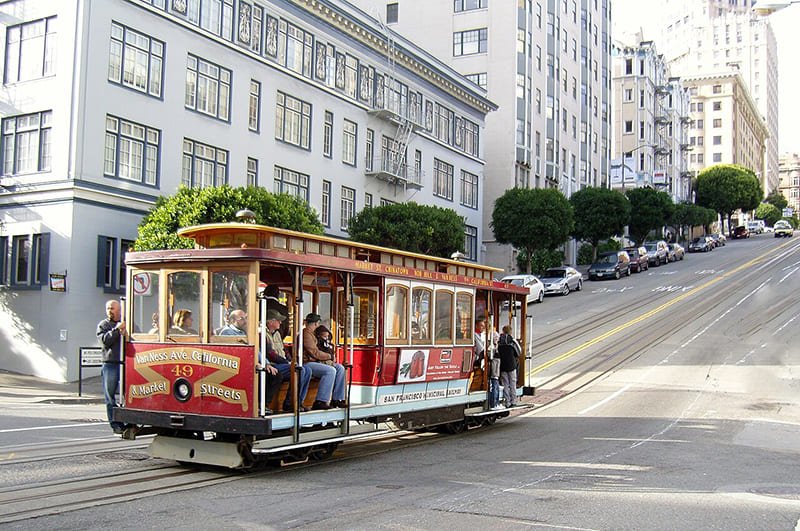
Children ages 4 and under ride free. A separate one-way ticket is needed for each paying passenger on each ride; an eligible Visitor Passport covers multiple rides.
See fares and pass options →The vehicle trip depends on line and traffic. Terminal queues can add substantial time; reserve more than the ride itself if your children need seats together.
Preschoolers and older children enjoy the hills, bells and moving street scenery. Babies can ride, but boarding with a folded stroller is awkward.
Terminal lines, street-level boarding, weather exposure and the need to collapse a stroller make a short ride require more preparation than a conventional bus.
Review the eight planning factors →Two historic cable car streets, two ways to see San Francisco
The sound usually arrives before the car does: a bell in traffic, followed by the rumble of wheels on rails and the distinctive clatter of an old-fashioned vehicle. Instead of relying on an onboard engine, San Francisco's cable cars grip a continuously moving cable under the pavement. Children can watch the grip operator work a large lever and the conductor manage passengers and stops. This is genuine public transit, not a closed sightseeing train, so the experience changes with the street. Riders pass storefronts, intersections and residential buildings while the tracks climb and dip across some of the city's steepest slopes. Families with younger children should choose an interior seat whenever possible; the exterior running boards are visually exciting, but they require close attention to footing and handholds and are not an appropriate place to assume a small child can stand safely. The best part for many children is simply noticing how the car keeps moving uphill where an ordinary bicycle would struggle.
For dramatic hills and a waterfront finish, the Powell-Hyde line travels between Powell and Market Streets downtown and Hyde and Beach Streets near Fisherman's Wharf. It runs through Nob Hill and Russian Hill, with distinctive steep sections and views toward the bay as the car approaches the northern terminus. A family can incorporate the ride into a visit around the waterfront rather than paying to go straight back. The nearby manual turntable is another interesting detail: at the Powell terminals, workers physically turn the single-ended cable car to reverse its direction. The California Street line offers a different mood. It travels east-west along California Street between the Embarcadero side of downtown and Van Ness Avenue, crossing the city's financial district and Nob Hill. That route makes a useful choice for families who primarily want the historic movement and hill-climbing sensation, without building a long waterfront itinerary around the ride. It does not continue to Fisherman's Wharf, and the lines should not be treated as interchangeable.
A first ride works best as one carefully chosen segment, not an attempt to collect every route. Children can compare the cable car with an ordinary Muni bus or historic electric streetcar, notice the narrow tracks and listen for the conductor's calls. Because some seats are exposed to wind and light rain, bring an extra layer even when the sidewalks feel warm. There is no attraction-style admission gate or guaranteed reserved seat: riders board as space allows, and a crowded vehicle may not keep a whole family in the same row. An adult should supervise children at the curb until the car stops completely and wait for the crew's signal before stepping aboard. The $9 single fare covers one direction and does not transfer between cable car lines. Families planning additional rides should compare a Visitor Passport against separate tickets; for everyone else, riding once and exploring the destination on foot is often a more relaxed introduction to this unusual part of the city.
Turn one cable car ride into a broader family day. Find nearby parks, museums and neighborhood routes in our San Francisco with kids guide, then choose where the cable car fits rather than crossing the city just to repeat it.
Which ages enjoy the bells and hills, and who needs extra help?
Infant
A baby can ride with an adult, and the fare is free, but the stroller must be folded before boarding. The steps and limited space can make a brief outing harder than it looks. Keep the baby securely held and plan an easy stop afterward.
Toddler
Toddlers may love the bell and moving scenery but need hands-on assistance at the curb and steps. Plan an inside seat and avoid promising a standing spot on an exterior running board.
Little Kids
A strong fit for curious preschoolers who notice how the car climbs, stops and rings its bell. Explain the difference between a seat inside and the open outside area, and keep an adult beside them throughout the ride.
Big Kids
Children in this range can follow the route on a map, compare the hills with ordinary streets and watch the grip and brake work. A single journey has enough action to feel distinctive without being a lengthy activity.
Tweens
Tweens may appreciate the vehicle mechanics, old wooden details and changing neighborhood views. They can help decide whether the scenic Powell-Hyde route or the California Street crossing better fits the rest of the day.
Teen
Teens interested in engineering, transit history or photography may enjoy the rare cable-operated system. They should still follow the crew instructions about standing, holding on and keeping phones put away when boarding or exiting.
Family Friction: the difficult part is getting aboard, not the ride length
The KidWaypoint score considers the real effort for a family: locating a stop, waiting, exposure to weather, boarding steps, stroller handling, nearby facilities, crowding and how easily plans can change.
The actual trip is manageable for most school-age children, but terminal queues and boarding can consume more attention than the short ride suggests. Families with strollers must fold them and take the child out before stepping aboard, while the high steps and open sides make supervision essential. Exposure to wind and rain depends on where the family sits. Choosing a short line segment, purchasing fares in advance and traveling without a bulky stroller can reduce the friction, although a particular vehicle cannot guarantee an empty row.
| Factor | Score | Why |
|---|---|---|
| Parking & Arrival | 3/5 | The cars operate on downtown streets without a dedicated attraction parking lot. Paid garages may be available in the surrounding areas, and terminal locations are reached on foot through busy intersections. |
| Queue & Wait Time | 3/5 | Popular turntables can have substantial waiting lines, and vehicles have limited space. Stops away from the terminal may reduce the queue but may not have seats available. |
| Heat & Weather Exposure | 3/5 | Open-sided seating and uncovered boarding areas expose passengers to wind and rain. Interior seats offer more shelter, but a family may not be able to choose one on a busy car. |
| Walking Distance & Terrain | 2/5 | The ride itself avoids walking the hills, but reaching a street stop can require steep sidewalks and safe crossing of busy streets. Families should choose a starting point they can reach comfortably. |
| Stroller & Mobility Access | 4/5 | SFMTA requires strollers to be collapsed and children removed before boarding. Steps are high, interiors are narrow and cable cars have no accessible wheelchair boarding. |
| Restroom & Baby-Care Access | 1/5 | There are no restrooms or baby-care spaces aboard a short transit vehicle. Families should use nearby public facilities before queueing; this is a limited trip rather than an extended venue visit. |
| Sensory & Crowd Load | 1/5 | Bells, street noise, jostling, close seating and packed queues can be intense, but the short duration and choice of a less busy route offer some ways to manage exposure. |
| Schedule Flexibility | 1/5 | Service operates on published daily routes and families can choose when to attempt boarding. There is no timed reservation, although queues and service disruptions can delay a planned ride. |
| Scored total | 18/40 | Medium Friction |
A folded stroller is allowed, but it cannot carry a child aboard
SFMTA explicitly permits collapsible or foldable strollers on cable cars only when they are completely folded and the child is removed before boarding. This rule is different from many other Muni vehicles, where a stroller may stay open if space and safety requirements allow. The historic car has several steps, limited standing room and no accessible boarding. A family with a toddler, stroller and bags should plan who holds the child and who carries the folded frame before joining a line.
Move away from the boarding edge and fold the stroller while waiting, not in the doorway when passengers are stepping off. Remove the child first and secure the frame so it cannot unfold. A compact, lightweight stroller is much easier to lift up the car steps than a travel system or heavy double stroller. SFMTA says collapsible strollers are allowed; it does not guarantee that every bulky configuration can be accommodated when the car is full. Keep your child beside you, away from the road and tracks, while preparing to board.
With two adults, one can concentrate on holding or guiding the child while the other carries the folded stroller and tickets. A solo caregiver should keep belongings minimal and avoid trying to manage a large folded frame, shopping bags and a toddler simultaneously on a steep street. Ask the conductor where to position the stroller so it stays out of the aisle and other passengers can move. Once on board, keep the child seated or securely supported according to the crew instructions. Do not count on spare space near the doorway or a special stroller compartment.
SFMTA states cable cars are not equipped with accessible boarding. There is no lift or ramp for a wheelchair or an occupied stroller, and the historic steps cannot be bypassed with an onboard device. Caregivers who need a step-free option should choose a suitable Muni bus or accessible rail connection instead; those vehicles follow different stroller and mobility boarding rules. Families should not assume the visually similar vintage streetcars have identical accessibility features either. Check the exact service and stop if mobility access will decide your route.
The vehicle has no restroom, changing table or feeding room, and a waiting line can delay access to neighborhood facilities. Feed and change a baby before approaching a busy terminal when possible. San Francisco hills may also make the walk from a garage, hotel or nearby attraction difficult with a stroller, even though the cable car itself saves climbing. At the destination, move completely away from the roadway before unfolding the stroller. Wait for the car to stop, follow the conductor’s directions and keep a free hand for steps and child support.
Historic cable car fares, operating hours and where to park
A single cable car ticket buys one one-way ride without a transfer to another cable car. Children four and younger ride free, but most visiting children five and older pay the $9 fare. Visitor Passports can be better value for families who plan multiple rides in the same day. Cable cars are public transit, so there is no separate museum admission or reserved seat.
| Ticket or rental | Price |
|---|---|
| Cable car one-way fare, age 5+ | $9 |
| Children age 4 and under | Free |
| Senior / disability / Medicare fare before 7 am or after 9 pm | $4 |
| One-day Visitor Passport, unlimited eligible Muni rides | $15 |
| Three-day Visitor Passport, unlimited eligible Muni rides | $35 |
| Seven-day Visitor Passport, unlimited eligible Muni rides | $47 |
| Qualifying San Francisco youth with Free Muni for Youth Clipper card | Free |
| Downtown garage or meter parking | Varies |
Fare example: Two adults and two children ages 7 and 10 pay $36 for one one-way cable car ride, or $72 for a round trip using separate single fares. A family expecting multiple rides can compare that with the official one-day Visitor Passport. The pass applies to eligible Muni services, not BART. Parking and any other attractions are separate costs.
Cable car service hours and ticket-buying rules
- Powell-Hyde generally runs daily from 7 am to 11 pm, subject to changes and live service alerts.
- California Street cable cars generally run daily from 7 am to 9 pm, subject to service changes.
- At Powell & Market, Bay & Taylor and Hyde & Beach terminals, pay before boarding from 8 am to 5 pm.
- SFMTA supports MuniMobile, Clipper and approved ticket sellers. At other stops or outside terminal kiosk hours, exact-cash payment to the operator may apply.
A journey on the California Street route or the Powell-Hyde route is usually short enough to fit into part of a family sightseeing day, but do not treat a timetable as a guarantee of how long you will wait. Queue length, vehicle capacity, street conditions and temporary stop relocations can change the plan. Before heading out, check the line-specific SFMTA page for current stops and status. Visitors who want the classic turnaround can allow time to watch the crew turn cars at a Powell terminal.
The best cable car ride begins with the stop, not the camera
Choose a line that works with your next destination and arrange the boarding details before the vehicle arrives. A little planning protects the fun from becoming a line-and-luggage problem.
- Choose the destination first.Powell-Hyde links downtown with the waterfront. California Street crosses Nob Hill and the Financial District but does not go to Fisherman’s Wharf.
- Let the children watch a turntable.At Powell line terminals, workers manually rotate the cable car to send it back the other way. Watch from a safe designated pedestrian area.
- Prepay before a busy terminal.SFMTA requires advance payment at the listed main terminals during kiosk hours. Having fares ready keeps the family together in the boarding line.
- Fold the stroller ahead of time.The child must be out of it before boarding. Decide who will carry the stroller and who will support the child on the steps.
- Select an interior seat for little riders.Exterior views are tempting, but the open running boards demand balance and careful holding. Let the crew determine safe positions and supervise young children closely.
- Dress for the weather, not the postcard.Even a sunny ride can feel cool on an exposed side of the car. A jacket and a plan for rain are useful; there is no weatherproof terminal waiting room guaranteed.
Questions families ask before climbing aboard a historic cable car
Details about the famous streets, how the cars actually move, safe family seating, tickets and which route fits a downtown visit.
What is a historic cable car in San Francisco, and is it a real form of transportation?
San Francisco's cable cars are working public transit vehicles, not replicas created solely for tourists. Their distinctive movement comes from a cable running beneath the street, which a grip operator attaches to or releases with a mechanical device. The cars themselves do not use a conventional engine to propel them uphill. Passengers travel on real city streets alongside ordinary traffic, and the operators follow public transportation rules. That is why your family needs a valid fare, may wait for the next car when one is full and cannot reserve a particular bench as if this were a sightseeing attraction. The system began as a solution to the city's demanding hills, and the historic cars have survived into modern service. Children who enjoy machines may notice the large controls, the bell and the difference between the open and enclosed parts of the car. A short ride can be a useful introduction to local history without requiring a museum visit or a lengthy guided explanation.
Which San Francisco street has the famous historic cable cars?
Several streets host cable cars, which is why the address can be confusing when a visitor searches for one famous stop. Powell Street at Market Street is the best-known downtown departure point for the Powell lines. The Powell-Hyde route then uses parts of Powell, Washington, Jackson and Hyde Streets as it heads toward the waterfront. Its destination is near Hyde and Beach Streets, close to Fisherman's Wharf. California Street has a separate historic line that runs between the Embarcadero side of downtown and Van Ness Avenue. It crosses Nob Hill and the Financial District without serving the Fisherman's Wharf terminal. If you are seeking the classic cable car turntable, head to a Powell line terminal rather than assuming every stop turns the car around. A quick check of the official route map is worthwhile because the line and its direction determine which hills and neighborhoods you will actually see. Temporary stop moves may also affect the exact boarding point.
Where can families board a historic cable car in downtown San Francisco?
For many tourists, Powell and Market Streets is the simplest downtown starting point because it is close to a major transit corridor and a busy shopping area. You will see the cable car tracks and the turntable used by the Powell services. The California line's eastern end is near California and Drumm Streets, and it has stops across the downtown Financial District. Families do not have to board only at the terminal: regular intermediate stops exist along the routes, and these can be convenient when your hotel or planned activity is uphill. However, a passing car may have limited room for a group or a folded stroller, so an intermediate boarding point does not guarantee an easier trip. Stand at a designated stop, wait clear of the rails and traffic, and follow the operator's instructions. Make sure your family is waiting for the correct line, since a car that looks similar may not travel toward your intended destination. Current stop and service information is published by SFMTA.
Are the Powell-Hyde and California Street cable cars the same experience?
Both routes use the same historic cable-driven principle, but they fit different sightseeing plans. Powell-Hyde offers the recognizable journey from downtown over steep neighborhoods to the north waterfront. It is a natural choice when your next stop is near Fisherman's Wharf, and the changing slopes and water views often create a more dramatic visual journey. The California Street cable car travels east-west across the Financial District and over Nob Hill toward Van Ness Avenue. It can be easier to incorporate when your family is already exploring downtown or does not need to finish by the bay. Both routes have steps, open-sided seating and the same stroller rule. Neither guarantees a quiet vehicle or a seat with the best view. If a young child would struggle with a long terminal line, the shorter route that matches your actual itinerary may be the more sensible choice, even if the postcard view is less famous.
Can a family ride a cable car more than once on the same ticket?
A standard $9 cable car ticket is valid for one one-way ride, not a round trip or a transfer between cable car lines. Leaving one car and boarding another normally means paying for another ride unless you have a pass that covers it. Children age four and younger travel without a fare, but ordinary visiting children age five and older generally pay the full cable car ticket price. A one-day Visitor Passport provides unlimited eligible Muni rides including cable cars during its validity, and multi-day passports are available too. For a family of four with two fare-paying children, two single rides each can quickly cost more than a pass, although a pass is not necessarily useful if the plan contains just one cable car ride. Compare how many actual cable car or Muni journeys your family expects, not just the number of stops on a sightseeing list. Local youth Clipper concessions have eligibility conditions and should not be assumed to apply to visiting children.
Is an open-sided San Francisco cable car safe for young children?
Cable cars operate with established crew and passenger safety rules, but parents still need to make sensible choices about seats and boarding. The vehicles travel through ordinary downtown intersections and up steep grades; some passengers sit in open sections or stand on exterior running boards while holding on. With a toddler or preschooler, choose an interior seat when possible rather than planning on an exposed standing position. Follow the grip operator and conductor's directions about where children may sit, stand or move, and do not lean outside for photographs. Wait until the vehicle has completely stopped before boarding or exiting, and check for street traffic when you step off. A folded stroller must be carried, not rolled aboard with the child inside. Strong wind, rain or a full car can make an otherwise pleasant short trip uncomfortable, so it is reasonable to let a crowded car pass and try a later one if your timetable allows.