New York Transit Museum with Kids - Brooklyn, New York
At the New York Transit Museum, children can step into subway cars their great-grandparents might have ridden, sit beneath old advertisements and explore a real 1930s station. The vintage train platform is the star, but steep entrance stairs, limited stroller access and a current air-conditioning outage deserve careful planning.
General admission is $15 for adults and $10 for visitors ages 2-17; children under two are not listed in the paid child bracket. Book a timed slot ahead.
Compare admission and extras →Allow about 90 minutes for a relaxed look at the trains, or two to three hours for kids who want to inspect every car and interactive exhibit.
Preschoolers love exploring parked carriages; school-age children can connect the vehicles with engineering, design and New York history.
Affordable tickets and indoor exhibits help, but two flights of stairs, limited stroller access and no current climate control add substantial effort.
See the full Family Friction score →Ride through a century of New York without leaving the platform
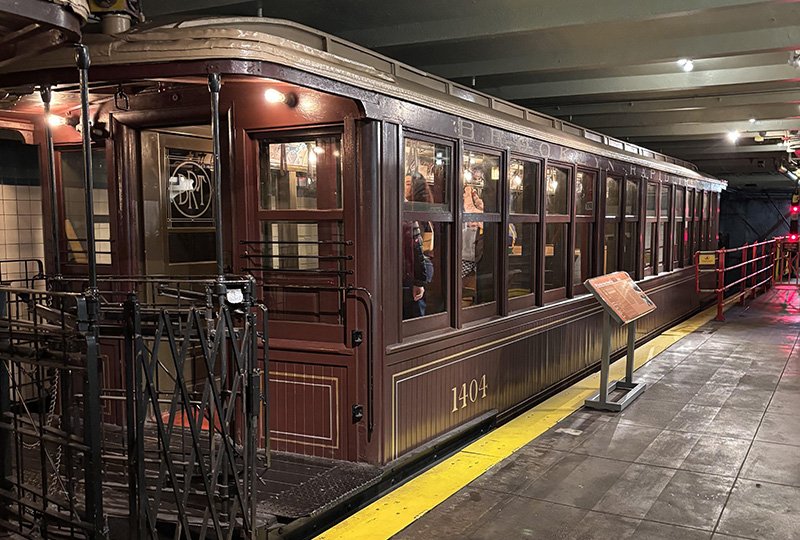
The most memorable part of the New York Transit Museum begins when families descend into Court Street, a real decommissioned subway station in Downtown Brooklyn. Down on the platform, children discover a block-long collection of historic subway and elevated cars, with examples dating to 1907. Many cars are open for visitors to step inside. Unlike a normal subway ride, nobody has to hurry through a closing door: children can compare old seats, handles, route signs and advertisements at their own pace. One car may have varnished details and woven seats; another feels surprisingly close to the trains parents use today. This turns the history of transportation into something children can touch and investigate rather than simply read about.
Upstairs, the experience expands beyond old carriages. Moving the Millions traces how New York kept growing through new train designs and changing routes, while Steel, Stone & Backbone explains the extraordinary work of building tunnels beneath a busy city. Ticket to Ride invites visitors to consider how fares were collected, from older equipment to later systems. Children fascinated by levers, turnstiles, signals and maps can connect familiar subway rituals with the people and inventions behind them. The museum also displays buses, trolleys and carefully made models, giving younger visitors recognizable objects to find even before they can understand the full timeline.
The setting itself offers a rare kind of imaginative play. A preschooler can pretend to be a conductor announcing stops; a seven-year-old can hunt for differences between two eras of train design; an older child can ask why certain materials, signs or seating layouts changed. Periodic family workshops bring extra hands-on activities, although these require separate registration and sometimes an additional fee. Crucially, the museum is not a ride on moving vintage trains: its regular exhibits are stationary. Special Nostalgia Rides are separately scheduled experiences, not part of ordinary admission. That distinction prevents disappointment, while leaving plenty to enjoy inside the old station.
Trade Manhattan landmarks for a journey underneath Brooklyn. The Transit Museum makes a lively counterpoint to skyscrapers, parks and famous viewpoints. Find more age-specific ideas and practical itineraries in our guide to New York City with kids.
A conductor fantasy for preschoolers, a design puzzle for older kids
Infant
An infant can accompany a caregiver, but the station stairs, absence of stroller lift access and underground temperatures make the visit inconvenient with babies.
Toddler
Toddlers who love trains will enjoy looking inside stationary subway cars and pretending to ride. Plan a short visit, hold hands near platform edges and be ready to carry a small stroller.
Little Kids
A particularly rewarding age: children can sit in old train cars, compare interiors and imagine being the driver or conductor. Short, playful investigations work better than lengthy historical explanations.
Big Kids
Excellent for curious school-age visitors. Give them a mission: find the oldest-looking carriage, compare fares and signs, or identify how train designs changed.
Tweens
Tweens interested in technology, design or New York history can explore construction, signaling and the engineering problems behind a huge transit network.
Teen
Teens with a specific interest in transit, urban history, architecture or photography may enjoy the details, but it is not a teen-focused interactive amusement attraction.
Family Friction: the hidden effort of visiting a real subway station
KidWaypoint’s eight-part framework compares practical family demands - arrival, lines, weather, distance, mobility, care facilities, sensory load and schedule freedom - so families can assess the effort of a visit, not simply its ticket price.
The Transit Museum is manageable for many families because admission is modest, reservations control crowding and the collection is concentrated in a compact two-level site. The largest hurdles are physical: the public entrance descends two flights of stairs, strollers cannot use the accessibility lift and some historic train interiors involve steps. The temporary loss of air conditioning makes heat a concern even on a rainy day. Plan food breaks outside before entering because there is no re-entry.
| Factor | Score | Why |
|---|---|---|
| Parking & Arrival | 3/5 | The Brooklyn museum is close to Borough Hall, Jay Street-MetroTech and Hoyt-Schermerhorn subway stations. Street parking is difficult to predict and private garage prices vary; the ordinary entry also requires two flights of stairs. |
| Queue & Wait Time | 1/5 | Timed tickets help regulate arrivals. Only limited tickets are sold on site, so reserve ahead and arrive near your slot; entry is allowed during the 30-minute window starting at the booked time. |
| Heat & Weather Exposure | 3/5 | The exhibits are indoors and protected from rain, but the current A/C outage leaves the museum without climate control, including historic train platforms that were already uncooled. |
| Walking Distance & Terrain | 2/5 | The platform spans a city block, and the museum occupies two levels. Families can shorten the tour, but platform edges, train steps and the main staircase call for attention. |
| Stroller & Mobility Access | 4/5 | There is no conventional elevator; the staff-operated wheelchair lift has a 450-pound total limit and does not allow strollers. Heavy strollers must be carried on the stairs; some vintage cars are not wheelchair-accessible. |
| Restroom & Baby-Care Access | N/A | Restroom facilities are available for visitors, but specific diaper-changing and private feeding amenities are not confirmed in the reviewed visitor guidance. |
| Sensory & Crowd Load | 2/5 | The underground environment may feel enclosed and lively when families gather inside popular cars. Museum sensory resources and selected adapted programs may help visitors who need a different pace. |
| Schedule Flexibility | 2/5 | The museum opens Wednesday through Sunday, 10 a.m.-4 p.m.; tickets are timed, nonrefundable and cannot be used for re-entry. Workshops require their own registration. |
| Scored total | 17/35 | Medium Friction |
Two flights down: plan the entrance before packing a stroller
The ordinary entrance is a stairway into an old station. A separate staff-operated wheelchair lift provides mobility access but cannot carry strollers, so traveling light makes a substantial difference.
The entrance at 99 Schermerhorn Street leads down two flights; carrying a heavy stroller while supervising young children can be difficult.
The accessible lift at Court and Schermerhorn is for eligible visitors with mobility needs, not stroller transport. An unattended stroller parking area is available inside.
Arrange lift assistance in advance when possible. The lift is slow, has a 450-pound total capacity and some historic carriage interiors remain inaccessible.
There is no bag or coat check. Consider a light carrier for toddlers and keep essentials manageable, especially when visiting with more than one child.
New York Transit Museum tickets, opening hours and the cost of getting to Brooklyn
Timed Brooklyn admission is budget-friendly compared with many New York museums, but a ticket is not the same as a ride on a historic train. Allow extra for local transport, garages and separately booked programs.
| Activity or service | Cost | What to know |
|---|---|---|
| Adult admission (18+) | $15 | Book a timed museum entry. |
| Children ages 2-17 | $10 | Regular admission to the Brooklyn museum. |
| Children younger than 2 | No listed charge | The paid child category begins at age two; confirm ticket allocation when booking. |
| Seniors 62+ | $10 | Age-based rate. |
| Visitors with disabilities | $10 | Individual rate; separate policy for groups of five or more. |
| Museum members | Free | Advance timed reservation is still encouraged. |
| MTA employees | Free | Official booking instructions include an employee code. |
| Family workshops | Varies | Special programs may require a separate reservation and fee. |
| Museum Highlights tour | Included when offered | Usually about one hour on selected weekends; space and dates can vary. |
| Nearby garage parking | Varies | No museum-specific parking rate is advertised; transit is generally simpler. |
Family cost example: Two adults and two children ages 2-17 pay $50 for regular museum admission ($15 + $15 + $10 + $10). Local subway fares, food purchased after leaving, parking and optional workshops are additional.
When does the Brooklyn Transit Museum open, and how do timed tickets work?
- Open Wednesday-Sunday, 10:00 a.m.-4:00 p.m.; closed Monday and Tuesday.
- Also closed on selected holidays including Juneteenth, Thanksgiving, Christmas and New Year’s Day.
- Online tickets are released about three weeks ahead; arrive no more than five minutes before your time.
- Entry is permitted within 30 minutes of your reserved time; re-entry after exit is not allowed.
- Ticket purchases are nonrefundable; contact the museum at least 24 hours ahead to request a transfer, subject to capacity.
Book the Brooklyn museum, not the separate free gallery at Grand Central Terminal. Their locations, hours and admission arrangements are different.
Small decisions that make an underground museum visit easier
The museum is approachable with children when you plan around the building’s historic quirks rather than treating it like a modern play center.
- Book for the day you actually want.Timed tickets are strongly recommended; no re-entry, limited walk-up stock and nonrefundable tickets make improvising risky.
- Start with the vintage train platform.Many kids will remember exploring old subway carriages more vividly than reading every upstairs caption.
- Leave bulky strollers at home.There is no passenger elevator and strollers cannot use the accessibility lift. A lightweight carrier may be more practical.
- Dress for an uncooled underground station.An ongoing A/C outage means indoor protection from rain does not translate into reliable air conditioning.
- Feed children before entering.Eating is prohibited inside, and you cannot step outside for lunch and return on the same ticket.
- Make a scavenger hunt of the details.Challenge children to find different seat materials, fare equipment, route maps and old advertisements.
New York Transit Museum: tickets, old trains and family logistics
Detailed answers about Brooklyn location, visit length, admission, hours, strollers and what children actually get to explore.
Where is the New York Transit Museum?
The New York Transit Museum is at 99 Schermerhorn Street in Downtown Brooklyn, inside the former Court Street subway station. Its main public entrance descends two flights of stairs from street level. For wheelchair access, go to the corner of Court and Schermerhorn Streets and use the call button for staff assistance with the lift. Nearby subway stations include Borough Hall, Jay Street-MetroTech and Hoyt-Schermerhorn, each roughly 0.2 mile away by the museum’s own travel guidance. Do not confuse the paid Brooklyn museum with the smaller, free Transit Museum Gallery & Store in Grand Central Terminal in Manhattan: they are separate sites with different exhibits and hours.
How long does it take to visit the New York Transit Museum with kids?
Allow roughly 90 minutes to two and a half hours for most family visits. Children who mainly want to enter and compare vintage trains may be happy in about an hour, while curious school-age children who read displays, explore the mezzanine galleries and investigate details along the platform can easily spend longer. The platform itself extends across an entire city block, so there is plenty to see without needing to rush. If a special workshop or museum tour is part of your plans, add its published duration. Because eating is not permitted inside and tickets do not allow re-entry, schedule lunch before or after the museum rather than planning a meal break halfway through.
How much are New York Transit Museum tickets, and do children get in free?
Regular admission to the Brooklyn museum is $15 for adults, $10 for children ages 2-17 and $10 for seniors ages 62 and older. Visitors with disabilities have a $10 individual rate, museum members enter free, and MTA employees have a separate complimentary admission process. The paid child bracket starts at age two; families with infants should follow the booking page’s instructions for under-two visitors. For a family of two adults and two paying children, ordinary museum admission totals $50 before transport or optional programs. Timed tickets are strongly recommended because only a limited number are sold onsite. Tickets are generally nonrefundable, and standard admission does not include separately ticketed vintage-train excursions.
What are the New York Transit Museum hours, and should we reserve tickets?
The museum in Brooklyn currently opens Wednesday through Sunday from 10 a.m. to 4 p.m. It closes on Mondays and Tuesdays and also on certain holidays, including Thanksgiving, Christmas and New Year’s Day. Timed admission slots typically become available online around three weeks before the visit date. The museum asks visitors not to arrive more than five minutes before their reserved time and allows admission during the 30-minute window beginning with that slot. Buy ahead for weekends and school holidays because walk-up capacity is limited. Check the official visit page just before traveling, especially when planning around a special program or public holiday.
Can you bring a stroller into the New York Transit Museum?
A stroller creates more complications here than at most conventional indoor museums. The historic entrance is down two flights of stairs, the building has no regular elevator and strollers are specifically prohibited on the wheelchair-accessibility lift. Parents who bring a stroller must be prepared to carry it downstairs; large or heavy models are therefore best avoided. The museum provides an unattended stroller parking area toward the back of the building but does not offer a general bag or coat check. A lightweight baby carrier is often simpler for families with a small child. Visitors who need mobility accommodations can contact the museum’s Access team about the staff-operated lift; some of the vintage train cars themselves cannot be entered by wheelchair.
Can families ride the vintage subway trains on display?
During an ordinary museum visit, the historic subway cars are stationary exhibits at the old Court Street platform. Children can step into many of them, sit on period seats, study signs and compare the interiors of different decades, but admission is not a ticket for a moving train ride. The museum occasionally operates separately advertised Nostalgia Rides on the subway system using historic equipment. Those experiences have their own tickets, route, schedules and age rules. If a child dreams of actually traveling aboard an old train, check the museum’s special events calendar instead of assuming the regular Brooklyn visit includes a ride.
Is the New York Transit Museum good for a rainy or very hot day?
It is a reliable way to avoid rain because the collection is inside a former subway station. However, it should not automatically be considered a cool-weather refuge. The museum has announced an air-conditioning outage affecting the rear mezzanine galleries and Education Center, and advises that no areas are currently climate controlled. The vintage platform level has traditionally lacked full climate control as well. Indoor temperatures may be uncomfortable during hot or humid weather. Bring water for use when permitted outside exhibit areas, wear light clothing appropriate to the forecast and check the museum’s latest operating notice before choosing it specifically as an escape from summer heat.
Are there bathrooms, food, and activities for children at the museum?
The museum is designed for family exploration, from old subway cars to fare equipment, maps, signal technology and exhibits about how New York transportation was built. Check the events calendar for special family workshops, accessible programs and occasional guided highlights tours; these are not necessarily included on every day. Visitor restrooms are available, but the published visitor rules do not guarantee a dedicated baby-changing or private nursing room. Eating is not permitted anywhere inside, and there are no public lunch tables. Because same-ticket re-entry is not allowed, plan a meal before or after your visit. Nearby Downtown Brooklyn and the Borough Hall area offer more practical places to take a food break.