The Museum of Flight with Kids: Concorde, Boeing Jets and Spacecraft
A child who has only seen an airplane through an airport window can stand beneath an enormous airliner wing, peer inside a Concorde and compare early flying machines with spacecraft at The Museum of Flight. The campus at Boeing Field has more to explore than one hangar, and some aircraft interiors close earlier than the museum itself. For families, the best visit starts with choosing which machines their children most want to see.
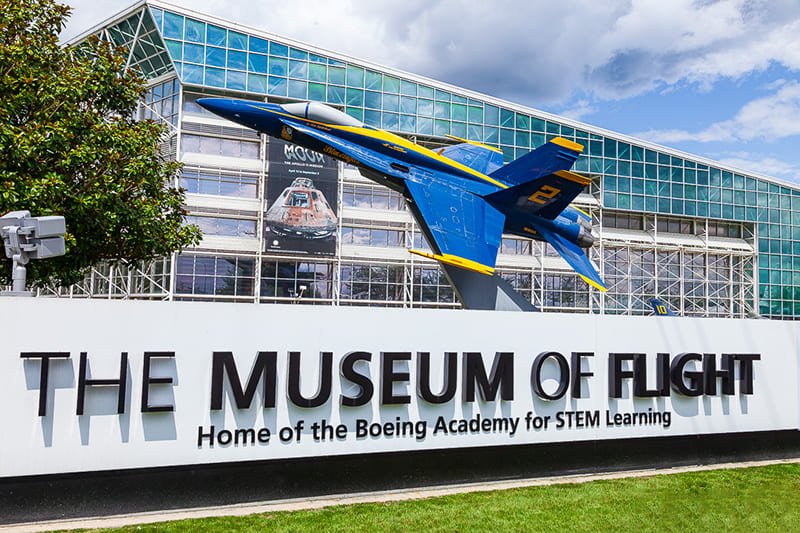
Adult admission is $29, youth 5-17 $21 and seniors $25, including tax. The first Thursday evening of each month is free.
View admission and free evenings →The large campus rewards a selective route. Aircraft interiors, the Red Barn and the Space Gallery can each add time; plan breaks.
Preschoolers can enjoy huge planes and hands-on areas; school-age visitors and teens can appreciate aircraft design and space technology.
Free parking and accessible indoor galleries help, while the outdoor pavilion, extensive walking and aircraft boarding need a little planning.
See the full Family Friction score →An enormous hangar, a supersonic cabin and the people who made flight possible
The scale hits first. Aircraft hang in the bright T.A. Wilson Great Gallery, with wings and landing gear visible from different levels. Children can compare a small early airplane with much larger machines and begin asking useful questions: why do some planes have propellers, how does a wing lift a heavy aircraft, and what must a pilot see from the cockpit? The historic Red Barn, once part of Boeing’s early airplane business, gives that comparison a local Seattle connection. Rather than reading every label, families can invite children to choose one aircraft and look for three things that make it different from the next.
The Aviation Pavilion provides the headline machines. It shelters the supersonic Concorde, an early jet Air Force One, a Boeing 747 and a Boeing 787 Dreamliner, alongside other historic aircraft. When open for boarding, these interiors reveal details that are hard to judge from outside: narrow passages, rows of seats, cabins and the difference between passenger travel in different eras. The pavilion is covered but open to outside air. It is worth reaching early enough to use the aircraft boarding hours, particularly if entering Concorde is a family priority.
The museum also connects airplanes with the wider story of flight. The Personal Courage Wing explores wartime aviation and the people behind it, while the Space Gallery includes a full-scale Space Shuttle Trainer used in astronaut preparation. Children who enjoy doing rather than only looking can use family exploration guides and check the schedule for workshops or demonstrations. Small visitors may be happy watching aircraft through the glass or taking a break near the Kids Flight Zone. The collection is too wide-ranging to absorb in one hurried loop, which makes a focused route more satisfying than ticking off every gallery.
Make room for Seattle beyond the hangars. Boeing Field lies south of the downtown waterfront, so the museum works best as its own substantial outing. For nearby family activities and other plans, explore our guide to Seattle with kids.
Different ages notice different things: size, controls or engineering
Infant
The aircraft and bright galleries offer visual interest, but a baby is here for the family outing rather than the interpretation. A stroller, feeding stops and a shortened indoor route are more useful than trying to board airplanes.
Toddler
Large airplanes are easy to recognize, and looking through the glass at Boeing Field can hold attention. Keep the visit brief and alternate quiet observation with a movement break; exhibits are not a free-play space.
Little Kids
Strong fit for plane-obsessed preschoolers who want to compare wings, wheels and cockpit windows. Family guides and hands-on areas can help between galleries, though any aircraft boarding requires close supervision.
Big Kids
Excellent age for comparing the Concorde with a 747 or 787, imagining the work of pilots and asking how spacecraft training differs from ordinary flying.
Tweens
Tweens can explore propulsion, aviation design and the aircraft collection in more detail. The historic Red Barn and full-scale Space Shuttle Trainer add context beyond recognizable passenger jets.
Teen
A strong destination for teens interested in aerospace engineering, aviation history or careers in flight. Personal Courage Wing also provides material for deeper questions about conflict and technological change.
Family Friction: a generous collection, but not one continuous indoor hall
This KidWaypoint score measures the work of a family visit rather than the quality of the exhibits. Arriving, waiting, staying comfortable, moving through the campus and handling children’s needs all contribute to the total.
Free parking beside the museum removes a common city-visit obstacle, and most galleries have accessible circulation. The main effort comes from the size of the campus: the covered Aviation Pavilion is across the campus from some indoor galleries, and going inside historic planes is different from rolling a stroller past them. Aircraft boarding windows are shorter than general museum hours. Families can make the day easier by deciding which areas matter, using lifts and taking breaks before younger children become overwhelmed.
| Factor | Score | Why |
|---|---|---|
| Parking & Arrival | 1/5 | Museum-operated visitor parking is free on both sides of East Marginal Way S, with accessible spaces. Visitors should choose the lot suited to their first planned gallery. |
| Queue & Wait Time | 2/5 | Regular admission is straightforward, but popular walk-through aircraft and free evening admission may draw groups. No exact queue length is promised. |
| Heat & Weather Exposure | 2/5 | The Great Gallery, Red Barn and Space Gallery are indoor spaces. The covered Aviation Pavilion is open-air, and movement between campus buildings can be exposed to weather. |
| Walking Distance & Terrain | 2/5 | The museum spans several buildings and a large pavilion; exploring every collection requires substantial walking. Visitors can shorten the route and use accessible pathways. |
| Stroller & Mobility Access | 2/5 | Strollers are allowed on museum paths and in public galleries, but steps and narrow interiors inside individual historic aircraft are a separate barrier. |
| Restroom & Baby-Care Access | 1/5 | Accessible restrooms are provided and Visit Seattle lists baby-changing facilities. Parents can ask staff for the closest suitable restroom on their chosen route. |
| Sensory & Crowd Load | 2/5 | Tall hangar spaces, films, groups and close aircraft interiors can be stimulating. Families can alternate busy exhibits with quieter galleries and breaks. |
| Schedule Flexibility | 1/5 | Most museum galleries are self-paced and open during general hours, but boarding aircraft in the Pavilion has an earlier closing time and premium experiences have their own availability. |
| Scored total | 13/40 | Low Friction |
Easy wheels in the galleries, harder access inside the airplanes
The museum permits strollers and offers wheelchair-accessible public galleries. The distinction that matters is between viewing historic aircraft from the floor and climbing into their compact interiors. Families with infants can enjoy a substantial visit without attempting the latter.
The spacious aircraft halls and the regular visitor routes are the practical way to see large collections with a baby. Use elevators and accessible paths rather than assuming all historic buildings or aircraft cabins share the same circulation.
Inside Concorde, Air Force One or other walk-through aircraft, expect steps, narrow aisles and original interior layouts. An adult may need to stay with the stroller while another accompanies a child, if entry conditions allow.
The Aviation Pavilion is covered but exposed to outdoor temperatures. Keep a stroller rain cover or warm layer handy, and consult the campus map for a route that avoids unnecessary backtracking.
The museum is big enough that a quiet pause can make a difference. Locate the closest restrooms and a place to sit before moving to another building; do not count on leaving a stroller or diaper bag unattended.
The Museum of Flight tickets, opening hours and where to park
General admission includes the main collection and Aviation Pavilion during their respective public hours. Prices include tax. Families who want a flight simulator or a special experience should budget separately; free First Thursday evenings have a shorter schedule than a regular day.
| Ticket or rental | Price |
|---|---|
| Adult general admission, ages 18+ | $29 |
| Senior general admission, ages 65+ | $25 |
| Youth general admission, ages 5-17 | $21 |
| Children ages 0-4 | Free |
| Museum members | Free |
| First Thursday evening admission, 5-9 p.m. | Free |
| Return visit within 7 days with receipt, adult - onsite only | $12 |
| Return visit within 7 days with receipt, senior or youth - onsite only | $10 |
| Museum visitor parking | Free |
| Simulators and special experiences | Separate price, if selected |
Family cost example: Two adults and two children ages 5-17 pay $100 in standard admission, including tax. If both children are ages 0-4, the same family pays $58. Parking is free; food and optional simulator activities are additional.
What time does The Museum of Flight open?
- Main museum galleries: daily, 10:00 a.m.-5:00 p.m., except posted closures.
- Aviation Pavilion aircraft access: 11:00 a.m.-4:00 p.m., shorter than the main museum day.
- First Thursday free admission: 5:00-9:00 p.m.; check which walk-through aircraft and special experiences are operating.
- Holiday closures and occasional gallery maintenance appear on the museum calendar.
- Plan to reach a must-see aircraft before its boarding window closes, even if the main doors remain open.
For visitors prioritizing Concorde, the 747 or Air Force One, the afternoon cutoff for aircraft boarding matters more than the general museum closing time. If you start at the Red Barn and spend an hour there, move to the Aviation Pavilion while aircraft access is still available. Check the official schedule for events or adjustments.
See the aircraft interiors first; save the small discoveries for later
A few choices at the start can save an aircraft-loving child from finding the boarding stairs closed after a long museum circuit.
- Start with your must-board aircraft.The Aviation Pavilion’s aircraft access has a shorter public window than the main museum. Visit Concorde or Air Force One early if going inside is a priority.
- Make aircraft comparison a game.Have children compare wing shapes, engines and cabin sizes between a small historic airplane and a jumbo jet. It gives the galleries a purpose without reading every label.
- Use a family exploration guide.Ask about the museum’s Family Gallery Exploration Guides, designed to turn galleries into an activity rather than a continuous stretch of looking.
- Pack a layer for the covered pavilion.Its roof protects aircraft, but it is open to outside air. A jacket can matter even when the indoor glass gallery feels warm.
- Use food breaks in designated spaces.Wings Café, picnic tables and the designated lunch space are better places for snacks than aircraft cabins, where food is prohibited.
- Check the program calendar.Family workshops, films and simulators can change the day’s route. Confirm ages, schedule and any separate charges before making one the centerpiece of a visit.
The Museum of Flight: questions beyond the ticket counter
Answers that help children connect the planes, buildings and space exhibits to the stories behind them.
Where is The Museum of Flight in Seattle, and is it a Boeing factory tour?
The museum is beside Boeing Field at 9404 East Marginal Way South, south of central Seattle. Although the address uses Seattle, the campus lies near the Seattle-Tukwila boundary and is separate from the Boeing factory tour offered farther north in Everett. The Museum of Flight is an independent nonprofit aviation museum with a broad collection from different manufacturers and countries. Families see restored historic aircraft, interpretation of flight history, spacecraft-related exhibits and the former Boeing Red Barn rather than watching a modern commercial airplane move down a production line. The difference matters when booking: the museum visit is designed around exhibits, aircraft and family learning, while an industrial factory tour is a distinct experience with its own rules. Visitors who want to understand Boeing's origins will still find relevant history in the museum, particularly in the Red Barn and major Boeing aircraft displays.
What planes does The Museum of Flight have besides Concorde?
The collection reaches well beyond one famous supersonic aircraft. The Aviation Pavilion features early Boeing jetliners, including examples of the 727, 737 and 747, along with a Boeing 787 Dreamliner and the first jet Air Force One. It also displays historic military aircraft such as a B-17 Flying Fortress, B-29 Superfortress and B-47 Stratojet. Inside the glass Great Gallery, smaller aircraft let visitors compare earlier flying designs with later advances. The Personal Courage Wing focuses on combat aviation and the people who flew or maintained aircraft. Not every airplane is available for internal boarding, and preservation work or operational requirements can change which interiors are accessible. For children, an enjoyable question is not simply how many planes there are, but why some have propellers, some have large jet engines and some are designed to travel faster or farther than others.
What is the Red Barn, and why is it important to Seattle aviation?
The William E. Boeing Red Barn is a historic wooden building associated with the beginnings of Boeing's airplane manufacturing business. Its workshops and displays help visitors imagine an era when aircraft were made from wood, fabric, hand tools and careful craftsmanship. That setting is dramatically different from the giant commercial jets displayed elsewhere on the museum campus. School-age children can compare early manufacturing methods with the engineering, testing and materials required for modern airliners, while older students may find the story useful when learning about Seattle's industrial growth. The building is particularly good for families who enjoy the human side of invention: not only the machine that eventually flew, but also the people who assembled parts, solved practical problems and turned an experimental enterprise into a lasting aviation industry. It offers historical context for the huge Boeing aircraft outside.
Is the Space Shuttle Trainer a real spacecraft that went into orbit?
No. The full-scale Space Shuttle Trainer at The Museum of Flight was used on Earth to help astronauts prepare for shuttle missions; it was not a vehicle launched into space. That makes it an unusually useful exhibit for explaining the work that happened before a crew ever reached the launchpad. Astronauts practiced procedures and learned the layout of equipment so familiar tasks could be completed in a demanding environment. Visitors can study the trainer and spaceflight interpretation in the museum's Space Gallery, while a more intensive crew-compartment experience is a separate program with its own conditions. Children sometimes assume that a spacecraft must have flown to be historically important. Here the opposite lesson is valuable: training hardware was essential to making real missions possible, and a precise replica of a working environment can reveal how thoroughly astronauts prepared.
Are the airplanes still flown, or can visitors touch the historic aircraft?
The major historic aircraft in the museum are preserved as collection objects rather than used for ordinary passenger flights. Many are displayed so visitors can study their design and history from a safe distance, and selected interiors are open to walk through when staffing and preservation conditions allow. The museum's conduct rules specifically prohibit touching collection objects without authorization, even if an aircraft looks sturdy or a child can easily reach its fuselage. These restrictions protect original materials, restored parts and other visitors. Children who enjoy interactive experiences can look for designated hands-on displays, family activities and optional simulators instead. A useful way to explain the rule is that preserved aircraft are evidence of engineering history. They can remain available for future generations only when visitors avoid climbing on wings, pulling controls or touching surfaces unless the exhibit expressly invites it.
What kinds of family learning programs are available?
Beyond static exhibits, the museum offers family gallery exploration guides and a changing calendar of talks, workshops, demonstrations and educational activities. Some programs focus on engineering challenges or the science of flight; others tell stories about pilots, astronauts and the wider history of aviation. Weekend family workshops appear on the public calendar, but the exact topic and participation conditions vary. A child who likes making or experimenting may benefit from choosing one scheduled activity and pairing it with a nearby gallery, rather than expecting every room to be hands-on. Older students can use the aircraft collection to investigate questions about materials, propulsion, navigation and design trade-offs. Parents should check whether a particular event is included with admission or has a separate ticket, and whether its content and age guidance suit their children. Programs can add depth, but they do not need to dominate a successful museum day.