MOPOP with Kids: Music, Games and Sci-Fi in Seattle
MOPOP turns the things children hear, play and watch into a museum visit: try an instrument in Sound Lab, sample independently made games, and inspect costumes and props from fantasy and science-fiction stories. It rewards families with older kids who already have favorite bands, films or games, while the horror gallery can be left out entirely.
Selected-date pricing varies. A reference checkout showed $34.95 regular admission, $26.20 youth ages 5-12 and free entry ages 0-4; verify your chosen visit.
See MOPOP ticket options →Hands-on music and gaming can hold attention longer than display galleries. A focused family visit can be shorter; serious fans may stay all afternoon.
Kids who enjoy making music, gaming or film design get the most from a visit. Younger children can join, but much is aimed beyond preschool age.
Elevators and indoor galleries make movement manageable; Sound Lab noise, darker exhibit spaces and some stroller limits need a plan.
See the full Family Friction score →Play the music, test the games, then step inside the stories
At MOPOP, the museum is most convincing when visitors can do something rather than merely look at it. Sound Lab gives families a chance to pick up electric guitars, experiment with drums and try mixing sounds without needing music lessons beforehand. Its studio pods are designed for hands-on experimenting with instruments, recording tools and audio effects. A child who has never touched a guitar can discover how an amplified note changes; a teen who already plays may spend much longer exploring sounds. The museum sits within Seattle Center, beside the Space Needle, but its focus is popular culture rather than the city skyline.
Indie Game Revolution changes the pace. Its playable selections spotlight independent game makers, letting children consider why a game is fun, how its rules work and what designers do differently from familiar big-budget titles. Fantasy: Worlds of Myth and Magic displays objects such as a Cowardly Lion costume and props associated with The Lord of the Rings. Infinite Worlds of Science Fiction explores how filmmakers imagine future technology and unfamiliar worlds. These collections are much more engaging if each family member picks a favorite object and explains what they notice in its design.
MOPOP does not promise every famous artifact will always be on display. Objects rotate, and temporary exhibitions come and go, so check the current lineup if a particular fandom is the reason for visiting. The museum also has Scared to Death: The Thrill of Horror Film, which is deliberately unsettling and optional. For a family with an enthusiastic eight-year-old and a younger sibling, a good route might begin with Sound Lab, include the game stations and one fantasy gallery, then stop before fatigue sets in. Older children can spend more time comparing film props, music history and the choices creators make when inventing characters.
Keep exploring Seattle together. MOPOP fits naturally into a Seattle Center day, with indoor exhibits here and more family outings nearby. Find age-based ideas and neighborhood logistics in the Seattle with kids guide.
When music, games and film worlds begin to make sense by age
Infant
Babies can accompany a caregiver through accessible public galleries, but the loud music stations, changing light levels and long exhibit route are not designed for infant engagement. Plan shorter visits and use the family facilities when needed.
Toddler
A toddler may enjoy bright visual installations or watching a parent make a sound. Still, the main interactive stations are intended for more independent visitors, and a short stop is more realistic than a complete museum tour.
Little Kids
Some six-year-olds will enjoy watching instruments and recognizing fantasy characters, especially with an older sibling. Many displays demand reading, sustained attention or game controls that younger children may not find satisfying.
Big Kids
A strong starting age for the playful parts: kids can experiment in Sound Lab, compare indie games and notice how film props create imaginary worlds. Skip darker galleries until you know a child will enjoy them.
Tweens
Excellent for children with strong interests in gaming, music or movie-making. Let them select an interactive station and give enough time to test several creative approaches rather than rushing through each room.
Teen
Teens who follow bands, design games or care about film genres can engage with deeper cultural stories behind the displays. A more self-directed visit often works better than a fixed adult-led checklist.
Family Friction: where MOPOP can slow a family down
A warm, accessible museum does not always mean a low-effort visit. At MOPOP, the biggest variables are volume, dark gallery environments, the length of the visit and restrictions on larger strollers.
The museum has six elevators, accessible entrances and family restrooms, so negotiating the building is generally less difficult than getting to and through the busy Seattle Center district. Noise is a different matter: Sound Lab is meant to be heard, while the horror exhibition is intentionally unsettling and some galleries use reduced lighting. Families can avoid those galleries and leave for a break using same-day re-entry. A compact stroller and a realistic two- or three-hour plan reduce much of the effort.
| Factor | Score | Why |
|---|---|---|
| Parking & Arrival | 2/5 | The 5th Avenue North Garage is close, but parking is paid and Seattle Center can be busy around events; monorail and transit provide alternatives. |
| Queue & Wait Time | 2/5 | Entry uses ticketing and a security screening point. Popular interactive stations can attract waits, although no fixed line length can responsibly be promised. |
| Heat & Weather Exposure | 0/5 | The exhibitions and the route between museum floors are indoors; only the trip from transit or parking exposes visitors to Seattle weather. |
| Walking Distance & Terrain | 1/5 | Multiple galleries cover a large building, but families can shorten the visit and use elevators instead of stairs. |
| Stroller & Mobility Access | 3/5 | Single strollers must be narrower than 30 inches; certain galleries accept umbrella strollers only, and tandem strollers or wagons are prohibited. |
| Restroom & Baby-Care Access | 1/5 | Family/all-gender restrooms are available, and the museum states that every restroom includes a changing table. |
| Sensory & Crowd Load | 4/5 | Sound Lab contains instruments and amplified sound; dark fantasy and horror presentations can be uncomfortable for sound- or scare-sensitive children. |
| Schedule Flexibility | 2/5 | The museum is self-paced and permits same-day re-entry with the ticket, but admission pricing and timed choices require advance attention. |
| Scored total | 15/40 | Medium Friction |
Which stroller works at MOPOP, and where can families take a break?
MOPOP is accessible across multiple levels, but its stroller policy is more restrictive than its wheelchair policy. Measure the stroller before you go and consider a compact umbrella model if you want to move through more exhibit rooms without parking it.
Single strollers under 30 inches wide are permitted. Wide singles may fail the limit, and tandem/double strollers, multi-child models and wagons cannot enter. A lightweight umbrella stroller gives the most flexibility across galleries.
Six elevators connect the building levels. Every entrance has an electric door opener, although individual exhibit doors do not; the main West Entrance is opposite the Seattle Center Plaza Playground. Ask Guest Services for the easiest step-free route if your approach is unclear.
Certain exhibition spaces admit umbrella strollers only. Stroller parking is available around the museum, but it is not the same as personal supervision or secure luggage storage. Take valuables and essential baby supplies with you when stepping away.
A stroller makes the long gallery route manageable, yet Sound Lab can be loud and exhibit lighting varies considerably. Parents can turn away from an overwhelming space, use a quieter part of the building, or leave and return the same day with a ticket.
MOPOP tickets, opening hours and Seattle Center parking
General admission is priced by selected visit date. The example rates below are a useful planning baseline rather than a promise for every day; Washington resident tickets have a separate qualifying discount. Admission covers the museum’s regular exhibitions, while special events may be priced differently.
| Ticket or service | Price | Important condition |
|---|---|---|
| Regular admission, reference rate | $34.95 | Final price depends on date; booking shows the current amount. |
| Senior 65+ / student with ID, reference rate | $31.45 | Bring qualifying identification. |
| Military with ID, reference rate | $27.95 | Eligibility and selected-date pricing apply. |
| Youth ages 5-12, reference rate | $26.20 | Rates for older youth follow the chosen ticket category. |
| Children ages 0-4 | Free | Include the child in the booking as directed. |
| Washington resident admission | 15% discount | State ID required; select the WA Resident ticket. |
| Seattle CityPASS option | Package pricing | Reserve your MOPOP visit through CityPASS after purchasing. |
| 5th Avenue North Garage | Paid, variable | Parking is separate from museum admission. |
Family cost example: At the reference rates, two regular admissions and two youth ages 5-12 total $122.30 before any transaction charges or discounts. Parking, food and special events are separate; always price the exact visit date first.
What time does MOPOP open, and can families leave and return?
- Standard published opening hours: 10:00 a.m.-5:00 p.m. daily; check the live calendar for closures or special events.
- Plan 2-3 hours for a family visit. Families focused on Sound Lab and games may prefer fewer galleries and more hands-on time.
- MOPOP permits same-day re-entry if visitors retain their receipt or digital ticket.
- Entry is through the West Entrance, opposite Seattle Center Plaza Playground; guests pass through security screening.
The museum’s hours are more predictable than its ticket prices, but schedule changes can occur. If the family wants both MOPOP and an outdoor Seattle Center attraction, using the re-entry rule for a meal or playground break can work better than trying to do everything inside the museum at once.
Give each family member a mission before stepping inside
A museum about fandoms works best when the visit follows genuine interests instead of a rigid gallery order.
- Begin with a sound-making challenge.Ask your child to try one unfamiliar instrument or create a short rhythm in Sound Lab before watching others use the equipment.
- Check the exhibition roster, not old photos.MOPOP rotates objects and temporary displays. A costume or music artifact featured in an old review may no longer be on view.
- Preview the horror area.Scared to Death is optional and designed to be frightening. Families can bypass it without missing the music, fantasy or gaming exhibits.
- Give game stations room to breathe.Indie Game Revolution includes playable titles; choose a few to explore instead of waiting to sample every screen.
- Use sensory support proactively.Exhibition-specific sensory ratings help identify loud or dim spaces; headphones and sensory bags are offered at the West Entrance while supplies last.
- Consider a mid-visit reset.Keep the digital ticket handy for re-entry and use a break at Seattle Center if the group wants food or fresh air.
MOPOP questions for curious kids and their parents
Background, creative questions and visitor details that help families decide whether this museum matches their interests.
What is MOPOP in Seattle, and is it mainly a music museum?
MOPOP stands for Museum of Pop Culture. It began with a strong emphasis on music but now explores a much broader field that includes independent video games, fantasy, science fiction, cinema and the objects that surround fan communities. The collection helps visitors see how songs, movie props and interactive media are designed and why particular ideas become culturally influential. It is not arranged like a conventional art museum, and it is not a place where every object is behind glass. Some galleries invite visitors to experiment, while others ask them to examine an original artifact or think about the story behind a piece of entertainment. For a family, the key is to choose sections that connect to the children’s existing interests rather than assume every gallery will hold their attention equally.
Who designed MOPOP Seattle, and why does the building look so unusual?
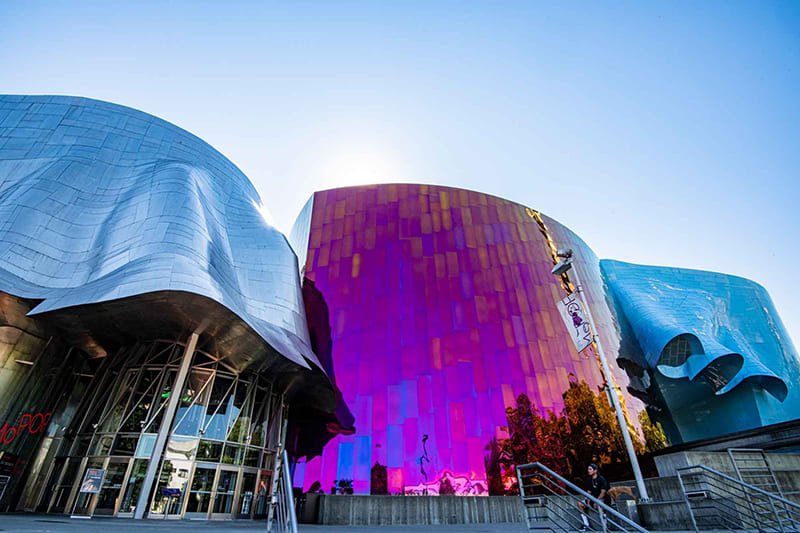
Architect Frank Gehry designed the building with sweeping curves and brightly colored metal surfaces rather than a traditional rectangular museum exterior. MOPOP describes an envelope of thousands of differently shaped metal pieces that respond to changing light. The result can look different from the plaza and from the monorail, even without entering. Gehry used advanced three-dimensional computer modeling to realize the complicated form. The unusual architecture makes a good observation activity for older children: ask what shapes they see, whether the walls suggest music or motion, and why a museum about creative expression might choose an unconventional building. Exterior photographs are possible as part of a Seattle Center walk, and seeing the building itself does not require an admission ticket.
Is the music at MOPOP performed live, or can visitors make it themselves?
Sound Lab is an interactive gallery, not a promise of a scheduled concert. Visitors can work with real instruments, recording tools and digital music ideas, while a set of acoustically isolated studio pods allows different visitors to experiment. Children can try simple beats, hear how mixing changes a song and recognize the difference between playing something and producing a recording. No formal music background is required, although younger children may need help understanding a station’s controls. Some museum events feature performances, but those are separate from the ordinary self-guided gallery experience. Parents whose children are worried about making mistakes may find the private-feeling pods easier than a public stage.
How does MOPOP connect video games with art and storytelling?
Indie Game Revolution treats video games as designed experiences instead of only as entertainment. Its rotating playable titles offer examples of how independent creators use visuals, rules, sound and unexpected ideas to build a game. Children can compare two games and ask why one feels funny, difficult, mysterious or relaxing. Older players may notice how a small studio makes choices differently from a major commercial franchise. The gallery makes an especially useful stop for teens interested in drawing, coding, music or game development, because it shows that a game depends on multiple creative disciplines. The selection changes, so a child should not expect a particular favorite title to be available every time.
Can families take photos or record video inside Museum of Pop Culture?
The museum generally allows personal photography in its galleries, but flash, tripods and selfie sticks are prohibited. Special exhibitions may impose additional restrictions, and posted instructions near individual objects take precedence. That is worth explaining to children who want to document every costume or prop. A practical approach is to choose a few meaningful photographs and spend more time discussing the object itself. When taking pictures at interactive stations, avoid blocking another visitor’s turn or recording strangers without permission. Families considering photographs for publication, commercial use or promotional projects should contact the museum about its separate permissions rather than assume ordinary visitor rules cover those uses.
What else is within easy reach of MOPOP for families?
MOPOP sits on the Seattle Center campus near the Space Needle, Seattle Center Monorail station and the Artists at Play playground. That location makes it possible to combine one indoor museum with a short outdoor break without arranging another car journey. The Seattle Center Armory also provides food options, while nearby attractions have their own admission rules and opening times. Families with younger siblings may find this location useful because one adult can prioritize a music or movie exhibition while the other plans a break outside. The monorail offers a simple connection to downtown near Westlake Center, though its fare is separate. A good combined day is usually one substantial paid attraction plus time to wander, rather than trying to fit every Seattle Center venue into one afternoon.