Fremont Troll with Kids: Seattle’s Giant Under-Bridge Sculpture
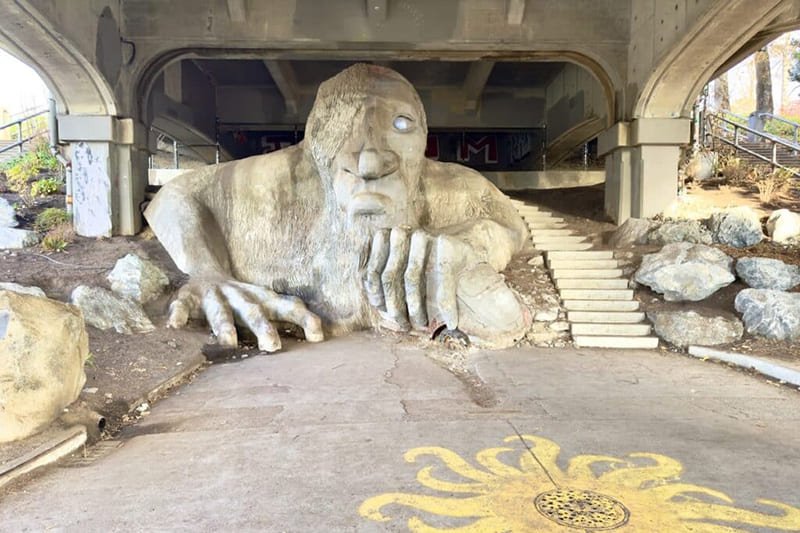
The Fremont Troll is a giant concrete figure hiding beneath the north end of Seattle’s Aurora Bridge, with one enormous hand wrapped around a Volkswagen Beetle. Finding it takes only a short detour through Fremont, but small children often want extra time to study its face, pose beside the car and invent a story about the creature under the bridge.
No admission, reservation or ticket is required to see the Fremont Troll from public space. Photographs are free, too.
Plan a free visit →This is a single outdoor sculpture, not a large attraction. Add time if children enjoy storytelling or a brief stop at adjacent Troll’s Knoll.
The unusual face and car appeal to toddlers and younger school-age children; older kids may enjoy the artwork’s history and photographs.
The stop itself is quick and free, but a sloped approach, uneven surfaces and road noise under the bridge add some effort with little children.
See the full Family Friction score →A concrete giant, a crushed Beetle and one very unlikely Seattle resident
A car appears first. Then children notice that the Volkswagen Beetle is not parked beside the sculpture at all: it is trapped beneath the enormous left hand of a troll. Look higher and the rest of the figure emerges from the shadow of the Aurora Bridge: shaggy concrete hair, a single shiny metal eye and a face with the scale of a storybook monster. The Fremont Troll is not a playground structure or an animatronic creature. It is a large piece of public art in an ordinary neighborhood street, and its odd placement is part of the surprise. For younger children, there is enough to examine without reading a sign or joining a tour.
Seattle artists Steve Badanes, Will Martin, Donna Walter and Ross Whitehead created the sculpture as a community art project. Its setting draws on the old fairy-tale idea that trolls inhabit bridges, while its materials turn that story into something unmistakably urban. The Beetle is a real car, and the troll’s metallic eye was made from a hubcap. Ask children to find both details before revealing them. Older kids may enjoy figuring out how a large sculpture could be constructed in place beneath a busy roadway and why Fremont chose something so eccentric for its public space.
The visit works especially well as a small mystery inside a wider Fremont outing. Start with a photograph from the approach, move closer to see the textures, then invite children to invent a name or a reason the creature is holding a car. Some visitors climb onto the sculpture, but the irregular concrete and sloping ground should never be treated as a certified play surface. Families who want more room to pause can continue just west to Troll’s Knoll Park, which has lawn, planting beds and seating. Fifteen minutes may be plenty for one child; another will spend longer deciding whether this troll is fierce, friendly or merely annoyed by the traffic overhead.
Keep exploring the city beyond the bridge. Pair this little Fremont discovery with waterfront walks, museums and age-friendly attractions in our Seattle with kids travel guide.
A big thrill for small explorers, with different rewards as kids grow
Infant
Babies will not understand the sculpture, but a quick photo stop can work if a caregiver carries them or keeps the stroller on a stable viewing position. Avoid pushing the stroller over the irregular ground at the base.
Toddler
A toddler may spot the car before recognizing the troll and enjoy naming its giant body parts. Hold hands near the uneven concrete, and plan a short visit before attention shifts to the street.
Little Kids
The storybook scale makes this a strong match for imaginative children. Invite them to count the fingers, find the hubcap eye and decide what the creature might say if it woke up.
Big Kids
Kids can connect the troll to public art, Seattle neighborhoods and creative reuse of ordinary objects. They may enjoy a photo challenge featuring the car, bridge and giant hand.
Tweens
Tweens who like unusual landmarks or photography can appreciate the sculpture’s strange design and how it transformed a forgotten under-bridge space. It is best combined with a longer Fremont walk.
Teen
Teens may enjoy the visual oddity, local art history or a quick social photograph, but the single artwork is rarely enough for an outing on its own. Add neighborhood stops if they want more to do.
Family Friction: the tricky part is the ground, not the ticket
KidWaypoint scores practical effort for families rather than artistic value. This brief stop has no admission queue or fixed tour, but its sloping street setting, exposed edges and bridge traffic deserve attention.
The Fremont Troll is simple to visit: no tickets, short viewing time and complete freedom to leave whenever a child has seen enough. The main challenge comes from its location at a sloped street end beneath a busy bridge, where the ground becomes uneven at the sculpture itself. Parents with strollers can enjoy the artwork from a safe spot without moving over the concrete, while children who want to climb need close supervision. Nearby lawn seating at Troll’s Knoll makes a better place to stop for a snack, but no dedicated baby-care facilities are established at the troll.
| Factor | Score | Why |
|---|---|---|
| Parking & Arrival | 1/5 | The sculpture has no designated visitor lot; families generally use legal neighborhood street spaces or other Fremont parking, then walk to the end of Troll Avenue. Availability and signs vary. |
| Queue & Wait Time | 1/5 | There is no admissions line or timed entrance. People may briefly gather for photographs around the face and car, so a clear photo can require patience. |
| Heat & Weather Exposure | 3/5 | The Aurora Bridge provides overhead shade and some protection, but the site is open at the sides and wind-driven rain can reach visitors. Walking to it is outdoors. |
| Walking Distance & Terrain | 2/5 | The artwork itself requires only a short stop, yet the approach is on a hill and the concrete and ground beside it are uneven rather than a level plaza. |
| Stroller & Mobility Access | 2/5 | Families can view the sculpture without climbing, but the sloping approach and irregular surfaces at its base limit comfortable stroller movement. Do not assume climbable areas are accessible. |
| Restroom & Baby-Care Access | N/A | This is an unstaffed outdoor sculpture rather than a visitor building; dedicated toilets, changing tables and feeding rooms at the artwork are not established. |
| Sensory & Crowd Load | 2/5 | Traffic on the bridge above creates persistent noise, and the underpass can feel enclosed. Visitors taking pictures may concentrate in the small area in front of the face. |
| Schedule Flexibility | 0/5 | The public artwork has no tour start, reservation, admission window or required duration. Families can look from the street and leave immediately if needed. |
| Scored total | 11/35 | Low Friction |
The photo is easy; rolling a stroller to the giant hand is less so
Plan to view the troll from firm ground near the approach rather than push a stroller onto the irregular concrete. The sculpture sits at a sloped street end, not inside a step-free museum or maintained playground.
Pause on the approach and look for a stable place to stop with the stroller and keep it out of vehicle access or pedestrian circulation. The giant head and car are visible without climbing onto the figure.
The concrete hand, surrounding surface and slope are part of an artwork, not an accessible play deck. If older children explore closer, one adult should stay with the stroller while another supervises them.
Walking from Fremont’s lower commercial streets may involve an uphill approach. Check your route before setting out, particularly with a heavy stroller, a child who is napping or a caregiver who needs to avoid steep grades.
There are hard edges and uneven footholds near the artwork, and photographs can distract adults from a toddler’s movements. For infants and new walkers, carrying them may be simpler than trying to position the stroller at the base.
Is the Fremont Troll free? Hours, getting there and parking
Yes. The sculpture is public outdoor art with no admission ticket, no tour desk and no purchase required. Nearby Troll’s Knoll is also a public park. Travel costs and any neighborhood parking charges are separate.
| Visit item | Price | Family planning note |
|---|---|---|
| Fremont Troll viewing | Free | Public view of the outdoor artwork; no tickets or reserved time. |
| Personal photographs | Free | No admission fee is required to photograph the figure from public space. |
| Troll’s Knoll Park | Free | Adjacent public lawn and seating area west of the sculpture. |
| Walking access | Free | The sculpture is reached from Troll Avenue N at N 36th Street. |
| Neighborhood street parking | Varies | Read curb signs for payment, time limits and residential restrictions. |
| Nearby commercial parking | Varies | Any available paid lots or garages charge separately. |
| Public transportation | Fare applies | Use current transit directions to Fremont and walk uphill to the sculpture. |
| Snacks and nearby businesses | Optional | Food and purchases are not connected to sculpture admission. |
Family cost example: Two adults and two children can see the Fremont Troll and visit nearby Troll’s Knoll for $0 in admission. Paying to park, ride transit or buy food is optional and separate.
When can families visit the Fremont Troll?
- The sculpture is outdoors in public street space, so there is no posted museum opening window or ticketed entrance.
- Troll’s Knoll Park next door lists park hours of 4 a.m.-11:30 p.m.; these are park hours, not formal hours for the sculpture.
- Daylight makes it easier to judge uneven footing and take photographs with younger children.
- Noise, rain and gatherings can change the comfort of a visit even when the artwork itself is accessible.
Families do not need a reservation or guided tour to view the sculpture. Because the location is under a working bridge rather than inside a staffed attraction, it makes more sense to choose a comfortable daylight stop than to plan around a fixed attraction schedule.
Make one strange sculpture into a mini-adventure
A few small choices make this short photo stop easier, especially for young children who want to move straight toward the giant hand.
- Find the car before naming the creature.Approach from N 36th Street and ask children what object is caught under the enormous hand. The discovery gives the stop a beginning rather than making it only a photograph.
- Photograph from two distances.First include the bridge overhead, then move closer for the face, the Beetle and the metal eye. Keep children on steady ground and wait your turn if other families are taking photos.
- Wear shoes with grip.The surface surrounding the sculpture is irregular. Rain can make concrete and nearby ground slippery, so avoid treating the head, hands or car as play equipment.
- Bring a short story, not a long schedule.Ask who the troll might be guarding or why it grabbed the car. Five minutes of imaginative play may be more engaging than a lecture about public art.
- Give the stroller a separate stopping point.One adult can supervise a child who wants a closer look while the other stays with the stroller on firm ground. Do not force wheels over raised concrete to reach the hand.
- Finish at Troll’s Knoll.The adjacent park offers lawn and seating for a snack or a break. Keep in mind that nearby amenities do not replace dedicated visitor toilets or infant-care facilities.
Fremont Troll questions worth answering before you go
Where it hides, how it was made, which route works for families and why its giant hand holds a real car.
Where is the Fremont Troll in Seattle, and how do you find it?
The Fremont Troll is at the north end of the Aurora Bridge, where Troll Avenue N meets N 36th Street in Seattle’s Fremont neighborhood. It is on the ground beneath the bridge, not on top of the roadway and not inside a museum. For navigation, use Fremont Troll or the intersection of N 36th Street and Troll Avenue N rather than simply searching for Aurora Bridge; the bridge itself is a long vehicle route. Approaching from the Fremont neighborhood, look for the short uphill street that ends at the large concrete figure. Families will usually recognize the sculpture immediately once they face the underpass, since its head and the car in its hand dominate the view. Nearby Troll’s Knoll Park is just west of it and makes an easy continuation if children want somewhere to sit after photographs.
What is the Fremont Troll, and who made it?
The Fremont Troll is a permanent piece of public art inspired by the folk-tale idea of a troll living beneath a bridge. Four artists - Steve Badanes, Will Martin, Donna Walter and Ross Whitehead - designed and built the sculpture with support from the Fremont community. Instead of a delicate gallery piece, they created a huge concrete creature embedded in an urban space under a busy road. One eye uses a metal hubcap, while a real Volkswagen Beetle is caught beneath its left hand. The work helped transform an otherwise overlooked under-bridge location into one of the neighborhood’s best-known landmarks. For children, the contrast between an imaginary monster and an ordinary old car is an accessible introduction to public art: they can enjoy the visual joke without needing prior knowledge of sculpture or Seattle history.
How do you get to the Fremont Troll without a car?
Public transportation and walking are practical options, particularly if the family is already exploring Fremont. Use current King County Metro trip planning to select a stop near Fremont Avenue N or N 36th Street, then follow local sidewalks toward the north end of the Aurora Bridge. The last portion is uphill from much of the neighborhood’s commercial area. That can feel more demanding with a toddler, a heavy stroller or tired children than the short map distance suggests. A family arriving by taxi or rideshare should choose a legal curbside drop-off nearby and walk the remaining distance instead of expecting a passenger-loading zone at the artwork itself. After the visit, it is easy to continue on foot through Fremont if everyone has the energy; otherwise, build the return trip around the nearest suitable transit stop rather than a steep detour.
How tall is the Fremont Troll, and is that a real car?
The Fremont Troll is commonly described as about 18 feet tall, although measurements can differ depending on whether a source includes its full sloping concrete form. The sculpture is much wider than an adult’s arm span, and its size is easiest to understand when a family member stands safely in the foreground of a photograph. The vehicle in its left hand is a real Volkswagen Beetle incorporated into the artwork, not a toy painted to look full-sized. Children may also notice that the troll has one prominent shiny eye made from a hubcap. Those reused everyday objects are part of what makes the sculpture so memorable. Parents can turn the size comparison into a simple game: ask whether a grown-up could reach the eye, how many people might fit across the hand, or what sort of car a giant would choose next.
Can kids climb on the Fremont Troll?
Visitors sometimes climb onto the sculpture for photographs, but that custom should not be mistaken for an official playground safety standard. The concrete is irregular, the base slopes and the surfaces may be slippery when damp. There are no playground-style handrails or soft landing areas around the figure. With toddlers and younger children, the safer choice is to admire the face and car from the ground and stand close for a photograph only where footing is secure. Older children who approach the sculpture should be closely supervised and should not be encouraged to jump between raised surfaces or climb to the head. The adjacent Troll’s Knoll offers a better location to pause after viewing, although it is a neighborhood green space rather than a full playground. The most important part of the stop is seeing the artwork, not reaching its highest point.
Is the Fremont Troll the same place as the large wooden trolls around Seattle?
No. The Fremont Troll is the concrete figure beneath the Aurora Bridge that holds a Volkswagen Beetle. It was created as neighborhood public art and stays in one fixed location. Seattle also has large wooden troll sculptures in other parks and neighborhoods, created as part of a different art project. They may share a fairy-tale theme, but they are distinct works, with different artists, materials, settings and walking conditions. If children have seen photos of a wooden troll sitting among trees or beside a path, they are probably thinking of a different installation. Check the name and map pin before traveling, especially when planning with a stroller. The Fremont sculpture is best treated as a brief city stop; a separate wooden-troll walk may require a longer park visit and different parking or trail plans.