Olympic Sculpture Park with Kids: Giant Art on Seattle’s Waterfront
The artwork is bigger than the children, and that is precisely the point at Olympic Sculpture Park. A red steel eagle, tall weathered walls and striking waterfront views turn an ordinary walk into a game of shapes and scale. Families can choose a short paved route, look for several works and leave whenever the weather or little legs demand it - all without buying a ticket.
The public art and outdoor paths are free. The nearby Seattle Art Museum downtown requires a separate ticket; parking and purchases can add costs.
Free admission and parking →See a handful of major sculptures in under an hour, or follow more of the winding path to the waterfront. There is no required circuit.
School-age children can compare unusual shapes and materials; toddlers enjoy a short outdoor walk, while teens may appreciate the design and photography.
Free access and broad public paths help, but the sloping route, waterfront exposure and paid parking add effort to a family visit.
See the full Family Friction score →The red Eagle, towering steel curves and a coastline full of surprises
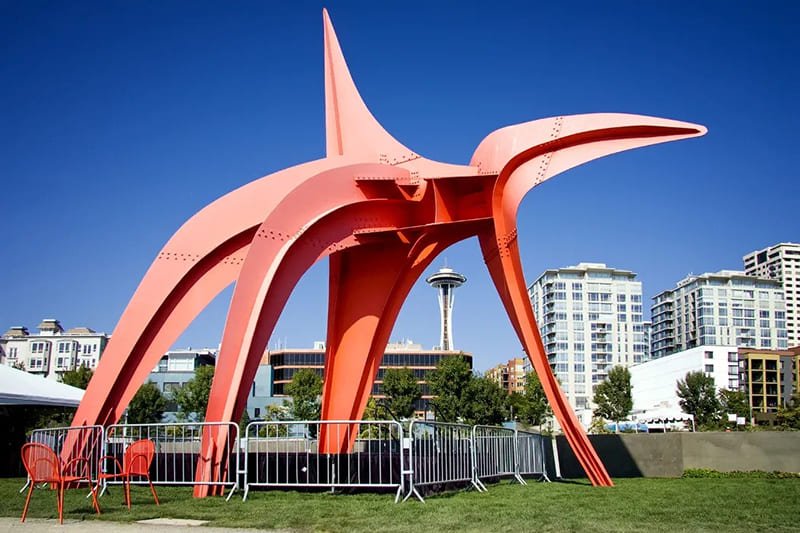
At first glance, Olympic Sculpture Park looks like a pleasant stretch of grass above Elliott Bay. Then Alexander Calder's The Eagle comes into view. The enormous red structure seems to balance on pointed legs, with wings or fins that children can interpret in entirely different ways. Ask a child to stand at a safe distance and decide whether it resembles a bird, a spacecraft or something invented. Nearby, Richard Serra's Wake creates another kind of puzzle. Its massive weathered-steel forms bend and lean, and their appearance shifts as visitors move along the permitted public path. This is art children can investigate with their eyes and feet rather than a gallery that asks them to stand still in front of a painting.
The park covers about nine acres, and its zigzag landscape descends toward the bay across a former industrial site. Seattle Cloud Cover, a patterned glass installation by Teresita Fernández, changes character with light and the background around it. Jaume Plensa's enormous Echo offers a very different scale and mood. Older children can compare how Calder uses bright color, Serra uses industrial metal and Plensa uses a recognizable human form. Younger children usually respond best to a simple scavenger hunt: spot one red sculpture, one work that appears to move, one unusual shadow and one place where the ocean becomes visible. The collection is outdoor art, not play equipment; touching and climbing sculptures are prohibited.
The scenery is part of the museum. From the paths, families can watch boats on Elliott Bay, notice the changing clouds over the Olympic Mountains and compare the park's lawns with the downtown buildings behind them. The park connects to waterfront walking, but the full descent is optional. Someone with a stroller can take in several works near the upper entrance and turn around, while children who enjoy walking can continue toward the lower paths. Unlike an indoor museum, there is no fixed exhibition sequence or closing gallery door that forces a rapid visit. Just remember that open space does not mean a playground: stay on designated routes, supervise children near roads and the waterfront, and keep a respectful distance from the works.
Give a Seattle family trip a little breathing room. Pair this waterfront art walk with other attractions suited to your children’s ages using our Seattle with kids guide.
Who gets the most from a sculpture walk, from stroller passengers to teens
Infant
A stroller walk can be pleasant when the weather is mild, particularly around the broad upper pathways. Little ones experience the changing sky, sounds and movement rather than the artwork itself.
Toddler
Bright colors and oversized shapes catch attention, but most toddlers will prefer a brief walk and frequent stops. The art cannot be climbed, so close supervision is necessary.
Little Kids
A color-and-shape hunt turns a half-hour outing into a game. Children can look for the red Eagle, wide curves and shadows without needing an art-history lesson.
Big Kids
Excellent for a first introduction to public sculpture. Compare the forms and materials, then let children invent a title before reading the real one.
Tweens
Kids who enjoy drawing, photography or design can study how the art changes from different viewpoints. A route down toward the bay adds some variety.
Teen
Strong fit for teens interested in contemporary art, architecture or photography. A short independent observation challenge can be more engaging than a long guided explanation.
Family Friction: the easy art stop that still has a hill
KidWaypoint scores eight practical demands on families, from getting there and pushing a stroller to weather, facilities and the freedom to leave early. Higher points mean more effort, not better or worse art.
No entrance queue, no admission fee and the freedom to visit just two sculptures make this a manageable outing. The trade-off is geography: the park steps down a hillside toward the water, so seeing more art also means coming back uphill. The open location brings wind and rain, and the garage is paid rather than complimentary. Families with small children generally do best with a short route and a clear turnaround point.
| Factor | Score | Why |
|---|---|---|
| Parking & Arrival | 2/5 | The dedicated garage at Broad Street and Western Avenue is paid, with accessible spaces available first come, first served. Public transit or a nearby downtown walk may avoid that cost. |
| Queue & Wait Time | 0/5 | The outdoor public park requires no timed ticket and has no standard entry line; visitors can arrive independently during posted hours. |
| Heat & Weather Exposure | 4/5 | There is little protection across the exposed lawns and waterfront paths. Wind, rain or direct sun may make a short outdoor visit uncomfortable, particularly with infants. |
| Walking Distance & Terrain | 3/5 | The main paved path follows a descending zigzag through a nine-acre site. A family can shorten the route, but an excursion downhill means an uphill return. |
| Stroller & Mobility Access | 2/5 | The broad paved path supports stroller travel, but grades, possible wet pavement and the park's multiple levels call for planning. Some peripheral surfaces are less practical than the main route. |
| Restroom & Baby-Care Access | 2/5 | The PACCAR Pavilion operates on a separate daytime schedule. A nearby indoor stop cannot be counted on outside its hours, and dedicated changing facilities are not specified in the published visitor overview. |
| Sensory & Crowd Load | 1/5 | This is generally an open-air setting where families can move away from groups. Traffic, trains and waterfront activity may still add noise, especially near the lower route. |
| Schedule Flexibility | 1/5 | Visitors can enter free during posted daylight-based hours, walk at their own pace and leave after a few works. Pavilion and special-program schedules are separate. |
| Scored total | 15/40 | Medium Friction |
A stroller-friendly art route, provided you plan for the return climb
Olympic Sculpture Park has a broad public pathway that winds down a hillside toward Elliott Bay. It supports an outdoor stroller walk, but pushing uphill at the end is different from a flat city-block stroll. Decide how far to descend before committing to the lower artworks.
Arriving near 2901 Western Avenue or the PACCAR Pavilion lets a family see works near the top before deciding whether to follow the descending path. A short, nearly immediate turnaround is perfectly reasonable with a baby.
The park is designed around a continuous walking route across different levels. Follow the main paved access route instead of cutting down grassy slopes or attempting shortcuts that may include steps or uneven ground.
The descent can feel easy while the stroller is rolling downhill; coming back toward Western Avenue requires more effort. A compact stroller with reliable brakes is useful on grades, especially with shopping bags or a sleeping child.
Strollers should stay on public paths and away from sculpture surfaces. The museum prohibits touching and climbing works; do not let children use low sculptural forms as benches or stroller parking spots.
Is Olympic Sculpture Park free? Hours, parking and what costs extra
Visiting outdoor sculpture, walking the public paths and watching the waterfront do not require tickets. Separate costs begin with parking, refreshments, paid events or a visit inside the Seattle Art Museum downtown.
| Activity or service | Cost | What to know |
|---|---|---|
| Olympic Sculpture Park entry | Free | Public outdoor sculpture grounds, no ticket required. |
| Permanent sculpture viewing | Free | Look at art from designated public pathways; do not touch or climb. |
| Waterfront path and public lawn | Free | Self-guided walk, subject to park opening hours and temporary closures. |
| Personal photography | Free | Permitted for private use; commercial filming and photography need permission. |
| PACCAR Pavilion | Free public access when open | Normally open 9 a.m.-4 p.m.; check any event-related changes. |
| Olympic Sculpture Park Garage, 0-1 hour | $6 | At Broad Street and Western Avenue; no overnight parking. |
| Garage, 1-2 hours | $11 | Published parking band; rates and availability may change. |
| Garage, 2-4 hours | $16 | Use the posted garage schedule for a longer visit. |
| Seattle Art Museum downtown | Separate admission | Indoor museum galleries are not included in the free sculpture park. |
| Food, special events or purchases | Varies | Optional services and ticketed activities are separate. |
Family cost example: Two adults and two children can see the outdoor artworks for $0 in admission. Parking for a visit lasting more than one hour and up to two hours is listed at $11, while a public-transit arrival avoids the garage cost. Food and the indoor Seattle Art Museum are separate.
What time does the sculpture park open, and when does the pavilion close?
- Outdoor park: opens 30 minutes before sunrise and closes 30 minutes after sunset.
- The changing daylight means exact clock times vary across the year.
- PACCAR Pavilion: normally 9:00 a.m.-4:00 p.m., independent of longer outdoor park hours.
- Temporary events or operating notices can affect specific areas; check the official park calendar.
The outdoor sculptures remain a daylight-oriented experience, not an indoor museum with a single fixed closing hour. Sunset is the most important timing variable. Families should leave enough daylight to return up the hillside and reach transportation before the park closes.
Make a sculpture hunt without turning it into an art lesson
A few observations work better than a long checklist when the gallery is an open hillside.
- Pick three shapes before setting out.Start with the red Eagle, the immense curves of Wake and a work that uses light or reflection. A small number of targets keeps the walk enjoyable for young children.
- Ask questions without correct answers.Does the Eagle resemble a bird or a plane? Which sculpture looks heavier? Encourage children to explain what they see rather than memorize artists' names.
- Keep artwork out of reach.Seattle Art Museum prohibits touching or climbing sculptures. Explain the rule before children approach the big pieces, some of which resemble playground structures from a distance.
- Use the upper park as your fallback.If weather, naps or the return climb make a full circuit unappealing, enjoy the top portion and turn back. There is no ticketed sequence to complete.
- Check daylight and pavilion hours separately.The outdoor park follows sunrise and sunset; the pavilion has shorter hours. Do not count on indoor shelter late in the day.
- Consider the wind before a waterfront descent.A coat and stroller rain cover are useful even on a mild-looking day. If the bay is windy or heavy rain starts, choose a shorter walk rather than relying on the sculpture park as a rainy-day attraction.
Olympic Sculpture Park: questions about the art, the walk and the waterfront
Practical details for families deciding how to explore Seattle’s open-air museum.
Is Olympic Sculpture Park free, or do families need museum tickets?
Olympic Sculpture Park is free to visit. There is no admission charge for children or adults to walk among its public outdoor sculptures, look out over Elliott Bay or follow the main paths during opening hours. It is operated by Seattle Art Museum, but it is not the same ticketed experience as visiting the museum's indoor galleries downtown. Families can spend fifteen minutes near the upper works or stay much longer without paying an entrance fee. The main potential expenses are parking, food, commercial services and any separately ticketed event. This also makes the park useful between other Seattle Center and waterfront activities, especially when a family wants a break from enclosed exhibitions. Check the official park calendar for temporary closures or events rather than assuming every area is available at all times.
What are the most recognizable sculptures at Olympic Sculpture Park?
Alexander Calder's The Eagle is a common first favorite because its bright red color and dramatic shape are easy to spot. Richard Serra's Wake is a completely different experience: massive rust-colored steel forms create a sense of movement and weight as visitors change position. Seattle Cloud Cover by Teresita Fernández uses glass and pattern, making the surroundings part of what you see. Jaume Plensa's Echo, a large sculpted head, gives children a recognizable image to compare against the abstract works. Families can also look for the ways an artist responds to the sea, light or moving air. The art is intended to be seen from public routes rather than climbed, so a simple looking game works better than treating the works like play structures. Some installations or temporary displays can change.
Can families combine the sculpture park with a longer waterfront walk?
Yes. Olympic Sculpture Park lies beside Seattle's waterfront pedestrian routes and near Myrtle Edwards Park, so it can be the beginning of a longer outdoor outing. That extension is optional, and a family does not have to reach the shore to enjoy the park's best-known sculptures. Parents with babies may prefer to stay near the upper entrances, especially if they must return to a parked car at Western Avenue. Older children who enjoy walking can follow the main route toward Elliott Bay and continue along neighboring public paths when access is open. The important planning detail is the uphill return: distance can feel deceptively short when the first part is downhill. Allow extra time for crossings, photographs and a relaxed trip back, rather than making the sculpture park one stop in an overly tight itinerary.
Is Olympic Sculpture Park a safe place for children to run around?
The open lawns and paths are appealing, but the park should not be treated as a supervised playground. It contains large works of art that must not be touched or climbed, as well as changes in elevation, city-side access points and waterfront connections. Keep younger children within easy reach, especially where the path curves or meets another route. Seattle Art Museum also asks visitors to walk bicycles, scooters, skateboards and rollerblades through the park, and active sports are not permitted. For energetic children, a sculpture scavenger hunt is a better match than chasing games near the installations. If a child needs actual climbing equipment, plan a separate playground stop rather than expecting the artwork to serve that purpose.
What is Seattle Cloud Cover, and why does it look different as you move?
Seattle Cloud Cover is a site-specific glass installation by artist Teresita Fernández. Its patterned surfaces engage with the daylight and the views beyond, so the effect changes depending on where a person stands and how the sky looks. Older kids can use it as a simple experiment in perception: stand at one end, describe the image and colors, then move to another point along the public route and compare the view. The artwork is a helpful reminder that sculpture does not always mean a solid object sitting on a pedestal. It can also frame a landscape or change the way a familiar scene appears. As with the other installations, enjoy it by looking rather than touching or climbing on any structural element.
Is Olympic Sculpture Park worth visiting with younger children?
It can be, as long as the family expects a short sightseeing walk rather than a children's museum or playground. A preschooler might enjoy finding the big red sculpture, watching boats and noticing strange shadows for twenty or thirty minutes. An infant may simply ride along in a stroller. Children who want to climb, build or play interactively may run out of patience quickly because the artworks are off-limits for touching. Start with a flexible goal, such as seeing three pieces and the bay, and stop when the child has had enough. A free visit removes the pressure to stay and 'get your money's worth.' On a dry day, the combination of striking art and open views can be a useful change of pace between more structured attractions.