Planet Word with Kids in Washington, DC
At Planet Word, children do more than read museum labels: they make rooms change with adjectives, speak into a famous-speech teleprompter, see books come alive and investigate how language shapes everyday life. This free museum is most rewarding for confident readers and curious teens, and its timed-entry system makes a little advance planning worthwhile.
Admission is $0; the suggested $15 donation is entirely voluntary. Reserve a free timed pass for your preferred session.
See tickets and add-on costs →The museum recommends about 90 minutes. Allow up to two hours if your family enjoys trying each interactive activity.
The museum itself recommends ages 10 and up: reading fluency, vocabulary and willingness to participate make a difference.
Indoor galleries and elevators help, but timed entry, interactive crowds, bright sound effects and the no-stroller rule add friction.
See the full Family Friction score →When words become the attraction: talking walls, magical books and a stage for your voice
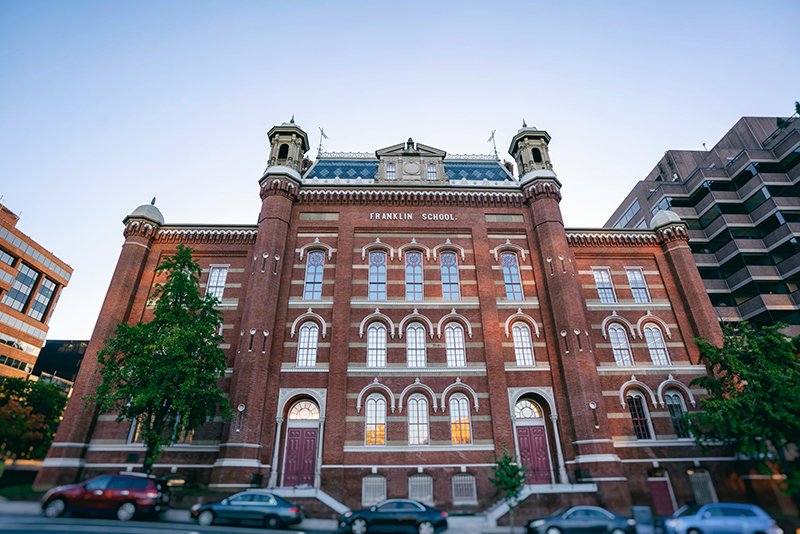
The first surprise at Planet Word can arrive before your family even enters the museum. Outside the historic Franklin School, Rafael Lozano-Hemmer’s Speaking Willow murmurs in hundreds of languages as people move beneath its branches. Upstairs, a 22-foot talking wall in Where Do Words Come From? turns the evolution of English into a performance rather than a textbook lesson. In The Spoken World, children encounter many languages and ways of communicating; First Words explains how people learn to talk, beginning with babies. These exhibits give older children a chance to wonder why familiar words sound different elsewhere, how expressions travel between cultures, and why even everyday slang has a story. A child who thinks museums are about standing silently in front of glass cases quickly discovers that this one asks visitors to talk back.
The second-floor galleries offer some of the strongest reasons to come with school-age children. In Word Worlds, descriptive vocabulary can change a room around you through immersive light, color and motion: "luminous" and "stormy" suddenly feel like creative tools rather than spelling-list entries. The Library uses projections and effects to make selected stories come alive, and it conceals a small poetry nook. Unlock the Music lets willing performers sing karaoke-style while exploring how lyrics work. Joking Around makes humor into a group challenge, while Lend Me Your Ears invites visitors to deliver a memorable speech using a teleprompter. Different personalities find different ways in: a performer may rush toward the microphone, a quiet reader may linger over the animated books, and a puzzle enthusiast may be more interested in how words create double meanings.
Teenagers can find unexpected relevance on the first floor. I’m Sold! examines the slogans and persuasive language of advertising, and Words Matter offers a recording booth for reflecting on language and personal experience. Instead of trying to cover every exhibit, parents can follow the museum’s recommended route from the third floor downward and ask children to choose a favorite word, sentence or persuasive trick along the way. For families that want a more demanding activity, Lexicon Lane is a separate paid word-sleuthing adventure that rewards careful reading and teamwork. The museum is not a conventional indoor playground: younger children can enjoy colorful moments, but much of its real appeal lies in interpretation, speaking, reading and collaborative thinking. That is exactly why Planet Word can be so memorable for tweens and teenagers.
Words can be the start of a bigger Washington adventure. Pair Planet Word with monuments, museums and other age-appropriate discoveries using our Washington, DC with kids guide, built to help families mix hands-on stops with the city’s history.
A much better fit for curious readers than for babies or preschoolers
Infant
Babies can accompany an adult, and ages under two do not require a timed pass, but there is little designed for independent infant engagement. Gallery strollers are prohibited, so plan for a carrier and a short visit.
Toddler
Toddlers may notice colorful rooms and hear different voices, yet word-based interaction, waiting and the need to remain close to an adult make this a poor dedicated toddler outing.
Little Kids
Some preschoolers will enjoy the animated books, sounds and visual changes, but many activities require reading, instructions or patient turns. Better as a brief add-on for a younger sibling than the main attraction.
Big Kids
Confident readers may enjoy Word Worlds, the magical Library and guessing games with an adult. However, children this age can need help understanding exhibit prompts and may tire before visiting all three floors.
Tweens
One of the strongest groups: tweens can test wordplay, perform a speech, examine persuasive advertising and solve problems together. Lexicon Lane is specifically suggested for ages 10 and older.
Teen
Teens can explore media literacy, language identities, song lyrics and rhetoric, then debate which exhibit changed how they think about communication. Give them freedom to choose between performance and quieter discovery.
Family Friction: timed entry and sensory surprises in a compact downtown museum
This eight-factor score looks beyond the free ticket: planning an arrival, waiting for interactive stations, moving through galleries without a stroller and managing sound and light may affect families more than the admission price.
Planet Word keeps a Washington museum visit manageable: its exhibitions are indoors, all public floors have elevators, restrooms are distributed throughout the building, and a 90-minute tour can feel satisfying. The real demands are reserving a timed pass, finding costly downtown parking if driving, taking turns at popular voice-activated displays and respecting a rule against strollers in the galleries. Families sensitive to noise should prepare using the museum’s sensory resources. The result is a low-effort outing for older kids who enjoy interactive learning, but a less comfortable choice for toddlers.
| Factor | Score | Why |
|---|---|---|
| Parking & Arrival | 2/5 | The entrance is on K Street rather than directly on 13th Street. Metro is convenient via McPherson Square or Metro Center, but nearby street parking is limited and garages charge variable rates. |
| Queue & Wait Time | 2/5 | Free timed passes are recommended because sessions can sell out. Busy interactive stations require turn-taking; arriving late may mean losing your slot. |
| Heat & Weather Exposure | 0/5 | The exhibitions are indoors, making this a useful rainy-day choice. The outdoor Speaking Willow is a short optional stop rather than a required weather-exposed route. |
| Walking Distance & Terrain | 1/5 | Three exhibition floors and a recommended 90-minute visit are manageable. Elevators link floors, and families can skip activities rather than follow a compulsory guided tour. |
| Stroller & Mobility Access | 2/5 | All public floors are wheelchair accessible, but strollers are not allowed in the galleries. Store yours in the designated area and use a carrier for a younger sibling. |
| Restroom & Baby-Care Access | 1/5 | Restrooms exist on each public floor, with single-stall all-gender facilities on the first floor. Dedicated diaper-changing or nursing rooms are not clearly promised. |
| Sensory & Crowd Load | 2/5 | Audio-reactive exhibits, lights, karaoke and occasional queues can be intense. Quiet spaces, a sensory map and loaner headphones help families adapt. |
| Schedule Flexibility | 1/5 | A reserved entry time matters, but once inside, the visit is self-guided. Tuesday closure, possible private-event gallery restrictions and last entry one hour before closing require a quick calendar check. |
| Scored total | 11/40 | Low Friction |
Bring a carrier, not a gallery stroller: navigating Planet Word with younger siblings
The historic Franklin School is accessible by elevator, but Planet Word prohibits strollers inside exhibition galleries. The decision to bring a baby carrier is more important here than the elevator route.
The museum provides a designated stroller-storage area, but does not assume responsibility for stored belongings. Take valuables with you and use an infant carrier if needed.
Elevators serve all public floors, and a limited number of manual wheelchairs can be borrowed at the Welcome Desk with a photo ID.
Restrooms are on all public floors, and all-gender single-stall restrooms are on the first floor. Confirm any particular baby-care need with staff on arrival.
Bring headphones if your child is sound-sensitive, or ask the Welcome Desk about sensory backpacks and a sensory map. Quiet spaces are available when the excitement becomes too much.
Planet Word tickets, donation choices, opening hours and downtown parking
General museum admission costs nothing, but a timed pass is the safest way to secure your arrival time. A voluntary donation supports the museum; the optional Lexicon Lane puzzle adventure is paid.
| Activity or service | Cost | What to know |
|---|---|---|
| General admission | Free | Timed passes recommended for everyone age 2 and older; under-two visitors do not need a pass. |
| Suggested admission donation | $15 per visitor, voluntary | The amount is suggested, not an entry fee. You may reserve free admission. |
| Lexicon Lane puzzle case | $50 per case | Separate reservation; suggested for up to four participants, with ages 10+ recommended. |
| Children under 2 | Free; no pass required | Adult supervision remains necessary, and strollers are not allowed in galleries. |
| Self-guided exhibits | Included | Talking word wall, Word Worlds, Library, music, humor, speeches and other standard galleries. |
| Immigrant Food restaurant | Menu prices vary | On the lower level; museum galleries do not allow eating or drinking. |
| Nearby garages | Rates vary | Garages at 915 and 1010 13th Street NW; no guaranteed complimentary museum parking. |
| Museum gift shop | Optional purchases | Present Perfect sells language-themed books, games and gifts. |
Family cost example: Two adults and two teens can visit the standard galleries for $0 if they choose not to donate. One optional Lexicon Lane case adds $50 for the group; transport, parking and food are separate. A voluntary $15 donation per person would bring a four-person contribution to $60, but it is never required.
What are Planet Word museum hours, and how early should families arrive?
- Monday and Wednesday-Friday: 10:00 a.m.-5:00 p.m.; Tuesday: closed.
- Saturday and Sunday: 10:00 a.m.-6:00 p.m. Last entry is one hour before closing, subject to capacity.
- Free passes are released on the first day of each month for the following month; limited same-day spaces may be offered.
- Check for special-event restrictions: for example, the third floor is scheduled to close at 2:00 p.m. on October 16, 2026.
Plan roughly 90 minutes once admitted. Start at the third floor while everyone is fresh, then descend through the second-floor performance and story galleries. A prebooked morning arrival is especially worthwhile if the third floor has a private event or you hope to combine the museum with lunch downtown.
How to get more from the words, performances and puzzling moments
Treat the museum as an interactive conversation rather than a checklist. A few choices can help older children connect the exhibits to their own world.
- Start high, before energy drops.Begin with the third-floor talking wall and language exhibits, then work down. The museum itself recommends this direction, and it prevents missing a favorite exhibit near closing.
- Reserve a free slot rather than gambling on walk-in availability.Passes are released a month at a time and popular sessions can fill. Tickets are free even if you skip the suggested donation.
- Let every child choose a kind of participation.Not everyone wants karaoke or a microphone. Pair more public performances with quieter book animations, word experiments and exhibit conversations.
- Turn Word Worlds into a family challenge.Ask each child to choose an adjective, describe its meaning and predict how the room might react before testing it.
- Save Lexicon Lane for your puzzle-loving group.The $50 case is a separate purchase for up to about four players; ages 10+ is the museum’s suggested range. Don’t purchase it automatically for a young sibling.
- Build breaks around the no-food rule.Visitors cannot eat or drink inside galleries. Stop for a meal outside the exhibition spaces, or use Immigrant Food on the lower level.
- Prepare sensitive visitors before arriving.Download the sensory map or social narrative, ask about quiet spaces, and borrow headphones or a sensory backpack if available.
- Keep an eye on special gallery closures.The third floor sometimes closes early for private events. Check the date-specific advisory before choosing a late-afternoon pass.
Planet Word: the questions families should answer before booking
Free passes, age fit, parking, voice-activated experiences and what to expect inside this downtown Washington museum.
Is Planet Word Washington DC free, and is the $15 donation required?
Yes. Planet Word offers free general admission for visitors of all ages. Its $15 per-person donation is a suggestion to help fund exhibitions and educational work; it is not an entry charge. Families can reserve free passes without agreeing to donate. Bear in mind that free museum admission does not cover optional paid activities such as Lexicon Lane, meals at Immigrant Food, transportation or parking. This distinction matters for larger families: a visit to the ordinary galleries can cost nothing even though the ticketing page invites a contribution.
Do we need Planet Word tickets in advance, and do babies need passes?
Advance timed passes are strongly recommended, particularly for weekends, school breaks and other popular dates. The museum releases reservations on the first day of each month for the following month, and only a limited number of same-day passes may be available. Visitors age two and older need a timed pass; children younger than two do not. A late arrival is not guaranteed admission, although staff may move you to another available slot. To avoid disappointing children, choose a time that allows for downtown travel delays and keep your confirmation accessible.
Where is Planet Word, and what is the easiest way to get there with children?
Planet Word occupies the historic Franklin School at 925 13th Street NW, Washington, DC 20005. The visitor entrance is on K Street, an important detail because approaching from the building’s mailing address alone can be confusing. McPherson Square station on the Blue, Orange and Silver lines is just across the nearby park, while Metro Center is a straightforward walk along 13th Street. Metro generally avoids the uncertainty of downtown parking. If using a stroller to reach the museum, remember it must be parked before entering galleries.
What can families actually do at the Planet Word Washington DC museum?
Planet Word is a three-floor museum devoted to how language works and why words matter. Families can make a 22-foot word wall speak, discover how people learn languages, change a room’s atmosphere with descriptive words in Word Worlds, interact with books in the Library, and experiment with lyric writing and performance in Unlock the Music. Older visitors can try a famous speech using a teleprompter, discover advertising tricks in I’m Sold! and listen to personal stories in Words Matter. The exhibits are designed for participation, so the experience is much closer to a series of small experiments than to a traditional display-only museum.
How old should kids be to enjoy Planet Word?
The museum officially recommends ages 10 and older, which matches the reading, speaking and abstract-thinking skills many experiences require. Tweens can engage with humor, speeches and the origins of words, while teens may appreciate the sections on advertising, personal identity and persuasion. Some children aged seven to nine who read confidently and enjoy verbal puzzles may also have fun with adult help. For toddlers and preschoolers, colorful projections can be appealing, but there is no conventional soft-play or preschool discovery area. Children under 18 must be accompanied by an adult.
How long does a Planet Word visit take, and what should we see first?
Plan around 90 minutes for a typical self-guided visit; families that stop at many interactive stations may spend closer to two hours. The museum recommends beginning on its third floor and working downward. That means seeing First Words, Where Do Words Come From? and The Spoken World while children are alert, then moving to galleries with performances, books and immersive word play. If you have only one hour, choose two or three experiences that match your children’s interests instead of rushing through every room. Check date-specific early closures for the third floor before making the plan.
What are Planet Word hours, and is it open on Tuesday?
Planet Word is normally open Monday and Wednesday through Friday from 10:00 a.m. to 5:00 p.m., and Saturday and Sunday from 10:00 a.m. to 6:00 p.m. It is closed on Tuesday. The last entry is one hour before closing, subject to available capacity. Special events, holidays and private bookings can alter access to individual floors even on otherwise normal opening days. For instance, an early third-floor closing is listed for October 16, 2026. For a family focused on the talking word wall, avoid visiting when that upper floor will not be fully available.
How much does Lexicon Lane cost, and is it worth adding for kids?
Lexicon Lane is a separate immersive puzzle adventure, not part of the standard free galleries. A case costs $50, and Planet Word suggests a team of up to four people and ages ten or older. It works best for a small group who enjoy reading clues carefully, debating possible solutions and solving a challenge together. If a family has younger children, consider whether they can participate meaningfully or would simply be waiting. Book the activity separately, and check the available slots because its hours can differ from the museum’s regular hours.
Is there parking at Planet Word in Washington DC?
Planet Word does not advertise a free onsite visitor parking lot. Street parking around 13th and K streets is limited, and nearby commercial garages have entrances at 915 and 1010 13th Street NW. Costs are set by the parking operator and can vary by arrival time, weekday and event activity. A family driving from outside the city should compare garage rates before leaving and avoid assuming that a free museum visit means free parking. For most visitors staying near Metrorail, McPherson Square or Metro Center is a simpler choice.
Can we bring a stroller, snacks or a baby into Planet Word?
Babies are permitted, and visitors younger than two do not need timed admission passes. Strollers, however, cannot be used in the galleries; the museum directs families to designated stroller parking and recommends a baby carrier. Food and drinks are also prohibited in the exhibition spaces, and water bottles must remain concealed. There are restrooms on each public floor, single-stall facilities on the first floor and food options nearby or at Immigrant Food on the lower level. Families with very young siblings should prepare for carrying them and handling breaks away from the exhibitions.
Does Planet Word work for children with sensory sensitivities or mobility needs?
The museum has elevator access to every public floor and offers a limited number of manual wheelchairs at the Welcome Desk. Some exhibits feature sudden sound, lively recordings, changing lighting and public performance, so the museum provides a sensory map and social narratives to help families prepare. Quiet spaces and sensory-friendly backpacks with noise-reducing headphones may be available to borrow; supply is limited. Children who dislike microphones can participate in other ways, such as exploring animated books or discussing word choices. For a quieter experience, look for the museum’s dedicated sensory-friendly programs.
Is Planet Word a good rainy-day activity and can families bring lunch?
Yes. The museum’s main exhibitions are indoors, so rain does not prevent a meaningful visit; only the outdoor Speaking Willow and the short walk from transit require weather protection. It is not a place for an indoor picnic, because food and drinks are prohibited inside the exhibition galleries. Plan lunch before or after your session, or consider the Immigrant Food restaurant on the building’s lower level. If you travel with children who need frequent snacks, give them time to eat before you enter and avoid scheduling your pass right over their usual mealtime.