National Mall and Lincoln Memorial with Kids - Washington, DC
The National Mall is not a single attraction with a ticket gate: it is a broad landscape of monuments, lawns and paths in the heart of Washington, DC. For families, the best first visit often begins at the Lincoln Memorial, follows the Reflecting Pool and pauses at the World War II Memorial. The sights are free, but the walking distances, open sun and limited nearby parking make a thoughtfully chosen route much more rewarding than a race across the entire Mall.
No ticket needed for the Lincoln Memorial chamber, Reflecting Pool or ordinary National Mall pathways. An optional lower-level museum requires timed entry.
Free visit and optional extras →An easy west-end walk can take 90 minutes with stops; add time for the Vietnam and Korean War memorials, meals or a longer route.
Strong for children who enjoy giant landmarks, open space and short history stories. Younger children need a stroller or a much shorter loop.
No admission queue and flexible stopping points help; heat, considerable distances, limited parking and variable restroom access take planning.
See the full Family Friction score →A giant marble Lincoln, a reflecting pool and stories written into the landscape
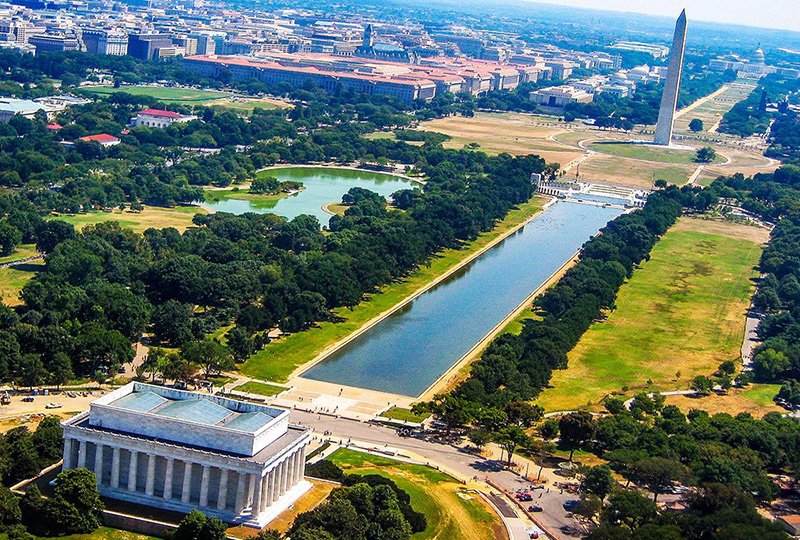
Stand on the steps of the Lincoln Memorial and the scale of Washington suddenly makes sense to a child. Abraham Lincoln sits high inside a marble chamber framed by enormous columns; outside, the long Reflecting Pool points toward the Washington Monument. Children can look for the engraved Gettysburg Address and Second Inaugural Address, count the columns or try to spot the Capitol in the far distance. The striking building gives a history lesson a physical setting without requiring a museum ticket or a guided tour. For older children, the small inscription marking the place of Martin Luther King Jr.'s 1963 'I Have a Dream' speech adds another story about the country's changing ideals.
The walk itself creates a sequence of discoveries rather than a single photo stop. At the World War II Memorial, children see state and territory pillars around a broad plaza and can look toward both the Lincoln Memorial and Washington Monument. Families with more time can turn toward the Vietnam Veterans Memorial, where names are engraved on a long, reflective wall, or explore the Korean War Veterans Memorial's sculpted figures. These places call for respectful, quiet observation; a simple explanation of why people remember sacrifice and service works better than a long lecture, especially for younger kids. The National Mall is also a good place for small observation games: find the tallest monument, notice a reflection or trace how the pathways connect landmarks.
There is one crucial difference between an inspiring outing and a tired family: distance. The Lincoln Memorial and the eastern end of the National Mall are separated by roughly two miles, before counting detours, museum entrances or the return journey. Children who might happily explore a half-mile stretch often struggle with an ambitious Capitol-to-Lincoln itinerary in summer heat. Start with one cluster of memorials and let the children decide whether to continue. The west end works particularly well because the Lincoln Memorial, Reflecting Pool and World War II Memorial can form a memorable visit without a full-Mall expedition. For rain, thunderstorms or extreme temperatures, save this exposed walk for another day.
Washington is easier to explore when each stop has room to breathe. Pair this memorial walk with a hands-on Smithsonian museum or a short indoor break, and choose the next activity by your children’s energy rather than distance alone. Find family-friendly ideas in our Washington, DC guide for kids.
School-age explorers get the most from a short route with memorable stories
Infant
An infant may enjoy the stroller ride and changes of scenery, but the wide exposed avenues, heat and limited opportunities for indoor breaks make this a less compelling destination in its own right. Keep the route brief and plan feeding and shade before leaving.
Toddler
Toddlers can point out columns, water and large statues, yet distance and respectful behavior at memorials quickly become hard work. A 20-40 minute stop with a stroller is more realistic than a full circuit.
Little Kids
A good introduction to Washington icons: look up at Lincoln, find the reflecting pool and choose a short observation game. Keep explanations simple and allow time for water and a snack outside memorial interiors.
Big Kids
Children can connect the Lincoln Memorial to the Civil War and Dr. King, compare monuments and understand why remembrance matters. An easy west-end itinerary is long enough without crossing the entire Mall.
Tweens
Tweens can read inscriptions, examine memorial design and talk about different ways history is remembered. Invite them to choose one additional memorial and navigate using a map.
Teen
Teenagers interested in American history, photography, architecture or civic life can appreciate the symbolism of the National Mall. A longer walk linking multiple memorials can be rewarding in comfortable weather, with thoughtful breaks.
Family Friction: the hidden cost of a free, wide-open memorial walk
KidWaypoint’s eight-part framework compares practical family demands - arrival, lines, weather, distance, mobility, care facilities, sensory load and schedule freedom - so families can assess the effort of a visit, not simply its ticket price.
Free, unticketed outdoor sightseeing is wonderfully flexible: families can arrive early, change direction and leave whenever children become tired. The obstacles are physical rather than financial. The west end involves long open walks, very little protection from afternoon sun or rain, limited close parking and variable access to services after daytime hours. A shorter route, stroller and public transportation reduce most of the effort. The optional Lincoln Memorial undercroft museum has its own timed-entry procedure and should not be confused with the always-free main chamber.
| Factor | Score | Why |
|---|---|---|
| Parking & Arrival | 3/5 | NPS recommends public transit because nearby spaces are limited. Metered National Mall parking is generally $2.30/hour, with time limits. The Lincoln Memorial is still a walk from Metro; driving adds a parking search. |
| Queue & Wait Time | 1/5 | No standard admission line or reservation is required to walk the Mall or enter the Lincoln Memorial chamber. Crowds may gather at the stairs and photo spots, while the separate undercroft museum involves reserved entry and screening. |
| Heat & Weather Exposure | 4/5 | Most of the route is outdoors on broad paved surfaces. Summer sun, humidity and storms can make even a manageable distance challenging, especially when children cannot retreat indoors quickly. |
| Walking Distance & Terrain | 4/5 | The Lincoln Memorial is about two miles from the Capitol. Even a selected western route adds distance around the Reflecting Pool, plazas and memorial approaches; steps at Lincoln have a separate elevator alternative. |
| Stroller & Mobility Access | 1/5 | Wide paved paths and an elevator to the Lincoln Memorial chamber help families with strollers and visitors with mobility needs. Crossing long distances remains the bigger issue; temporary closures and crowding can require detours. |
| Restroom & Baby-Care Access | 2/5 | Public restrooms, including family facilities near the Lincoln Memorial, exist but are not distributed uniformly across a long outdoor route. Daytime undercroft facilities have changing tables, though undercroft admission is separately controlled. |
| Sensory & Crowd Load | 1/5 | Open paths provide space to step away from a crowd, but buses, demonstrations, traffic, tourist groups and busy memorial steps can increase stimulation. Quiet respect is expected at memorial sites. |
| Schedule Flexibility | 1/5 | Outdoor memorials and public paths are accessible around the clock; choose your own pace without timed admission. Elevators, restrooms and museums have more limited hours, and events may alter access. |
| Scored total | 17/40 | Medium Friction |
A stroller-friendly memorial walk still requires a distance strategy
The paved promenades make the west end navigable with a stroller, and an elevator reaches Lincoln’s main chamber. Bring water and plan your turnaround point: accessibility does not shorten the distance.
The memorial chamber can be reached using the elevator beside the main stairs. Check daytime access and any maintenance notices before relying on it for a stroller or mobility device.
The pool provides a clear visual route toward the World War II Memorial, but reaching the far end and returning adds real walking. Decide in advance where a younger child can turn around.
A sun canopy, refillable water, hat and layers matter. The walk offers impressive views but only scattered shade and indoor refuge; move to shelter if storms approach.
Follow paved approaches and crossings rather than stair shortcuts. In the Lincoln chamber, keep children close and avoid blocking others taking time for reflection.
Is the National Mall free? Memorial access, undercroft passes and parking
The outdoor National Mall, Reflecting Pool, World War II Memorial and main Lincoln Memorial chamber cost $0 and require no ordinary entry pass. Only certain separate attractions, such as the new lower-level Lincoln museum or Washington Monument interior, have their own reservations.
| Activity or service | Cost | What to know |
|---|---|---|
| National Mall outdoor pathways | Free | Open access; choose a short route and watch for event closures. |
| Lincoln Memorial main chamber | Free | No standard ticket required; accessible elevator available during operating hours. |
| World War II Memorial and Reflecting Pool | Free | Outdoor stops on an easy western National Mall route. |
| Vietnam and Korean War Veterans Memorials | Free | Optional detours for older children who can appreciate solemn remembrance. |
| Lincoln Memorial Undercroft - advance | $1 reservation fee | Separate timed-entry museum below the memorial; advance reservations may be booked online. |
| Lincoln undercroft - same-day | Free, limited | Limited same-day tickets, subject to availability; separate security screening. |
| Washington Monument interior | Separate reservation | Not part of this outdoor walk; requires its own timed-entry procedure. |
| NPS metered parking | $2.30/hour | Generally 7 a.m.-8 p.m., daily; usually maximum three hours at the same meter, with exceptions for certain lots. |
| Metro, snacks and optional tours | Varies | Public transit, meals and commercial guided tours are additional family expenses. |
Family cost example: Two adults and two school-age children can walk from the Lincoln Memorial toward the World War II Memorial and explore the public memorial spaces for $0 in admission. If the family books four advance undercroft museum passes, reservation fees total $4; transit, parking, food and any optional tours remain separate.
What time is the National Mall open, and when should families start?
- Outdoor Mall and Lincoln Memorial: open 24 hours daily under normal conditions; special events and closures can change access.
- Lincoln Memorial services: nearby restrooms, elevator and lower-level experiences have limited operating hours, even though the outdoor monument stays open.
- Best family timing: morning for cooler summer weather and gentler light, or late afternoon for shorter walks in comfortable conditions.
- Memorial walk: allow 90 minutes to three hours for a western route with photo stops, conversation and rest breaks, not a Capitol-to-Lincoln marathon.
- Optional lower-level museum: check undercroft timed-entry availability before promising the visit to your children.
A visit at sunrise or after dark can be atmospheric, but parents should not assume every indoor facility is available then. Daylight makes reading markers, finding pathways and managing family rest breaks simpler. The outdoor memorials are the focus of this itinerary; galleries and reserved interiors are separate experiences.
Keep the route short enough that the monuments still feel extraordinary
These practical choices turn an enormous outdoor landmark district into a visit children can actually enjoy.
- Start at Lincoln if it is your must-see.Make the seated Lincoln your first big moment while children are fresh, then choose the Reflecting Pool or a nearby memorial according to energy and weather.
- Use the Reflecting Pool as your distance gauge.Walking its entire length toward the World War II Memorial takes longer than it looks. You can admire the view from the steps without committing to the full stretch.
- Offer one history story per stop.Lincoln’s leadership and emancipation, Dr. King’s speech and the meaning of remembrance are easier for younger visitors to absorb as short stories tied to a visible place.
- Do not confuse the chamber with the new museum.The famous statue is free without reservations. The lower-level undercroft museum, opened in 2026, has separate timed entry and security screening.
- Use respectful games, not loud playground games.Spot architectural shapes, reflections and inscriptions, but speak quietly around solemn war memorials and avoid running across commemorative spaces.
- Plan water, bathrooms and your ride home first.Check a family restroom location before you set out; bring water, and decide whether the return is on foot, by transit or by a prearranged pickup.
- Give bad weather permission to change the plan.A museum can be saved for rain, but an exposed National Mall walk loses much of its appeal during thunderstorms or unsafe heat.
- Avoid collecting too many landmarks.A memorable Lincoln-Reflecting Pool-World War II Memorial walk beats four hours of rushed walking with exhausted children.
National Mall and Lincoln Memorial: practical family questions answered
Clear answers on walking distance, free access, the Lincoln Memorial, timed-entry extras and visiting with children.
What is the National Mall in Washington, DC?
The National Mall is a large public landscape of lawns, paths, monuments and memorials connecting some of Washington’s most recognizable sights. It is not a shopping mall or a single indoor museum. Families commonly explore the open spaces around the Washington Monument, the World War II Memorial, the Reflecting Pool and the Lincoln Memorial, with many Smithsonian museums farther east. The visitor experience is mostly self-directed: choose which memorials to see, stop for photographs, read inscriptions and take breaks when needed. The monuments have different purposes and levels of solemnity, so explain to children that some stops commemorate people and historic events rather than provide play equipment. For a first trip with school-age children, the western end is a manageable introduction without trying to cross the whole district.
Where is the National Mall, and which end should families visit first?
The National Mall lies in central Washington, DC, between the U.S. Capitol area and the western memorial landscape near the Lincoln Memorial and Potomac River. If seeing the statue of Abraham Lincoln is your priority, begin at the Lincoln Memorial at 2 Lincoln Memorial Circle NW. From there the Reflecting Pool provides a natural orientation line toward the World War II Memorial and Washington Monument. If your day is centered on Smithsonian museums, starting farther east near Smithsonian Metro may make more sense. Do not enter a generic National Mall map pin into navigation and assume it will put you near your chosen landmark: the district spans a considerable area, and the most convenient arrival point depends on which stops matter to your family.
How long does it take to walk the National Mall with kids?
NPS notes that the distance from the Lincoln Memorial to the Capitol is about two miles one way. An adult might cover that distance briskly, but a family walk includes road crossings, photos, snacks, questions, bathrooms and rest. For younger children, allow about 90 minutes to three hours for the western section, such as Lincoln Memorial, a portion of the Reflecting Pool and the World War II Memorial. A more ambitious full-length traverse with museums or additional memorials can occupy much of the day. Remember that a point-to-point walk may leave you far from your car or original Metro station. A short out-and-back is easier for a tired child than a long route that still requires returning to the starting point.
Is it free to visit the National Mall and Lincoln Memorial?
Yes. Normal outdoor access to the National Mall, the Lincoln Memorial’s main chamber, the Reflecting Pool and surrounding public memorials costs nothing. You do not need a paid sightseeing tour or a timed-entry ticket to see the seated statue of Lincoln. This article covers that free outdoor experience. Some nearby attractions are different: the Washington Monument interior uses reservations, and the Lincoln Memorial’s new undercroft museum requires a separate timed-entry ticket. Meals, Metro fares, parking and commercial tours may also add cost. For a family that stays on the public outdoor memorial route and arrives without a parking fee, the admission total can be $0.
Does the Lincoln Memorial have a museum, and do children need reservations?
The main Lincoln Memorial chamber with the famous statue is free and does not require a ticket. Since June 25, 2026, a new museum and undercroft experience has also operated on the lower level. That separate visit requires timed entry and security screening. As listed by the NPS, advance tickets have a $1 reservation fee, while limited same-day passes may be available free on a first-come basis. The museum uses exhibits and multimedia to explain the building’s history and its place in American public life. Families who primarily want the statue and Reflecting Pool can skip the undercroft entirely; families with older children interested in construction, design and civil rights may choose to add it, allowing extra time for the entry process.
Can children use a stroller or wheelchair at the Lincoln Memorial?
Yes, there are accessible paved approaches around the memorial landscape and an elevator to the Lincoln Memorial chamber, avoiding the monumental staircase. The elevator is located beside the stairs, and the NPS accessibility page provides detailed directions. A stroller can make the long outdoor paths much easier for a preschooler, although parents should be prepared for occasional crowded areas, uneven transitions and detours around work or events. The important distinction is that accessible routes do not make the National Mall compact: the greatest challenge may be the distance between landmarks rather than a single staircase. Check elevator access before a late-evening visit because some facilities close even while the memorial itself remains open.
Where are bathrooms and places to change a baby near the Lincoln Memorial?
NPS lists public men’s, women’s and family restrooms on Daniel Chester French Drive near the Lincoln Memorial, across from the accessible parking spaces. These are sensible facilities to locate before starting a walk, because bathrooms are not available at every point along the Reflecting Pool. The new undercroft museum has additional accessible restrooms with baby-changing tables in the men’s, women’s and family facilities, plus a bottle filler, but it is a separate timed-entry experience. Do not assume you can use its amenities without museum access. Bring a portable changing mat, water and essential supplies, and check daytime facility hours if visiting in the evening.
Does the National Mall have parking close to the Lincoln Memorial?
Parking exists around the broader National Mall, but finding a space close to the Lincoln Memorial can be difficult, especially on weekends and during major events. NPS lists metered roadside spaces along sections of Constitution Avenue, Ohio Drive and other nearby roads. The standard NPS meter price is $2.30 per hour, generally enforced from 7 a.m. to 8 p.m., with a three-hour limit at many spaces; some designated areas permit longer stays. A small number of accessible spots are available near Lincoln on Daniel Chester French Drive. Families using a car should study the current parking map and street signs rather than relying on an assumed free lot at the monument. Metro, taxi or a planned drop-off can save a long parking search.
What is the easiest way to visit the Lincoln Memorial with children without a car?
Public transport is usually less stressful than searching for parking, though no Metro station opens directly at the Lincoln Memorial steps. NPS identifies Foggy Bottom-GWU and other stations for reaching the western Mall, but families should still budget for an outdoor walk from the station. For a first visit, use a mapping app to route to Lincoln Memorial specifically, not simply to National Mall. Bring the stroller if a child tires easily, carry drinks and decide how you will leave before walking toward other memorials. If one adult can manage a drop-off or a taxi is within budget, arriving near the western memorial zone may preserve more energy for sightseeing. Check live transit conditions and temporary road closures on the day.
Is the National Mall a good rainy-day activity for families?
Not as the main plan. The Lincoln Memorial chamber has a roof, but the experience described here depends on walking through exposed outdoor plazas, paths and memorial grounds. Heavy rain, thunderstorms, icy surfaces and hot, humid weather can make the route uncomfortable or unsafe, especially for young children. The Mall also offers few convenient indoor places to retreat along some stretches, and nearby Smithsonian museums are separate destinations with their own hours and rules. For light drizzle and older children, a very short Lincoln Memorial visit might still work if conditions are safe. For an all-day rain plan, choose an indoor museum instead of trying to turn a long monument walk into a weatherproof outing.
What should kids look for at the Lincoln Memorial and Reflecting Pool?
Begin with the scale: the columns, Lincoln’s seated sculpture and the inscriptions of the Gettysburg Address and Second Inaugural Address. Older children can ask why public leaders chose to memorialize Lincoln and what the building says about national ideals. Outside, find the spot associated with Martin Luther King Jr.’s 1963 “I Have a Dream” speech, then face the Reflecting Pool and identify the Washington Monument in the distance. At the World War II Memorial, notice the state and territory pillars and explain that this is a place to remember people who served and sacrificed. These observations work best as quiet, brief conversations rather than worksheets or loud challenges; they help children relate the monuments to real history while respecting other visitors.
Can families visit the National Mall at night?
Outdoor National Mall and Memorial Parks sites, including the Lincoln Memorial, generally remain open 24 hours, and illuminated monuments can be particularly striking after sunset. That does not mean all facilities remain available: restrooms, museums and elevators close in the evenings or operate on separate schedules. For families with children, nighttime sightseeing requires extra attention to footing, temperature, lighting and the journey back to accommodation. Keep the route shorter than a daytime visit, identify a safe pickup or transit plan, and do not assume nearby services will be open. If an accessible elevator is essential, confirm its operating availability before choosing an evening visit.