Space Needle with Kids: Glass Floor and Seattle Views
The Space Needle is an observation tower rather than an amusement ride. Families rise in a glass elevator to a 520-foot viewing level, then explore The Loupe, a slowly revolving glass floor at 500 feet. The attraction is compact, but timed entry, changing visibility and a no-stroller rule can shape the whole visit.
Timed adult prices change with the visit slot. Youth 5-12 and seniors 65+ have discounted date-specific rates; children 0-4 enter free.
See ticket categories and extras →Admission and security can take time before the elevator. A relaxed family visit includes both viewing levels and photographs, without a fixed tour duration.
Older children can identify landmarks and enjoy the moving glass floor. Younger visitors may be bothered by heights, wind or waiting.
The observation experience is short and elevator-served, but timed entry, crowded viewing areas and the requirement to leave strollers below add complications.
See the full Family Friction score →Two heights, one city: the Space Needle from a child’s viewpoint
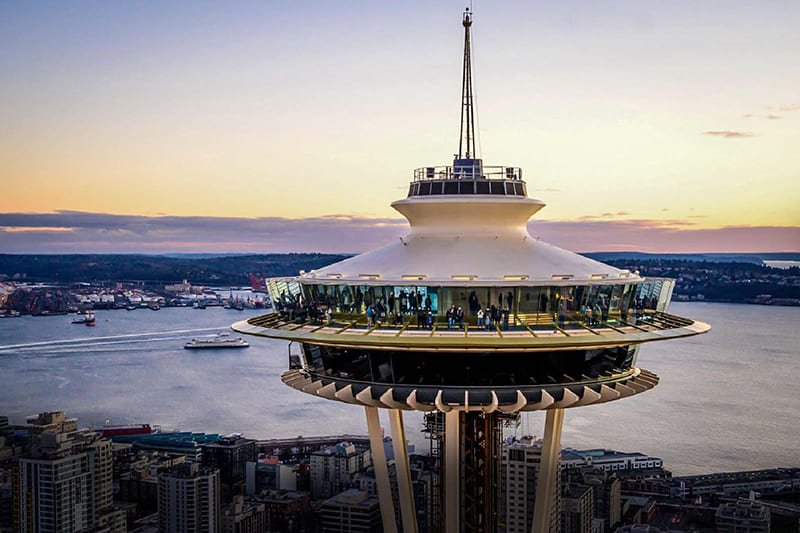
The elevator ride comes first. Through its large windows, kids can watch the legs of the tower fall away and Seattle Center shrink beneath them. The Space Needle is 605 feet tall, but visitors do not climb to its tip. The main viewing level sits 520 feet above the ground and gives a nearly continuous panorama across the city. Instead of simply telling children to admire the skyline, make a game of finding Seattle landmarks: the waterfront, Puget Sound, ferries, downtown towers and, in clear conditions, mountain ranges far beyond the buildings. The changing light matters. A sunny afternoon reveals detail; low cloud may hide the long-distance view completely.
The upper observation level includes an indoor glass-walled area and an open-air section. The outward-leaning Skyriser glass benches are a striking photo spot, although children who dislike exposed heights may prefer to observe from inside. Below is The Loupe, a glass-floored platform 500 feet above the street. It rotates gradually, not like a spinning carnival ride. Looking through the floor can reveal structural elements of the tower and the city below. Some children find it thrilling to stand over a transparent panel; others need time to approach it or may decide the solid sections feel better. Both reactions are entirely reasonable.
This is a focused Seattle landmark visit rather than a half-day children's museum. The Building the Marvel exhibit introduces the tower before the ascent, and the experience includes opportunities for photos and looking closely at the mechanics of the building. The Space Needle can be especially memorable for children already interested in engineering, maps or tall structures. What it cannot promise is a perfect view. Cloud, fog and rain can reduce visibility even while indoor areas remain open. An unhurried visit with one strong viewing opportunity is better than rushing children between glass panels and expecting everyone to enjoy the height in the same way.
Use the Space Needle as one stop in a Seattle family itinerary. Pair the view with other Seattle Center activities, or compare indoor and outdoor plans in our guide to Seattle with kids.
Who enjoys a glass-floor observation tower most?
Infant
An infant can join a caregiver, and admission is free at this age. The practical challenge is carrying the child because strollers must stay at the entrance; a feeding or nap break is easier to arrange before admission.
Toddler
Toddlers may enjoy the short elevator ride and bright city lights, but the transparent floor and waiting lines can be unsettling. Keep the visit simple and do not expect a child to stand on The Loupe.
Little Kids
Little Kids can look for boats, buildings and miniature-looking cars far below. Some will love the glass floor, while others need to remain with a parent on a solid section.
Big Kids
Children this age can read the skyline like a map, compare the two viewing heights and watch the floor move slowly beneath them. A good fit when they are comfortable with heights.
Tweens
Tweens often appreciate the engineering: glass barriers, elevator machinery and a rotating platform. Ask them to identify the harbor and trace routes across the city from above.
Teen
For teens interested in architecture or photography, Seattle looks different from each side of the tower. The experience has more appeal when they choose a few views to capture rather than being rushed around.
Family Friction: the elevator is easy; planning the visit takes more work
KidWaypoint measures eight practical pressures on families, from arrival and waiting to mobility, facilities and flexibility. A higher number means more effort, not a less enjoyable view.
Space Needle is compact once guests reach the top, with elevators and lifts connecting the main viewing experiences. The family challenges happen around that short visit: finding parking, arriving within a timed window, passing security and leaving a stroller downstairs. Open-air wind, transparent flooring and other visitors can also affect children who are uneasy with heights or noise. The schedule is more controlled than a self-paced public viewpoint, so a cloudy day or a sudden change of plans may feel costly.
| Factor | Score | Why |
|---|---|---|
| Parking & Arrival | 3/5 | The tower is in busy Seattle Center. Nearby garages require a walk, and space at the tower itself is limited; valet is an expensive alternative. |
| Queue & Wait Time | 3/5 | Entry is timed and includes screening, exhibits and an elevator queue. The operator advises allowing time to reach the top rather than expecting immediate admission. |
| Heat & Weather Exposure | 2/5 | Indoor viewing is possible, but the upper level also has an open-air section. Wind and low cloud can change the experience and reduce the value of distant views. |
| Walking Distance & Terrain | 0/5 | Once inside, the route is compact and elevator-based; this is not an extended walking tour or a hilly outdoor trail. |
| Stroller & Mobility Access | 4/5 | Strollers are not allowed inside and must be left in a vehicle or designated area before entry. Accessibility lifts are available for guests using mobility aids. |
| Restroom & Baby-Care Access | 1/5 | Restrooms are available within the attraction, including facilities on the mezzanine. Specific baby-changing or feeding amenities should not be assumed without staff guidance. |
| Sensory & Crowd Load | 3/5 | Elevator loading, popular photo points and the glass floor can feel busy; glass exposure and open-air wind may overwhelm sensitive children. |
| Schedule Flexibility | 2/5 | A reserved arrival time makes switching plans less convenient. Guests must check change arrangements if visibility or family needs disrupt the selected slot. |
| Scored total | 18/40 | Medium Friction |
Leave the stroller below: how to manage the Space Needle with young children
A stroller cannot go up to either viewing level. Families must plan for a child who walks independently, can be safely carried, or travels using a permitted mobility device. The elevator and lifts help with access once inside, but they do not override the stroller policy.
The Space Needle directs families to leave strollers in their cars or use the designated stroller area. Do not count on taking even a compact stroller upstairs, and avoid leaving valuables or essential supplies in an unattended stroller.
The operator permits infant car seats, which can help a very young child, but a bulky seat is still a lot to manage with tickets, a bag and an elevator queue. Parents may prefer a suitable carrier and a very small day bag.
The tower provides access lifts between the observation level and The Loupe, and mobility scooters are permitted. Staff can direct eligible visitors toward the courtesy entrance and help arrange an accessible route rather than the illuminated stairway.
Children can view Seattle from solid indoor areas without stepping onto transparent glass. Hold younger children close near crowded photo spots and plan the return elevator before a tired child becomes overwhelmed.
Space Needle tickets, daily opening times and Seattle Center parking
Space Needle general admission includes the upper observation area and The Loupe. Prices depend on the selected date and arrival time; a discounted ticket is not a separate, less complete viewing experience.
| Ticket or service | Price |
|---|---|
| General admission | $35-$55, date-dependent |
| Youth ages 5-12 | Discounted rate shown at booking |
| Seniors ages 65+ | Discounted rate shown at booking |
| Children ages 0-4 | Free |
| Chihuly Garden & Glass + IMAX combo | From $74, verify selected offer |
| Fast Pass combo | From $129, verify selected offer |
| Valet parking, limited availability | $25/hour |
| Seattle Center garage parking | Varies by facility and event |
Family cost example: Two adults paying the lowest published general admission of $35 each would spend at least $70 before adding tickets for children ages 5-12. The youth rate and checkout total depend on the selected time slot; children ages 0-4 enter free.
What time does the Space Needle open? Use the ticket calendar, not a fixed daily hour
- The Space Needle opens year-round, but weekday, weekend and event hours are not uniform.
- Official hours can shift between morning and evening openings, including extended hours on some days.
- Entry appointments are sold in 15-minute windows, with a shorter assigned arrival interval within each window.
- Arrive with enough time for security and elevator access; the operator advises that reaching the observation level can take about 30 minutes.
Check the live opening time and final entry slot for the exact visit day. Sunset tickets can be particularly appealing for older children, but clear weather and good visibility are not guaranteed. Do not assume the listed closing time means you can arrive without a timed ticket at the last moment.
Small decisions that improve the view from the top
A memorable visit depends on visibility, comfort and a sensible time slot more than on rushing to the glass floor.
- Check the skyline before paying.Look at the local cloud ceiling and forecast; a clear street-level sky does not automatically mean Mount Rainier will be visible.
- Book a calm arrival window.Timed tickets help control entry, but security and elevator queues remain part of the trip. Avoid a slot that cuts into a child’s usual meal or rest period.
- Leave the stroller and large bag below.Use the designated stroller area or your car, and carry only essential items. Free luggage lockers are available for eligible bags.
- Start with the indoor panorama.Let children acclimate to the height through floor-to-ceiling windows before inviting them onto an open-air bench or transparent flooring.
- Keep the camera ready for both levels.Try a wide skyline picture above and an engineering detail shot through The Loupe. Complimentary digital photo experiences may be available.
- Use the monorail if downtown is your base.The Seattle Center Monorail links downtown with the attraction area and can remove the cost and uncertainty of parking near the tower.
Space Needle questions families ask before going up
Detailed answers about the tower, its levels, and what makes the experience different from a regular city viewpoint.
What is the Space Needle, and why was it built in Seattle?
The Space Needle is a 605-foot observation tower at Seattle Center. Its saucer-shaped top, slim central shaft and sweeping legs were conceived as a futuristic symbol for a World's Fair centered on the Space Age. Today, it is an observation attraction rather than a working communications tower or a hotel. Visitors ascend by elevator to look over Seattle, Puget Sound and, when the weather permits, the surrounding mountains. The tower's architecture is part of the experience: children can follow the structure from its foundation to the glass-enclosed top and see how a distinctive building becomes a symbol of an entire city. Before the elevator, the Building the Marvel experience provides background on how the tower came to exist. Children who enjoy models or construction may get as much from observing its supports and mechanical details as from the panorama itself.
How tall is the Space Needle in Seattle, and how many floors can visitors explore?
The complete Space Needle stands 605 feet tall, while the upper public observation level is about 520 feet above the ground. Another public level at roughly 500 feet contains The Loupe, the slow-moving glass floor. Between these heights is a mezzanine service level. This matters when a child asks whether the elevator reaches the very top of the structure: it does not take visitors to the tip. Although the tower contains multiple building levels and service areas, ordinary sightseeing centers on the two observation experiences rather than a series of conventional hotel or office floors. An internal staircase connects the two observation levels for many visitors, but there is also staff-assisted lift access for people who need a step-free route. The difference in height is modest; the feeling underfoot is what changes most dramatically.
Does the Space Needle rotating glass floor move fast?
No. The Loupe rotates slowly, so the aim is to let visitors see the city and tower structure from changing angles rather than create an amusement-park sensation. Many guests will notice the scenery shifting only after standing still for a while. Transparent sections reveal the space beneath the tower, while more solid areas provide a comfortable place to stop. Parents can show children what lies below before asking whether they want to walk farther onto the glass. A child who feels uneasy can stay on a nontransparent portion and still enjoy the indoor panoramic views. The glass floor is included with general admission, so there is no need to buy a separate ride ticket for it. The experience is about observing motion and perspective, not being strapped into a rotating attraction.
Are the views from Space Needle worth the ticket price on a cloudy day?
It depends on what the family wants to see. Low clouds may conceal Mount Rainier and distant mountain ranges, but the tower can still offer close views of downtown streets, Seattle Center and the waterfront. A child interested in the glass floor and the elevator may enjoy the visit even when the horizon is hazy. A family buying tickets primarily for a mountain panorama should be more cautious. Because ticket prices vary by arrival time and season, consider the forecast alongside the available price before choosing a slot. It is also worth comparing a short stop at a public overlook with the paid tower experience: the Space Needle adds a distinctive engineered structure, high glass walls and The Loupe, not a guarantee of perfect weather. If visibility is the main reason for visiting, some flexibility in the schedule can be valuable.
Can families take their own photographs at the Space Needle?
Personal photography is encouraged, and the attraction includes several places where the perspective looks different. The open-air upper observation level frames Seattle behind the glass barriers, while The Loupe allows unusual downward pictures through its transparent floor. Guests can also take pictures through the elevator windows when permitted without blocking others. The Space Needle offers complimentary digital photo experiences with admission, although visitors should check the current process for retrieving them. A practical trick with children is to choose one landmark to photograph from two sides of the building and compare how its shape changes. Tripods are generally permitted, but guests must keep walkways and shared viewing spaces clear. Phones should be securely held, especially near crowds or during transitions between levels. Families do not need to purchase a professional photo package just to document the visit.
Can you combine the Space Needle with Chihuly Garden and Glass or another Seattle Center stop?
Yes, and that often makes practical sense because the tower sits inside Seattle Center rather than in an isolated part of the city. Chihuly Garden and Glass is nearby and is sold with the Space Needle in an advertised combo option. Be careful to compare what that package actually includes, especially if an IMAX component is part of the current offer; prices and terms can change. Other Seattle Center attractions are independently operated and require their own admission, so a Space Needle ticket is not a pass to the entire campus. Families with smaller children may prefer to balance the short, highly structured tower visit with a more flexible activity afterward. Older children who enjoy art may appreciate the change from city panoramas to colorful glass installations. A meal or outdoor break in the Seattle Center area is another reasonable way to avoid scheduling two timed attractions back to back.