United States Botanic Garden with Kids - A Tropical Escape in Washington, DC
A few blocks from the U.S. Capitol, the United States Botanic Garden turns an ordinary museum stop into a walk through humid tropical forest, prickly desert landscapes and rooms scented with living flowers. Admission is completely free, and the Conservatory is a particularly useful indoor choice when Washington weather turns wet. For children who like to get their hands dirty, the seasonal outdoor Children’s Garden offers tools, planting beds and water play-but it does not stay open year-round.
All Conservatory galleries and outdoor gardens are free. No admission pass is required, even for special seasonal displays.
Admission, hours and transport →Allow 60-90 minutes for tropical and desert rooms; add 30-45 minutes when the outdoor Children’s Garden is open and your child enjoys digging and watering.
Babies and toddlers can enjoy an easy sensory stroll; children 4-9 can turn the changing habitats into a plant-discovery game. Older visitors may enjoy it as a shorter science stop.
Free entry, compact indoor galleries and step-free routes help; metered parking, humid rooms and the seasonal outdoor play space require some planning.
See the full Family Friction score →From rainforest canopy to cactus country: a world of plants in one glasshouse
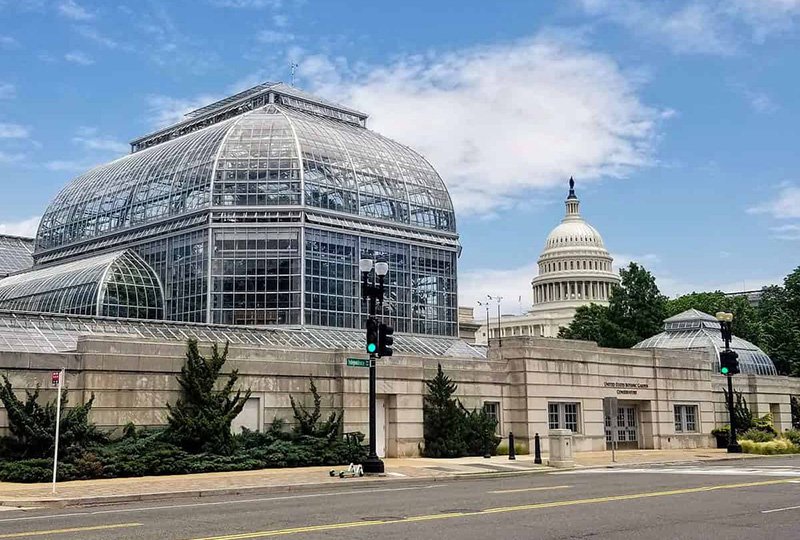
Young visitors do not have to be enthusiastic gardeners to enjoy the Conservatory. Enter the Tropics and the air feels different: huge leaves gather overhead, tropical plants climb toward the 93-foot glass dome and a waterfall brings sound and movement to the forest setting. Children can look for the contrast between broad rainforest leaves and the spines of desert cacti, or count the shades of green in Garden Court. The elevated Canopy Walk, reached by elevator as well as other routes, gives school-age children a different perspective on how plants compete for sunlight. In the Primeval Garden, ferns and other ancient-looking vegetation create an excellent opening for conversations about prehistoric Earth-even though this is a botanic garden, not a dinosaur museum.
The most hands-on part for young children is the seasonal outdoor Children’s Garden, reached through the Conservatory complex. When it is open, kids can use child-size watering cans and gardening tools, explore planting stations, investigate a climbing-platform structure and walk through a kiwifruit-vine tunnel. Motion-activated misting poles may make play wet, so a change of clothes can be worthwhile. In 2026 the garden opened April 11; its operating season runs from spring into fall rather than year-round. That distinction matters: the glasshouse works as a rainy-day destination, but this garden is an outdoor experience. Unlike ordinary Conservatory plant displays, the Children’s Garden specifically invites supervised digging, planting and touching appropriate materials.
The quieter exhibits reward curious kids who enjoy searching for details. World Deserts offers strange cactus shapes and examples of plants designed to survive without frequent rain; Orchids demonstrates remarkable flower forms; Medicinal Plants opens a conversation about how people use plants; and Plant Adaptations invites children to work out why one leaf might be waxy and another full of spines. Parents can ask children to spot three plants that grow in very different climates, or pick a favorite flower and sketch it. The USBG also supplies free family activity guides and a cell-phone audio tour. This is a living collection with delicate plants, so children should stay on paths and touch only where a specific activity allows it. For a family exploring the Capitol area, the real appeal is a refreshing change of pace from long corridors and historical exhibits.
Make room for green discoveries between Washington’s big museums. After a rainforest walk and a little garden play, discover other free museums, family-friendly outdoor stops and age-specific ideas in our Washington, DC with kids guide.
Little botanists first: where each age finds its own adventure
Infant
A brief stroller loop works well for a baby who enjoys looking at overhead leaves, moving water and changing light. Go slowly through humid rooms and use the changing tables near the south restrooms when needed.
Toddler
Toddlers can spot giant leaves, colorful flowers and waterfalls with an adult close by. When open, the Children’s Garden adds child-size watering tools; keep small hands away from protected plants elsewhere.
Little Kids
An excellent age for the seasonal Children’s Garden: children can dig, water, explore platforms and search for fruit plants. In the Conservatory, play a simple rainforest-versus-desert spotting game.
Big Kids
Turn the Tropics, Orchids and World Deserts into a nature detective trail: find a cactus, a climbing vine and a flower with an unusual shape. Canopy views and activity sheets add depth.
Tweens
Kids with a real interest in biology can compare climate adaptations, investigate medicinal plants and use a field journal. Without that curiosity, a short Conservatory stop may suit them better than a long visit.
Teen
Teens interested in photography, botany, conservation or architecture may enjoy the glass dome and unusual collections. Otherwise this works best as a quick free stop near Capitol Hill, not an all-day destination.
Family Friction: the practical trade-offs of a free living museum
KidWaypoint rates the family effort behind a visit across arrival, queues, weather, walking, mobility, baby care, sensory conditions and schedule flexibility. Lower scores mean fewer logistical obstacles, not less educational value.
The U.S. Botanic Garden is a manageable, no-ticket stop for many families: the Conservatory is compact, accessible paths are marked, changing tables and bottle-filling are available, and children can explore at their own pace. The practical inconveniences are mostly outside the entrance-limited metered parking-and inside the climate-controlled-by-plants rooms, which may feel noticeably hot, humid or damp. The Children’s Garden increases the appeal for young kids but requires a seasonal check and good outdoor conditions. Families who need calm spaces can ask for sensory resources and seek the cooler East Gallery, West Gallery or South Transition.
| Factor | Score | Why |
|---|---|---|
| Parking & Arrival | 2/5 | No visitor parking garage or reserved visitor lot is provided. Metered street spaces are limited; Federal Center SW Metro station is roughly three blocks away and is often simpler than driving. |
| Queue & Wait Time | 1/5 | There is no admission charge or timed-entry pass, but a popular weekend, school group or special exhibit can make narrow Conservatory passages and the lobby busier. |
| Heat & Weather Exposure | 2/5 | The Conservatory gives protection from rain, yet the Tropics is intentionally warm and humid, and misters and water features can leave damp spots. The outdoor Children’s Garden cannot be treated as a wet-weather playroom. |
| Walking Distance & Terrain | 1/5 | Families can make a short loop through connected plant houses rather than crossing a huge campus. Optional National Garden or Bartholdi Fountain stops extend the route. |
| Stroller & Mobility Access | 1/5 | Accessible, step-free routes are mapped; most plant houses have automatic doors, and an elevator reaches the Canopy Walk. Some bridges, metal grating and wet surfaces require care. |
| Restroom & Baby-Care Access | 1/5 | Accessible restrooms have child-changing tables; a drinking fountain and bottle refill are near the south-side restrooms. A dedicated nursing room is not confirmed on the visit page. |
| Sensory & Crowd Load | 1/5 | Plant houses may feature waterfall noise, scents, mist and fluctuating humidity; sensory bags and quieter galleries help families adapt the experience. |
| Schedule Flexibility | 1/5 | The Conservatory usually opens every day 10 a.m.-5 p.m. with no booking. Children’s Garden access, however, is seasonal, and occasional special programs change the visitor experience. |
| Scored total | 10/40 | Low Friction |
Strollers, humidity and small comforts inside the Conservatory
The glasshouse has mapped step-free routes and automatic doors through most plant houses, with an elevator to the Tropics Canopy Walk. Bring a stroller if it helps, but expect damp walkways and distinct temperature changes as you move between habitats.
Pick up the visitor map in the lobby: step-free connections and the Canopy Walk elevator let families see elevated tropical foliage without carrying a stroller up stairs.
Wood pathways, metal grating and misted sections can be slippery or feel uneven under stroller wheels. Keep children close around pools and water features.
Staff can direct you to the air-conditioned East Gallery, West Gallery or South Transition. The main tropical house is maintained for plants, not at one uniform visitor temperature.
Changing tables and accessible restrooms are in the south Conservatory area. Refill bottles there before visiting plant houses, especially when you have a baby or preschooler.
Is the United States Botanic Garden free? Admission, hours and getting there
The Conservatory and outdoor gardens charge no admission and require no entrance ticket. Budget for transportation or metered parking-not museum tickets-and remember that the seasonal Children’s Garden is an outdoor area.
| Activity or service | Cost | What to know |
|---|---|---|
| Conservatory admission (all ages) | Free | No ticket or timed-entry reservation required. |
| Seasonal Children’s Garden | Free | Supervised outdoor planting, digging and misting when the garden is open. |
| National Garden outdoor grounds | Free | Gated outdoor gardens have a different opening schedule from the Conservatory. |
| Bartholdi Fountain and Gardens | Free | Separate garden across Independence Avenue; visit dawn to dusk. |
| Family activity sheets and guides | Free | Ask at the entrance or download before arriving. |
| Public audio tour | Free to access | Mobile data or phone-call charges depend on your provider. |
| Visitor parking | Metered/varies | No on-site public visitor lot; nearby metered streets are limited. |
| Metro or bus fare | Varies | Federal Center SW is the closest listed Metro station; fares depend on the trip. |
Family cost example: Two adults and two children can enter the Conservatory, explore the galleries and use the seasonal Children’s Garden for $0 in admission. Metro fares, nearby parking, snacks and separately booked activities elsewhere in Washington are additional costs.
United States Botanic Garden hours: check which garden you mean
- Conservatory: normally 10:00 a.m.-5:00 p.m. daily, closed December 25; some scheduled events extend hours.
- Gated outdoor National Garden: 7:30 a.m.-5:00 p.m. daily, with hours until 7:00 p.m. from April 1 through September 15.
- Bartholdi Fountain and Gardens: generally dawn to dusk, across Independence Avenue.
- Children’s Garden: seasonal spring-to-fall operation; it opened April 11 in 2026. Verify whether it is open for your specific visit.
The glasshouse and outdoor garden areas are not one interchangeable attraction: each has a different routine and outdoor conditions can affect the Children’s Garden. A weekday morning can make hands-on discovery easier, while afternoons often give a family more flexibility to find a quieter gallery. Always use the live hours page when planning around holidays or a specific program.
A low-stress nature mission beside the Capitol
Small decisions make this free stop more rewarding than trying to hurry past every flower.
- Begin in the Tropics, then compare the desert.The contrast between huge humid-forest leaves and water-saving cacti makes an easy science story for children: how does each plant survive in its home climate?
- Treat the Children’s Garden as a seasonal bonus.Confirm that it is open before promising a child digging or misting. Carry a change of clothes for enthusiastic little gardeners.
- Use a field journal, not a forced lecture.Invite children to draw the most unusual leaf or find a plant from three habitats. The Garden offers free activity guides for families.
- Bring water and watch room-to-room temperatures.The Tropics is warm and humid; cooler galleries are available, and the south-side restrooms have drinking water and a refill station.
- Take Metro instead of hunting for a parking space.Federal Center SW serves Orange, Blue and Silver lines. There is no dedicated visitor parking lot at the Conservatory.
- Keep plant-care rules clear before arriving.Look closely, photograph personal memories and stay on the paths. Save touching, digging and watering for Children’s Garden activities specifically meant for children.
United States Botanic Garden: detailed questions families ask
Practical answers about free admission, Children’s Garden activities, Conservatory temperatures, hours, parking and babies.
Is the United States Botanic Garden free, and do families need tickets?
Yes. The United States Botanic Garden is free for everyone, including children, adults and visitors who are not Washington residents. No timed-entry ticket, reservation or general-admission pass is needed for a self-guided visit to the Conservatory, National Garden or Bartholdi Fountain and Gardens. That makes it a convenient stop when you have only an hour between other attractions. Even though admission is free, an outing can still involve Metro fares, metered street parking or snacks bought elsewhere. Special classes or separately advertised programs may have their own registration procedures, so check the event listing if you want more than the ordinary garden visit. For casual family exploration, simply arrive during the applicable opening hours.
Where is the United States Botanic Garden in Washington, DC, and how do you get there?
The Conservatory is at 100 Maryland Avenue SW, Washington, DC 20001, immediately southwest of the U.S. Capitol and near the eastern end of the National Mall. The public Conservatory entrance is on Maryland Avenue. From Federal Center SW Metrorail station, take the Orange, Blue or Silver Line and walk north along Third Street SW for about three blocks, crossing Independence Avenue on the way. That walk is often easier than searching for parking on a busy sightseeing day. Families should distinguish this building from Bartholdi Fountain and Gardens across Independence Avenue; both are part of the Botanic Garden campus, but they are not the same entrance. Look for the Conservatory’s glasshouse when navigating.
What can children actually do in the United States Botanic Garden Children’s Garden?
The outdoor Children’s Garden is designed for supervised, hands-on exploration rather than simply looking at labeled plants. During its operating season, children can experiment with kid-size digging tools and watering cans, tend planting stations, climb a platform discovery structure and explore a tunnel covered by kiwifruit vines. Motion-activated misting poles can also be fun on warm days, although children may get wet. The activities are especially engaging for toddlers, preschoolers and early elementary-school visitors who like to move and use their hands. It is not a year-round indoor soft-play room: in 2026 it opened April 11 and the Garden describes it as a spring-to-fall attraction. Check the current season before organizing a trip around it. Bring spare clothes if water play is likely.
What are the United States Botanic Garden hours, and is the Children’s Garden open all year?
The main Conservatory normally opens every day from 10:00 a.m. until 5:00 p.m. and closes on December 25. The gated outdoor National Garden normally operates from 7:30 a.m. until 5:00 p.m., with closing extended to 7:00 p.m. from April 1 through September 15. Bartholdi Fountain and Gardens is generally available from dawn to dusk. The outdoor Children’s Garden operates seasonally in spring, summer and fall, not through the full winter, and its status should be checked against the current Children’s Garden page. Special programs can also extend hours on particular dates. Families combining the glasshouse with other museums should plan using the Conservatory schedule rather than assuming every garden on campus follows it.
Is the Conservatory a good rainy-day attraction for babies and young children?
Yes, the glasshouse protects families from rainfall and gives children something visually interesting to explore without purchasing admission. A baby can look at overhead foliage, colorful flowers and moving water from a stroller, while preschoolers can compare cacti with tropical leaves or search for interesting shapes. Still, rain-friendly is not the same as cool or dry everywhere. Some plant houses, especially the Tropics, are deliberately humid and warm, and water features or misters can make paths damp. The East Gallery, West Gallery and South Transition provide cooler indoor conditions if anyone becomes uncomfortable. The Children’s Garden is outdoors, so leave that part out of a genuinely rainy-day plan and do not promise outdoor digging or misting.
Does the United States Botanic Garden have parking?
The Conservatory does not operate a dedicated visitor parking lot or garage. Metered street spaces are available within a few blocks but can be limited, especially when Capitol-area traffic or nearby events are busy. A small number of accessible metered parking spaces are available near Maryland Avenue SW, and visitors can consult the city parking map for specific current locations and rates. For most families not already driving in Washington, Federal Center SW Metrorail station is the simpler option. It is served by Orange, Blue and Silver trains and is a short walk to the entrance. If you need to drop off a family member with limited mobility, the accessibility information also identifies Maryland Avenue as a useful approach for paratransit or rideshare drop-off.
Are strollers allowed, and are there toilets and changing tables?
Strollers are welcome, and the Conservatory has step-free accessible paths marked on its visitor map. Automatic doors connect most plant houses and an elevator reaches the Tropics Canopy Walk, allowing families to enjoy elevated views without stairs. Nevertheless, several pathways involve grating, bridges, mist or damp surfaces, so pushing a stroller slowly is sensible. Accessible restrooms and child-changing tables are available near the south side of the Conservatory, along with a drinking fountain and water-bottle refill station. The official information does not identify a dedicated private nursing room; ask Visitor Services for help finding a suitable quiet place if needed. The Garden asks guests to keep strollers and personal belongings with them rather than leaving them unattended.
What is the best route through the United States Botanic Garden with kids?
For a first visit lasting about an hour, start in Garden Court to let children orient themselves among fountains, useful plants and colorful flowers. Next visit the Tropics for the tall forest canopy and waterfall, then move to World Deserts to compare completely different plant survival strategies. If attention is holding, add Orchids or Plant Adaptations and finish by asking each child to choose the most surprising plant. Families with younger kids visiting during the Children’s Garden season can save another 30 minutes or more for digging and watering outside. Older science enthusiasts may prefer the Primeval Garden, Medicinal Plants and a field-journal activity. Do not try to read every plant label with preschoolers: two or three vivid contrasts generally create a more memorable outing.
Is the U.S. Botanic Garden suitable for children with sensory sensitivities?
It can be, especially if adults plan around the conditions of different rooms. The Conservatory contains changing temperatures, floral scents, waterfall sounds, bright or shifting natural light and intermittent mist. Those sensations may be fascinating to some children and overwhelming to others. Visitor Services offers sensory bags that can include noise-reducing headphones, weighted lap blankets and fidget items, loaned against a government-issued photo ID. The Garden also provides sensory planning information and virtual previews so families can identify areas to avoid. Tuesdays, Wednesdays and some afternoons are often less busy than peak visiting periods, although that is not a guarantee. Staff can guide you toward cooler, calmer galleries if your child needs a break.
Can families bring snacks, and is there a café in the Botanic Garden?
Do not plan on the Conservatory being a full-service lunch stop. The official visit page describes limited seasonal refreshments from a vendor on some summer weekends, rather than a year-round restaurant or café. Families can refill water bottles at the south Conservatory area, but should plan proper meals at another location and follow staff instructions about where eating is permitted. For a short visit with toddlers, a snack before arriving and a water bottle can prevent an otherwise enjoyable walk from becoming rushed. The Conservatory sits near several other Capitol-area destinations, so it makes sense to build a meal stop into the wider itinerary rather than expecting numerous food options among the plant displays.