What to Do in Washington DC on a Rainy Day With Kids
A gray forecast can complicate a family trip to Washington, DC faster than parents expect. The National Mall looks compact on a map, yet its broad lawns, exposed paths and widely spaced entrances mean that getting from one landmark to the next can involve a substantial walk in the rain. With a stroller, wet jackets and children who need a bathroom break, that distance matters. Deciding what to do in Washington DC on a rainy day therefore starts with geography, not simply with a list of museums.
The city has an unusual advantage for families: major collections with free general admission, downtown galleries, indoor cultural spaces and convenient public transit connections. Still, free entry does not always mean unrestricted entry, and a building can have limited facilities or particular rules for bags and strollers. This guide explains how to choose Washington DC rainy day activities according to your children's ages, avoid unnecessary transfers and keep room in the schedule for meals and rest. The focus is a manageable day rather than an exhausting attempt to see everything.
An Indoor Plan That Leaves Room to Breathe
A reliable rainy-day plan has one main indoor destination, a nearby place to eat and a backup that does not require crossing the city. Start with the location of your hotel and the weather forecast, then check admission conditions and the route to the entrance. Children generally handle a change of plans better when the day includes time to sit, eat and move at their own pace. The family-friendly options below can help you choose an outing without treating every museum as an obligation.
Smithsonian National Postal Museum
Indoor galleries make this a strong rainy-day stop for families.
Planet Word
Indoor interactive museum with elevators; a reliable rainy-day option for older kids.
Library of Congress
Indoor architectural and exhibition visit suitable for rainy days.
US Capitol
Guided historic rooms and Visitor Center are indoors; security queues and the approach from transit may be outside.
United States Botanic Garden
Indoor Conservatory galleries offer a rain-friendly visit; seasonal Children's Garden and outdoor grounds are exposed to weather.
National Museum of American History
Indoor climate-controlled galleries and family play spaces offer a strong rainy-day option; check Wonderplace and Spark!Lab schedules.
National Air and Space Museum
Indoor museum galleries offer a weather-protected outing; arrival and security queues can be outside.
Smithsonian National Museum of Natural History
Mostly indoor galleries make this a strong rainy-day option; security and the walk from transit are outdoors.
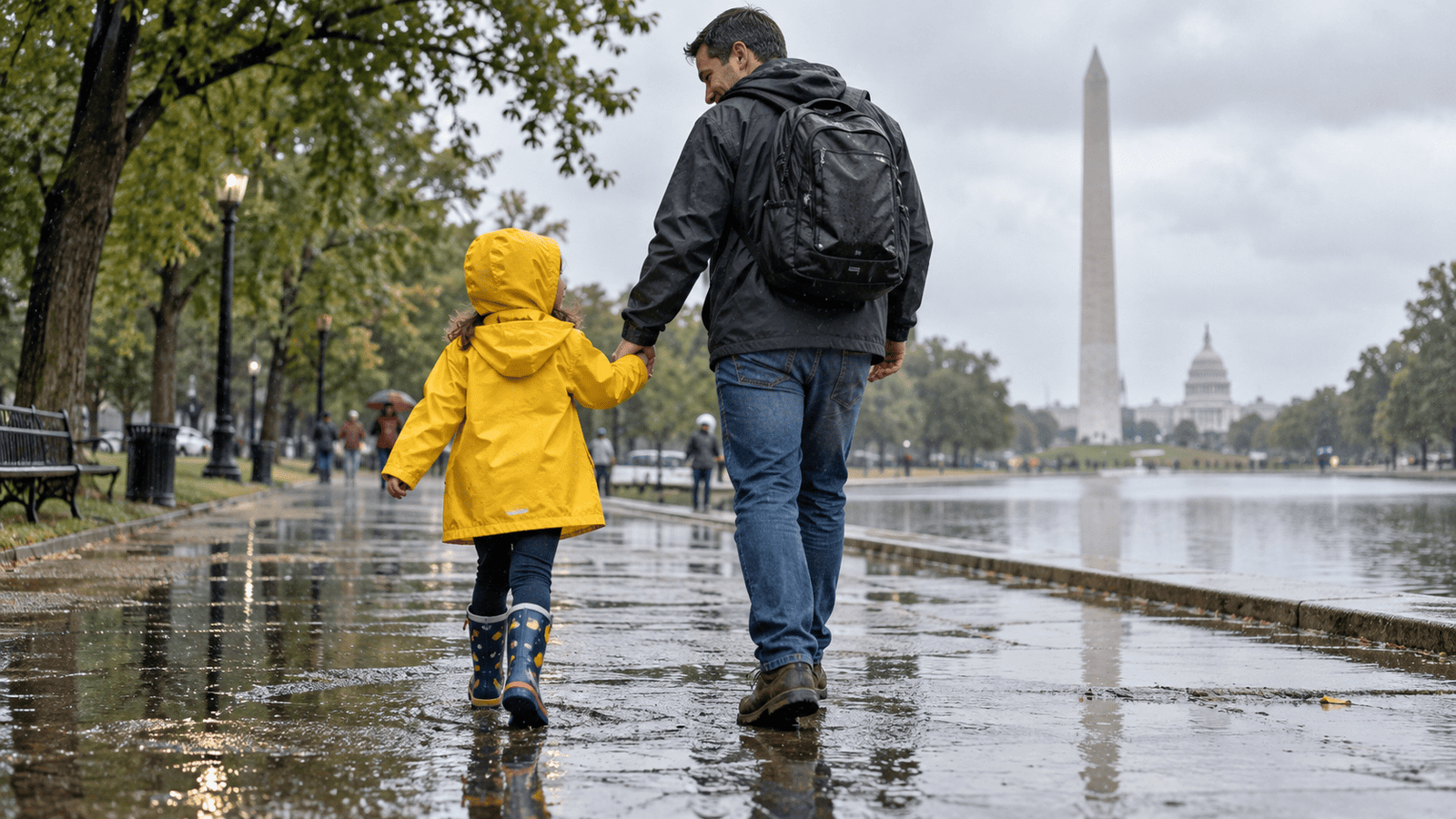
Indoor Museums Worth Considering Beyond the Usual Stops
Families searching for the best indoor activities Washington DC rainy day options will find plenty of familiar institutions, but less obvious choices can suit a wet afternoon just as well. Art galleries offer flexible visits without a fixed performance time, and some have interior spaces where children can pause between exhibits. What counts as a successful visit depends less on the number of objects on display than on whether a child can engage with a few of them. Consider the following venues when the family wants a change from landmark sightseeing.
Follow a Few Works of Art Instead of Every Gallery
The National Gallery of Art offers free general admission and includes both the West Building and East Building near the National Mall. The West Building holds European and American art, while the East Building emphasizes modern and contemporary work. Rather than asking children to appreciate an entire collection, parents can pick one question to explore: Which paintings tell a story? How does a sculpture look different when you walk around it? Giving school-age children a small task can make a traditional art museum more approachable without turning the visit into a lecture.
The two buildings are connected through an underground concourse, a useful detail when rain makes outdoor transfers unpleasant. That connection does not eliminate every exposed part of the journey, since families must still reach the gallery from their hotel, transit stop or parking location. Choose an entrance ahead of time, and check the museum map for accessible routes and visitor facilities. For a preschooler who is ready to leave after a single room, free admission makes a short, unhurried visit more practical than a costly ticketed attraction.
Families should also review the gallery's rules for belongings, photography and any special programs they hope to attend. Admission to the galleries is free without a ticket, but some events require separate registration. The outdoor Sculpture Garden may be worth saving for clearer weather rather than adding another wet stop simply because it is nearby. Before leaving: consult the official visitor guide for entrances, current exhibitions and family resources.
Try Portraits, Familiar Faces and a Covered Courtyard
A child who is not interested in landscapes might still have plenty to say about a portrait. At the Smithsonian National Portrait Gallery, paintings, photographs and other works introduce people who shaped American history and culture. Parents can encourage children to study clothing, expressions or objects in a portrait before reading its label, which turns observation into a manageable game. Older children may want to connect a historical figure to something they have studied at school, while younger ones may simply enjoy comparing faces and poses.
The museum shares its building with the Smithsonian American Art Museum, providing additional galleries without the need for a separate trip across town. One notable feature is the glass-roofed Kogod Courtyard, where families can take a seated pause protected from the weather. It is a useful break between exhibition rooms, not a playground, so parents should set expectations accordingly. General admission to the Portrait Gallery is free, and the venue publishes its own visitor and program information.
This is also a reasonable option for families who want to avoid starting another museum visit too early. The gallery's published opening time is later than that of some institutions around the Mall, so confirm hours rather than relying on the schedule of a different Smithsonian building. Allow time for the walk from the Metro and avoid assuming every nearby business or connecting building has indoor access. Plan ahead: review the official hours and family program listings, particularly if you are hoping to join a scheduled activity.
Choose a Quieter Collection for Curious Older Children
The Smithsonian National Museum of Asian Art displays objects and artworks from cultures across Asia, including ceramics, sculptures, paintings and decorative arts. For a child interested in patterns, materials or stories told through objects, this can be a thoughtful alternative to a large hands-on attraction. Parents may find it more rewarding to focus on a handful of objects and ask what the child notices than to move briskly through every room. It is particularly suitable for families comfortable with an exhibit-led visit rather than constant physical activity.
The museum occupies the Freer Gallery of Art and the Arthur M. Sackler Gallery, and Smithsonian visitor information lists free admission without passes. However, not every exhibition or event is equally appealing to young children, and certain objects or galleries may require more quiet observation than a toddler can manage. Check the current exhibitions before traveling so the family knows what it intends to see. When a child is tired or overstimulated, leaving early is a perfectly sensible decision, especially when admission has not created a financial pressure to stay.
Its location close to the Mall can make it a convenient option if a family is already nearby, but it should not be treated as automatically connected indoors to other museums. The final walk may still be exposed to rain, and conditions can differ between entrances. Pack wet items so they do not drip onto exhibition floors and follow staff directions about larger belongings. The Smithsonian museum listing confirms admission details and points visitors toward information about current programs.
Compare the Choices Before Committing
| Indoor option | What children can engage with | Planning trade-off |
|---|---|---|
| National Gallery of Art | Paintings, sculpture and visual comparisons | Large collection; select a small route rather than seeing both buildings in full |
| National Portrait Gallery | Faces, biographies and family conversation | Better for children comfortable observing artwork; check later opening time |
| National Museum of Asian Art | Objects, patterns, craftsmanship and cultures | Quieter gallery setting; choose exhibits according to attention span |
| Indoor movie or stage performance | A seated story with a defined beginning and end | Fixed start times, variable ticket costs and sound levels |
| Hotel recreation or lounge space | Unstructured rest, games or a meal break | Amenities and access vary by property; confirm availability |
These are family planning comparisons, not official age ratings or guarantees that every exhibit and program will be operating on a particular day.
How to Keep a Wet-Weather Day Affordable and Simple
An unplanned rainy afternoon can become expensive even in a city known for free museums. A family might pay for a rideshare to cross town, purchase last-minute show tickets and then discover there is no convenient place nearby for lunch. When weighing Washington DC rainy day activities, calculate the full outing rather than comparing admission prices alone. A short free visit with a predictable route can be better value than an ambitious paid program that requires two transfers and leaves everyone exhausted.
Build the Day Around One Neighborhood
The Mall, Penn Quarter and other central neighborhoods each offer different possibilities, but switching between them repeatedly can make a wet day more complicated. If your morning starts at a museum near the Mall, choose a nearby lunch stop and keep any second attraction geographically close. Families staying by Gallery Place may find a portrait-focused afternoon easier than returning to a distant landmark after lunch. This is not about avoiding exploration; it is about reducing the moments when a tired child must stand outside while adults work out directions.
For parents with a stroller, the directness of the route matters as much as the mileage. A short-looking walk may involve crowded sidewalks, puddles, escalators that cannot accommodate strollers or building entrances on the opposite side of a block. Before setting off, inspect the official entrance instructions and the transit agency's accessibility information. A route that lets the family move slowly without repeated changes is often worth choosing over one that saves only a small amount of money.
Keep an Actual Budget, Not Just a Ticket Budget
Many parents see a free admission label and stop calculating costs. Yet parking, transportation, snacks, a restaurant meal and optional paid experiences can turn the outing into an unexpectedly expensive day. A practical spending plan should separate costs the family must pay from purchases it can skip. This is especially useful for families with multiple children, because even modest individual ticket or food prices add up across the group.
- Admission: Check whether general entry is free, ticketed or subject to a timed pass; do not assume free admission means walk-in access to every special program.
- Transportation: Compare the full group cost of Metro, parking and a rideshare, including stroller logistics and the final exposed walk.
- Food: Choose a realistic meal stop before children become hungry; confirm whether outside food may be brought into the venue.
- Extras: Decide in advance whether museum shops, special exhibitions and paid workshops are part of the budget.
- Flexibility: Read cancellation terms for performances or activities with reserved time slots before purchasing.
Free museums can also be a relief when the family needs to change plans halfway through the day. If a toddler is overtired or a child is uncomfortable with a noisy crowd, leaving does not mean forfeiting a large admission fee. That flexibility is a genuine planning advantage, but it does not erase transport and meal costs. Parents who keep their primary activity and meal in the same area are less likely to spend money simply to rescue a poorly paced schedule.
What Works for Different Ages?
A family with a preschooler and a teenager may technically be able to enter the same gallery, yet their needs inside it can be very different. Younger children often need a clear endpoint, regular movement and practical breaks, while older children may want a more challenging exhibition or time to explore independently within the rules of the venue. Use these age-based considerations as a planning filter, not as promises that a particular institution officially admits or excludes an age group.
| Age group | A useful rainy-day approach | Check before going |
|---|---|---|
| Infants (0-1) | One calm indoor stop, feeding and changing breaks | Changing areas, permitted bags, stroller access |
| Toddlers (2-3) | A brief visit with chances to pause or leave easily | Noise, narrow exhibit rooms, food rules |
| Little Kids (4-6) | An observation game and a small set of exhibits | Restrooms, walking demands, hands-on opportunities |
| Big Kids (7-9) | A theme to investigate, such as portraits or architecture | Exhibit descriptions, interactive materials |
| Tweens (10-12) | Room for questions, sketching or self-guided discovery | Program registration, gallery rules |
| Teens (13-17) | Exhibits tied to art, identity, history or personal interests | Content suitability, independent attendance policies |
These suggestions reflect general developmental considerations. Always check a specific venue's visitor rules, and adjust the visit to your child rather than the age label.
Getting Around DC When the Weather Turns
Rain in Washington is not always dramatic, but ordinary showers can still make an otherwise comfortable day frustrating. Exposed approaches to museum entrances, crowded street crossings and wet steps become more awkward with small children or a stroller. The most useful preparation is to understand how the family will move between safe indoor spaces and how it will get back to the hotel if the weather worsens. A forecast is not a reason to abandon the city, but it should change the way an itinerary is paced.
Use Transit for the Route, Not as the Activity
The Washington Metropolitan Area Transit Authority publishes maps, service alerts and accessibility information for Metro trains and buses. A station near a museum can reduce exposure compared with a long walk, although neither a station entrance nor the walk from the platform to the destination is necessarily weatherproof. Elevator service is particularly important when traveling with a stroller or wheelchair. Look for current alerts before departure and identify an alternative if an accessible station entrance or elevator is unavailable.
Walking with children through downtown may be manageable in a light shower; wind, lightning and very heavy rain call for different decisions. Avoid rushing across intersections or crossing broad open areas simply to preserve a reservation. If the forecast includes thunderstorms, follow alerts from the National Weather Service and seek substantial indoor shelter. A bus stop shelter or open-sided structure is not a safe place to wait out lightning.
Pack for Short Transfers and Indoor Comfort
A bulky rain bag can become a nuisance at museum security, but arriving with soaked clothes is uncomfortable too. Keep essential items accessible and pack a small waterproof bag for wet outer layers. Children's spare socks are sometimes more useful than an extra toy after a puddle-heavy walk. Review venue rules for backpacks and stroller parking before departure; institutions can have different requirements, and staff may ask visitors to carry or store belongings differently from what they expected.
- Choose layers that can be removed indoors. Heated or air-conditioned galleries may feel very different from the street.
- Protect the essentials. Use a waterproof pouch for tickets, medication, charging cables and anything that must stay dry.
- Check the stroller cover. Use the manufacturer-approved cover with adequate ventilation; avoid improvised plastic coverings.
- Make a return plan. Identify a practical route back to the hotel before the children are tired, rather than navigating from scratch later.
If you have a reservation, allow a buffer for weather-related transit delays and security lines. Do not assume staff can admit late arrivals or that an unused ticket will be refunded. For a day with no reservations, take advantage of the freedom to pause: a meal, quiet courtyard or rest back at the hotel may be more useful than squeezing in one additional museum. Rain changes how families experience the city, and adjusting the pace is often the best response.
A satisfying visit to Washington, DC does not depend on completing every outdoor landmark in the original itinerary. The city offers enough indoor cultural spaces for parents to make selective, age-appropriate choices without automatically buying expensive replacement activities. Start with an accessible destination that fits the children's interests, then assess how everyone feels before adding another stop. Free general admission can help with that flexibility, although timed programs and transport still require planning. Check official schedules and visitor rules rather than relying on assumptions about one museum based on another. Keep the route compact, carry sensible rain protection and treat lunch and rest as parts of the plan. That approach gives a wet-weather day a clear structure without making the family feel rushed.
Frequently Asked Questions
What to do in Washington DC on a rainy day with young children?
For young children, choose one indoor destination near your accommodation or an easy transit connection, rather than planning several museums in succession. Look for facilities that support feeding, diaper changes, stroller access and frequent breaks. An art museum can work if you select a small number of visually engaging displays and leave when the child has had enough; not every young child will enjoy the same level of quiet observation.
Check the venue's security and bag rules before leaving, especially if you are carrying supplies for an infant. A calm lunch and a return to the hotel may be more practical than an additional attraction if the weather is persistent.
Which Washington DC rainy day activities are free?
The National Gallery of Art, National Portrait Gallery and Smithsonian National Museum of Asian Art publish free general admission information. That makes them useful choices when a family wants to avoid the expense of replacement attraction tickets. However, a free museum visit can still involve parking, transit, meals and paid programs.
Always check whether the particular activity you want is included in general admission. Some events require registration, and other DC institutions may require timed passes even when entry is free. Official visitor pages are the safest source for current requirements.
Are museums in Washington DC connected underground?
Some museum buildings have internal connections, but Washington's major attractions do not form one continuous underground museum network. The National Gallery of Art has an underground concourse between its East and West Buildings, which can reduce exposure during a visit. That should not be confused with a weatherproof route from a Metro station or between unrelated museums.
Before relying on any indoor connection, consult the official site map for the specific institution. Families using strollers should also verify accessible paths, elevators and which entrances are available to visitors.
What are the best indoor activities Washington DC rainy day options for teens?
Teenagers who enjoy art and discussion may prefer the National Gallery of Art, while those interested in people, politics or cultural identity may engage with the National Portrait Gallery. The National Museum of Asian Art offers a different focus on objects, materials and cultures. These suggestions depend on personal interests and are not official teen ratings.
Allow older children to choose a theme or exhibit and avoid assuming that a large museum must be covered completely. A shorter self-directed visit can create more meaningful discussion than several hours of compulsory gallery walking. Check the museum's rules if you plan to let a teenager explore separately.
Should families drive or use Metro on a rainy day in DC?
The choice depends on the hotel location, group size, mobility needs and destination. Metro can remove the burden of downtown parking, but it may still require outdoor walking and station access by stairs, escalators or elevators. Driving can offer more control over luggage and child seats while introducing parking costs, traffic and walks from garages.
Compare the complete route rather than just the time shown by a navigation app. For stroller users, check WMATA elevator alerts and the venue's accessible entrance guidance. If the forecast worsens, prioritize a safe and predictable return journey over visiting an extra stop.
Can a family visit the National Mall in heavy rain?
The National Mall is an open outdoor landscape, and many monuments and memorial approaches are exposed to the weather. Light rain may be manageable with suitable clothing, but thunderstorms, lightning or intense wind change the safety calculation. Families should follow weather alerts and avoid remaining in exposed areas during dangerous conditions.
If outdoor sightseeing is the main purpose of your trip, keep it flexible and move indoor activities into the wetter period. Do not assume that a museum nearby provides a completely sheltered route from a memorial; check the actual walking distance and entrance location.
How can parents avoid spending too much on a last-minute rainy-day plan?
Begin by reviewing the tickets, hotel amenities and reservations already included in your trip. Then choose a free or low-cost indoor destination within a convenient neighborhood and decide on a meal stop before leaving. The largest avoidable expenses may come from repeated rideshares, spontaneous ticket purchases and poorly timed meals rather than the museum itself.
If you do book a paid activity, read the cancellation terms and verify whether the experience is entirely indoors. Keep one alternative that does not require a reservation. A modest, well-paced afternoon is often better value than trying to compensate for every minute of outdoor sightseeing lost to rain.